
Commissioners hear PacifiCorp and CAISO plans for congestion allocation, protections for firm transmission holders
Get AI-powered insights, summaries, and transcripts
Subscribe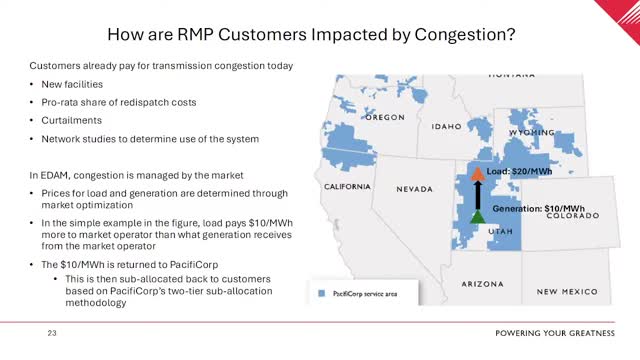
Summary
PacifiCorp and CAISO presenters told Utah regulators that CAISO will aggregate congestion differentials and return them to PacifiCorp, which will first use the pool to fully offset congestion for qualified, firm point‑to‑point schedules and then distribute remaining funds to other participants.
PacifiCorp and CAISO presenters reviewed how congestion costs and congestion revenues generated inside PacifiCorp’s balancing authority will be quantified, collected by CAISO and returned for distribution.
Doug (surname not specified in the transcript), the presenter on congestion topics, explained that congestion occurs when lower‑cost generation cannot reach load because of binding transmission constraints, and that the hour‑by‑hour nodal LMP contains energy, congestion and loss components. He said CAISO will collect congestion differentials into a single charge code and return those funds to PacifiCorp for allocation within its balancing authority.
PacifiCorp said it worked with stakeholders to design an allocation approach intended to protect firm transmission holders and long‑term point‑to‑point customers (including monthly or longer balanced self schedules). Under the company’s explanation, CAISO will first guarantee a full congestion offset for certain “qualified schedules” — examples given were monthly or longer‑term firm or conditional firm point‑to‑point schedules — so those customers will not face a double charge (paying PacifiCorp point‑to‑point tariffs and then being exposed to EDAM congestion differentials). Remaining congestion revenues in the ISO bucket would then be distributed to other market participants pro rata by load or export share.
Brattle and others previously studied congestion under historical EIM flows and forecasted EDAM congestion; PacifiCorp said studies found historical EIM congestion was not fully predictive of future EDAM congestion and that one forecast put EDAM‑period congestion at roughly $12 million per year across the studied footprint. PacifiCorp staff said that the company’s approach of returning congestion to qualified schedules and then allocating remaining amounts should address stakeholder concerns.
Transmission customers and municipal utilities asked questions about whether the pool of qualified schedules would shrink over time as reservations expire and how congestion revenues and refunds will be disaggregated. PacifiCorp said the qualified schedule protection is optional and that customers who do not self‑schedule can still participate economically in the market but would not receive the guaranteed congestion offset.