
Middletown City board hears how ‘Success Liaisons’ connect students and families to community supports
Get AI-powered insights, summaries, and transcripts
Subscribe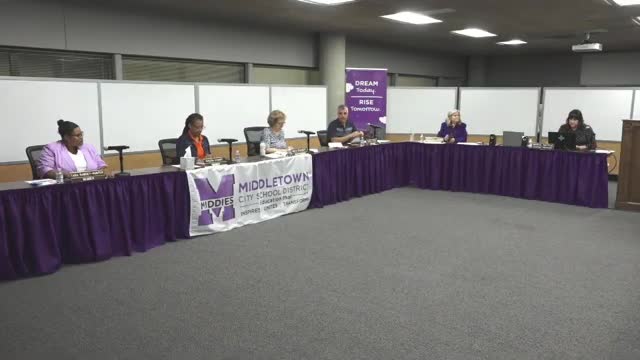
Summary
MIDDLETOWN, Sept. 29, 2025 — Staff from the Middletown City School District detailed the work of the district’s Success Liaisons program on Monday, telling the Board of Education the initiative focuses on building relationships with families to remove nonacademic barriers to student learning.
MIDDLETOWN, Sept. 29, 2025 — Staff from the Middletown City School District detailed the work of the district’s Success Liaisons program on Monday, telling the Board of Education the initiative focuses on building relationships with families to remove nonacademic barriers to student learning.
“My job is addressing the noncognitive barriers that prevent students from focusing on their learning,” said Emily Morgan, a success liaison who works at Mayfield and Creekview elementary schools. Morgan described referrals from school staff, community agencies and word-of-mouth and said liaisons concentrate their efforts on families with students enrolled in the district.
The program supervisor, Carrie Winns, and four liaisons — Myla Perry, Emily Morgan, Julie Kaido and Kaylee Bennett — spoke to the board about how the team connects families with community resources, provides tangible goods and arranges services such as eye exams and temporary housing referrals.
“The child is absolutely the center of what we do,” said Myla Perry, who serves Rosa Parks and Wildwood elementary schools. Perry described relationship-building that enables liaisons to identify needs that families might not otherwise disclose and then link families to supports.
Morgan gave several examples of how small interventions affected school performance: supplying detergent, clothing and hygiene items for a student who had become an attendance concern and arranging an in-school eye clinic that led to the child receiving glasses. “I’ve never seen the student just light up so fast,” Morgan said of the moment a student put on glasses and began participating more fully; a teacher later reported improved test scores.
Julie Kaido, who works with middle- and high-school students, said liaisons often start with material needs — rent, utilities, graduation regalia — and then use built trust to address deeper barriers. “It might start with the tangibles, but after that is when we really get to the barriers that are getting in the way of making our students successful,” Kaido said, citing a case where help obtaining a cap and gown enabled a student to graduate and enroll in college.
Kaylee Bennett summarized program output for the previous school year: “Last year, we assisted 445 students through our Success program. We assisted 66 families with our Mandy funds and we had a total of 121 Care Portal referrals.” Bennett explained that Care Portal is an online platform used by liaisons to post needs that local churches, community groups or individuals can view and fulfill.
Board members praised the team’s work and asked for additional performance data. One board member noted the apparent caseload — about 110 students per liaison — and asked whether the program was reaching capacity. District staff acknowledged capacity constraints and said liaisons are “limited by time and space,” including travel to family homes and being assigned to multiple buildings.
Board members also asked about measurable outcomes. District staff said the liaisons collect extensive data and offered to provide the board with additional metrics at a future meeting.
The presentation also highlighted local partnerships: Butler County’s Early Childhood/Neighborhood Collaborative (referenced in the meeting as Butler County ENC) and Butler County Educational Service Center support the program’s placement and funding.
Board members thanked the liaisons and Carrie Winns for their work and asked staff to bring follow-up data that digs deeper into measurable impacts of the program.
The board meeting continued afterward with routine consent and finance items.