Get Full Government Meeting Transcripts, Videos, & Alerts Forever!
Get email alerts on the Cannabis Setback Variance topic
No spam. Unsubscribe anytime.
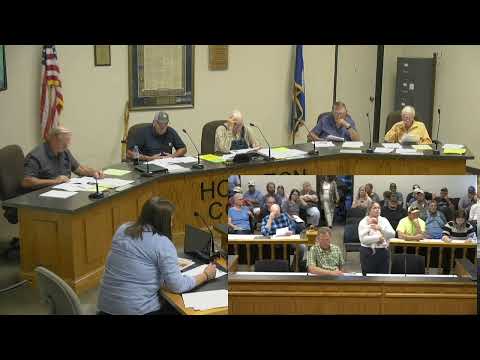
Board denies variance request for cannabis microbusiness in Hokah after extensive public comment
Summary
The Houston County Board of Adjustment denied a requested variance to reduce setback requirements for a proposed cannabis microbusiness in Hokah (parcel 23021600). The hearing drew large public turnout, with parents, teachers and city officials urging denial because the site lies near St. Peter's School and other facilities used by children.
The Houston County Board of Adjustment denied a variance request that would have reduced required setbacks for a proposed cannabis microbusiness on a vacated portion of First Street North in the city of Hokah.
Applicant Adam Steele sought two variances for Parcel 23021600 in Hokah: one to reduce the county's 1,000-foot setback from schools and a second to reduce the 500-foot setback from public parks and athletic fields. County staff described the state statute that permits local units of government to adopt time, place and manner restrictions and summarized how Houston County's cannabis business ordinance establishes the county's setbacks (1,000 feet from schools and 500 feet from parks/athletic fields). The county also noted that cities may adopt their own ordinances; Caledonia and La Crescent have set different, often shorter, setback distances.
The hearing drew substantial public comment. Dozens of residents, parents and school staff spoke over the course of the item. Opponents repeatedly stressed proximity to St. Peter's School, a daycare and a ball diamond. Gary Van Damelen, a trustee for St. Peter's parish and a retired attorney, said, "We have 45 students in our school, we've got another 20 kids in the daycare center. All of them are within the scope of this ordinance." Rachel Dejarlis, a teacher at St. Peter's School, said, "As a parent and as a teacher, I would say that we should follow the ordinance that is in place." Several speakers urged the board to either deny the variance or to table the request until neighboring cities' experience with cannabis businesses becomes clearer.
Adam Steele told the board he plans to operate initially as a medical dispensary and described a community-focused approach: "Normalizing cannabis in a safe and welcoming space delivering positive experiences," he said, and added he will train staff on "informed choices about responsible use." Steele said he has invested about $10,000 so far in preparing the site and that he intends to pay employees $20 an hour. He also said the business would have no on-site consumption and that state rules require secure storage and ID checks.
County staff presented technical findings and led the board through the six variance criteria. Board members split on several findings related to practical difficulties, character of the locality and whether the applicant had created the need for a variance. Several members noted that some existing downtown establishments sell hemp-derived products and that parts of the county use different setback distances; others stressed that those operations had been grandfathered or were governed differently.
After deliberation the board moved to deny the variance. The roll-call vote on the motion to deny the variance was recorded as: Dean Hoppell yes, Wayne Runaghan yes, Franklin Hahn yes, Ken Anderson yes, Ken Visker yes. The board recorded the denial as the practical result of failing to meet certain findings (notably findings 2 and 5 as discussed in the hearing). Board members and multiple public speakers cited public-safety and child-safety concerns near the school and daycare as decisive.
Several Hokah city officials and council members had earlier informed the county they were not supportive of the proposed location; Tom Bernsdorf, a council member who lives on Main Street, told the board the city's four council members he had consulted were against the site in its current location. Amelia (Environmental Services/Zoning staff) explained that the distance measurements used for the requested variance are measured building-to-property-line; after double-checking that method staff said the requested adjustments equated to roughly 625 feet to the required 1,000-foot school setback and about 160 feet to the required 500-foot park setback.
The applicant and some local residents argued the business would bring jobs and economic activity to Hokah and that regulatory safeguards (ID checks, sealed packaging, no on-site consumption) reduce the risk to minors. Opponents countered that children walk Main Street regularly and that the ordinance exists to protect that daily route. A number of residents asked the county to uphold its ordinance rather than grant a variance that would reduce the intended buffer from children's activity areas.
Following the vote, county staff noted that changes to the zoning ordinance itself would require a separate process through the Planning Commission and County Board; board members discussed whether to draft a proposed ordinance amendment for future consideration. The denial stands as the Board of Adjustment's final action on the variance request.