Get Full Government Meeting Transcripts, Videos, & Alerts Forever!
Get email alerts on the K12 Math Pathways topic
No spam. Unsubscribe anytime.
La Canada Unified outlines 7–12 math pathways, summer challenge exams and placement policy
Summary
District leaders and teachers explained middle- and high-school math pathways, summer placement exams, UC "a–g" implications and a revised placement policy at a parent information session. Officials emphasized that challenge exams are content exams requiring preparation and described summer and in-year options for acceleration.
La Canada Unified School District officials and secondary math teachers presented the district's 7'12 math pathways, summer placement-exam opportunities, and the district's placement regulation during a parent information session held online. Assistant Superintendent Jim Cardinal opened the session and described the meeting purpose as explaining pathways, placement policy and options for acceleration.
The session laid out two main middle-school options: a two-year sequence of Math 7 followed by Math 8 (the college-preparatory pathway) and a single-year accelerated course, 7/8 Advanced, that covers both seventh- and eighth-grade standards and normally leads into Algebra 1 in eighth grade. "They're content exams. They're used to measure the degree of proficiency of your students," Cardinal said when explaining the district's view of summer challenge exams.
Why it matters: course choices in grades 7 and 8 determine several downstream options for students, including which high-school sequence they follow, eligibility for honors courses, and the likelihood of taking Advanced Placement (AP) calculus or college-offered courses at La Canada High School (LCHS). Officials repeatedly framed challenge exams as selective, content-heavy tests that require formal preparation rather than ad-hoc study.
Key facts and program details
- Presenters: Jim Cardinal (Assistant Superintendent for Curriculum and Instruction), Jared Gould (Principal, La Canada Middle School), Cindy Calm (LCHS calculus teacher and former math department chair), Juan Nunez (LCHS teacher), Samantha Wright (eighth-grade math teacher) and parent representative Mrs. Khan.
- Middle-school pathways: Math 7 '1 Math 8 (two-year college-prep); 7/8 Advanced (one-year condensed course covering both grade standards) that typically feeds into Algebra 1 in grade 8 and then honors-level sequences in high school.
- Acceleration options: rising sixth-to-seventh graders can (a) enroll directly in 7/8 Advanced where recommended by sixth-grade teachers, (b) take summer challenge exams (offered twice) to place into 7/8 Advanced or algebra, or (c) pursue summer course work. The district also described in-year moves by teacher recommendation and summer coursework options into high-school courses.
- Challenge-exam thresholds and practice: Presenters described the exams as content exams aligned to the 7/8 Advanced curriculum. Jared Gould summarized recent results and the district's adjustments to policy. For some pathways, a 70% or higher score on the relevant summer exam has been used as a threshold to advance; other placement exams presented in the session used an 80% threshold for a higher step. Officials cautioned that passage rates are historically low and that students who accelerate typically have formal preparation.
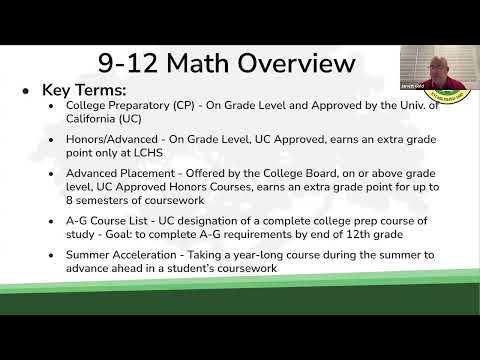
- High-school context: LCHS offers UC-approved college-preparatory courses, honors courses (weighted on GPA), and 24 AP courses. AP Calculus AB and BC, AP Statistics, and a Pasadena City College (PCC) multivariable calculus/linear algebra option taught on the LCHS campus were described as available endpoints for accelerated students.
- Policy and guidance: The district referenced Administrative Regulation AR 6152.1 (placement in math courses) and the broader statutory expectation (referred to in the presentation as the math placement act of 2015) that districts adopt fair, objective and transparent placement protocols. Presenters said the district worked with the Board of Education to revise the placement policy language to clarify parental request procedures for placement changes.
What officials emphasized
Teachers and administrators repeatedly cautioned that the summer challenge exams cover material beyond typical elementary curricula and that students should undertake formal, structured preparation if they plan to attempt them. "They're very difficult because they're covering a lot of material, and the kids can't pass this test if they just know it at a surface level," Samantha Wright, an eighth-grade teacher, said.
Presenters also noted multiple ways to accelerate beyond the summer exams, including recommended teacher referrals, summer coursework at accredited providers, and in-year placement changes supported by counselors. The district encouraged parents to weigh student interest and wellness alongside academic acceleration.
Parent engagement and next steps
District leaders announced creation of a parent advisory committee to run alongside the K—8 math adoption committee, with three initial in-person meetings scheduled at the district office (dates were listed in the slide deck). The presenters said they will distribute the slide deck and a recording of the session to families and will follow up with book titles and course-link resources.
Closing: Officials asked parents to plan with teachers and counselors, to consider formal preparation for students attempting challenge exams, and to balance academic acceleration with student wellness and extracurricular commitments. "We want them to be in great hands," Calm said of the LCHS math faculty in closing.