Citizen Portal

House passed 7-week stopgap; Appropriations chairman says Senate must act

6439401 · September 30, 2025

Get AI-powered insights, summaries, and transcripts

Subscribe
AI-Generated Content: All content on this page was generated by AI to highlight key points from the meeting. For complete details and context, we recommend watching the full video. so we can fix them.

Summary

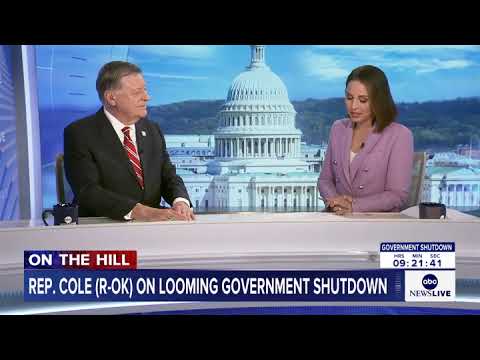
House Appropriations Committee Chairman Tom Cole said the House voted to keep the government open for seven weeks and is awaiting Senate action, warning that Democratic demands for long‑term spending increases risk a shutdown.

Tom Cole, Oklahoma Republican and chairman of the House Appropriations Committee, said the House voted to keep the federal government open for an additional seven weeks and is now waiting for the Senate to act.

"I authored the bill to keep the government open for another 7 weeks," Cole said in a studio interview. He said the House approved the short-term continuing resolution and that the Senate’s response will determine whether a shutdown occurs.

Cole argued the immediate standoff reflects a dispute over unrelated policy demands. "They're asking for us to commit to spend a trillion and a half dollars in exchange for a 4 week extension of government spending," he said. "It's a ridiculous request." He added that, in his view, Democrats are using the threat of a shutdown to gain leverage on items outside routine appropriations such as Medicaid and subsidies for the Affordable Care Act.

Cole described local consequences if funding lapses in his district, which he said is home to about 16,000 civilian defense workers at Tinker Air Force Base and roughly 6,000 civilian workers at Fort Sill. "They understand," he said, arguing that the prospect of a shutdown would harm federal employees and defense contractors in affected districts.

On the question of presidential authority to withhold foreign aid appropriated by Congress, Cole characterized the Supreme Court’s recent order as a temporary stay rather than a final ruling. "If you actually read the decision, what they did was stay a lower court decision and still reserve the right to make the final decision," he said. He said the constitutional question about rescission and executive spending authority dates at least to the 1970s and that it may ultimately be resolved by the Court.

Cole said the House has done its work on appropriations and that the Senate must produce bipartisan legislation the House can act on. He said House leadership has put members on notice to be ready to return within 24 to 48 hours and that he is a lead negotiator on the appropriations issues.

He also defended Congress’s constitutional authority over spending while acknowledging administrative practices at the Office of Management and Budget dating back decades. "The problem is we're shutting the government down where the Senate is, and that's actually gonna enhance the power of the executive branch," he said.

The interview did not include a roll-call vote count for the House action; Cole said broadly that "almost every Republican in the House and the Senate voted to keep the government open" and that "almost every Democrat in the House and the Senate voted to close it." The transcript did not provide specific vote tallies. The Senate’s position and any formal Senate vote were not specified in the interview.

Cole’s remarks focused on (1) the House passage of a short-term continuing resolution to extend funding for seven weeks, (2) his view that Democratic demands for substantially higher spending threaten a shutdown, and (3) a pending legal question about presidential withholding of funds that the Supreme Court has temporarily authorized to proceed.

The next steps described by Cole are Senate consideration of the House measure and a possible rapid return of House members if the Senate’s response requires further action.