Get Full Government Meeting Transcripts, Videos, & Alerts Forever!
Get email alerts on the School Health Clinic topic
No spam. Unsubscribe anytime.
Nationwide Children's updates Mount Vernon City School Board on school-based clinic; reports 471 visits last year, seeks higher use
Summary
Nationwide Children's Hospital staff briefed the Mount Vernon City School Board on operations and goals for the school-based health center at Mount Vernon High School, reporting 471 visits last school year, a measured 3% attendance improvement in matched studies, telepsychiatry support, and unused clinical capacity with a daily target of 12–14患者.
Nationwide Children's Hospital gave the Mount Vernon City School Board an update on its school-based health center at Mount Vernon High School, reporting 471 visits in the last school year and saying the clinic has capacity to serve more students and community members.
Mary Gaderloin, senior director of school health for Nationwide Children's Hospital, told the board the program aims to provide comprehensive primary care for children who lack a routine medical home and to support the district's academic goals by reducing absenteeism and disciplinary incidents. "We are open to anyone and everyone," Gaderloin said, describing the clinic's intention to prioritize Mount Vernon students while remaining available to community children through age 22.
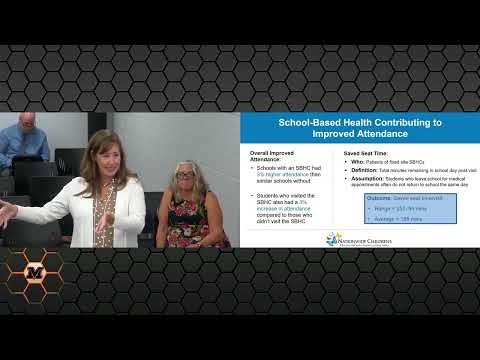
The presentation summarized research and local program data. Gaderloin said a matched-study of schools with and without school-based health centers showed a roughly 3% improvement in attendance where centers exist, and internal analyses showed similar gains when comparing users versus nonusers within a single school. She described a measurement called "saved seat time," which compares time in class preserved by in-school care versus leaving campus for appointments; Gaderloin said the program's internal analysis found more than three hours of saved seat time per appointment on average.
Laurie Shewer, a nurse practitioner who staffs the Mount Vernon High School clinic, introduced herself to the board and described clinical services available at the site. Services listed include well visits, vaccinations, same-day acute care, sports physicals, work permits, chronic disease management, and primary care–level mental health diagnosis and medication management. Staff said the clinic offers telepsychiatry consultations when cases need specialist input.
Gaderloin and clinic staff emphasized that the school-based clinic is intended to complement, not replace, students' existing pediatrician relationships. The clinic sends an "after-visit summary" to a student's regular provider to encourage continuity of care. Staff said the program was established in part because data showed a higher proportion of children in the region lacked a routine primary care relationship and instead used urgent care or retail clinics.
Mount Vernon staff on the presentation team include a school health liaison, Bridget (last name not specified), who was described as handling engagement, communications, and data pulls, and Jennifer (last name not specified), who helps staff the clinic. Gaderloin said the clinic currently averages about three visits per day and that the team would like to increase that number to 12–14 visits per day to better use available capacity.
Presenters identified marketing and transportation as barriers to greater use. They said outreach to families, clear communication about services, and transporting students from nearby schools to the clinic are strategies being pursued in coordination with district staff.
Gaderloin framed school-based health centers as a response to workforce shortages in mental health care, explaining that nurse practitioners trained in assessment and medication management can address some mental health needs and preserve psychiatrist capacity for more complex cases. She added that when nurse practitioners identify cases that need specialist care, telepsychiatry is used so students can be seen quickly with family participation if desired.
No formal board vote or action was recorded during this presentation. Board members had the opportunity to hear the update and ask questions; presenters requested suggestions on outreach and partnership to increase utilization.
The presentation named several state- and national-level partners and framers of school health policy cited by Gaderloin, including the National School-Based Health Alliance and state offices such as the Department of Education and Workforce, Department of Health, Department of Medicaid, and the Governor's Office of Appalachia, which the presenter said have supported expansion of school health services in Ohio.