Get Full Government Meeting Transcripts, Videos, & Alerts Forever!
Get email alerts on the City Budget 2026 topic
No spam. Unsubscribe anytime.
City manager presents proposed 2026 Moses Lake budget totaling $127.4 million
Summary
City Manager Rob Carlinzi and Finance Director Madeline Prentice delivered the proposed 2026 budget, which the manager described as $127,443,942 across city funds; council workshops were scheduled and staff outlined a financial sustainability plan and major priorities including water resources and community engagement.
City Manager Rob Carlinzi presented the Moses Lake proposed 2026 annual budget to the City Council, describing a total of $127,443,942 in planned resources across city funds and outlining the council's top priorities for next year.
Carlinzi read the manager's budget message and told the council the budget funds core services and also supports the council's adopted priorities for 2026, which the message lists as: achieve financial sustainability; secure sustainable and reliable long-term water sources; improve the city's image and reputation; select and fund a fire-service delivery model and a third north-end fire station; plan for a new police station; identify a second lake crossing location; and make progress on Washtucna Highway projects in Moses Lake.
The budget message states the combined proposed general and street fund expenditures for 2026 are $41,861,372 and that the city remains in a deficit position despite reductions since the 2025 estimate. Carlinzi said earlier cuts reduced the projected deficit from the 2025 adopted forecast; the 2025 adopted budget projected a deficit of about $3.5 million. The proposed 2026 budget includes a $250,000 transfer to the city's rainy-day fund and plans to launch a public financial sustainability process in early 2026 to bring expenses and revenues into alignment over a six-year forecast horizon.
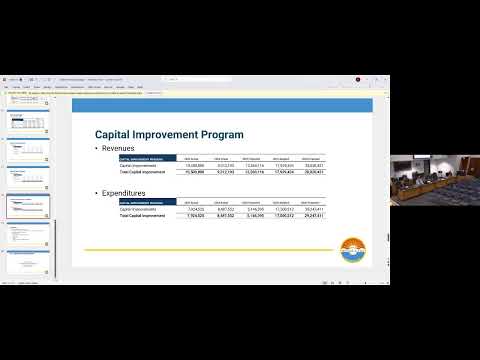
Carlinzi and Finance Director Madeline Prentice summarized other notable points in the document: - The capital improvement program for 2026 proposes roughly $29.2 million in expenditures and continues a multi-year CIP through 2030. - The city relies on three state-level budgets (operating, transportation, capital) for possible project funding; staff recommended targeting the capital budget for urgent infrastructure requests. - Utility tax receipts are projected to grow (electric, gas, cellular) while development-related revenues (building permits and plan review) are projected to decline. - Labor-related costs include a 2.7% CPI-based salary assumption, an employer pension contribution rate reduction, and continuing pressure from L&I premium increases for police and fire (noted as consecutive years of double-digit increases).
Prentice noted the county assessor's preliminary assessed values were not yet available and staff used prior-year figures to calculate a tentative property tax levy. Carlinzi asked council members to review the hard-copy budget and attend upcoming workshop dates; he said staff aim to complete adoption before Thanksgiving but that state law allows until Dec. 31.
Councilmembers asked clarifying questions about staffing and specific capital projects, and staff said a series of budget workshops will walk the council through departmental budgets in more detail. The council did not take any final action on the budget at the meeting; staff will bring the proposal back for workshops and eventual adoption.