Get Full Government Meeting Transcripts, Videos, & Alerts Forever!
Get email alerts on the Agenda Design topic
No spam. Unsubscribe anytime.
Trustees find prior agenda contained no items focused on student outcome monitoring
Summary
In a coach-led agenda evaluation exercise, Oklahoma City trustees reviewed a recent regular meeting and concluded it provided no substantive data about student progress relative to district goals; coaches urged redesign to free meeting time for monitoring.
Coaches working with the Oklahoma City Public Schools board led trustees through an agenda-evaluation exercise and concluded the district's recent regular business agenda provided little to no time spent on monitoring adopted student goals.
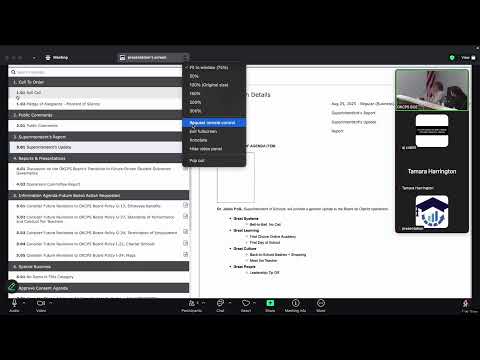
Coach AJ asked trustees to mark each agenda item as either student-outcomes focused or not. After reviewing an August 25 agenda, trustees reported that none of the items gave board members "more clarity as to whether or not children are actually growing relative to our goals," AJ said. He told the board that many districts spend only 0 to 5 percent of meeting minutes on learning; those that prioritize learning target about 50 percent.
Board members discussed practical steps: flagging items to keep, delete or modify; moving items that are legally eligible to the consent agenda by default; and redesigning superintendent updates to be more data driven. Board member Laurie Bowman suggested modifying the superintendent update to include more data on student learning; another trustee recommended treating information items that will be voted on later as part of an extended voting process.
AJ recommended the board perform the time-use evaluation monthly and aggregate minutes across all board and committee meetings. The coaches said the board should compress time spent on routine "other" activities and voting so the board has more minutes available for goal monitoring.
No formal board votes were taken during the training; the exercise was instructional and intended to guide future agenda design.