Get Full Government Meeting Transcripts, Videos, & Alerts Forever!
Get email alerts on the Promotional Exam topic
No spam. Unsubscribe anytime.
Civil Service Board finds violations in Miami police lieutenant exam, recommends all candidates get second-phase test
Summary
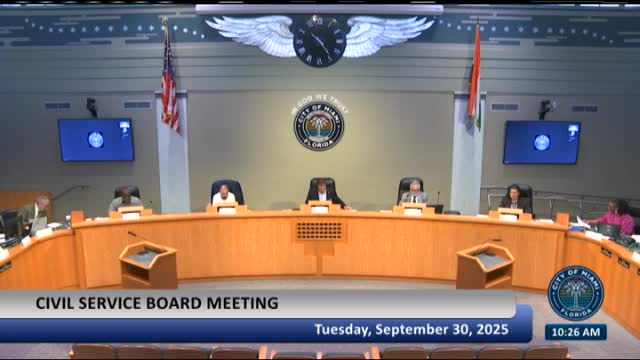
After a daylong grievance hearing, Miami—s Civil Service Board voted that the police department—s process for advancing candidates from the written multiple-choice portion to the in-basket exercise violated civil service rules and recommended that all candidates who took the first day be allowed to take the in-basket portion.
The Miami Civil Service Board on Sept. 30 voted that the police department mishandled the promotional process for its 2025 lieutenantAexamination, finding by 4-1 that the methods used to decide who advanced from the written, multiple-choice test to the second, in-basket exercise violated the boardA—s rating rules. The board also voted, 3-2, to recommend to the city manager that all candidates who took the first day of testing be permitted to take the in-basket (phase 2) now used to complete the exam.
Why it matters: About 76 candidates took the first-day technical knowledge test; the department announced in April that only the top 35 scorers would proceed to the in-basket. Candidates and two sergeants who challenged the process told the board that the cut came months after the job posting and candidate materials, that the situational-judgment portion had been removed late, and that seniority and veteransApreference points are added after full scoring, meaning many candidates never had a chance to be fairly ranked on the combined exam.
At the hearing, the employeesAattorney, Terry Gutman Valdez, said the departmentA—s April decision upended expectations created by the Nov. 18, 2024 job announcement and the official police bulletin, both of which described a three-part structure and study materials. "You can't, five months later, decide that instead of everybody who does part 1 going on to part 2 ... only 35 people are going to go from phase 1 to phase 2," Gutman Valdez told the board. "My clients devoted significant amounts of time and money to prepare. They should not have been cut out midstream." (Terry Gutman Valdez, opening statement.)
The city defended its choice as an attempt to reduce subjectivity and administrative risk. Assistant Chief Armando Aguilar and Chief Manuel A. Morales testified that the situational-judgment component was removed after the union raised subjectivity concerns and that the 35-person cutoff was set to match projected promotion needs (the department estimated 21 vacancies over the life of the list and added a buffer). "We wanted to correct for standardization issues," Aguilar told the board, describing challenges of using multiple assessor panels for in-basket grading. Morales testified he made the final decision after consulting staff and legal advisers and said the change aimed to protect members by increasing the number of challengeable multiple-choice items and keeping the assessment panels consistent.
The boardA—s discussion focused on two civil service rules cited in the grievance: rule 6.5 (methods of rating) and rule 6.6 (establishing passing grades/ranking). The board majority concluded the departmentA—s shift to a numerical quota (top 35) to determine who progressed instead of announcing a standard for progression earlier in the process was inconsistent with the rules governing rating and candidate ranking. A minority member said the departmentAacted in good faith to make the exam fairer and to prevent litigation by limiting subjective components.
Subpoenas and no-shows: The hearing record also notes that two city witnesses subpoenaed to explain HRAprocessesA(Angela Roberts, director of human resources, and Dr. Krause, the testing subject-matter expert) did not appear in person or on Zoom despite subpoenas; the board flagged those absences and asked staff to notify the city manager. The attorney for the challengers said HRAwitnesses had been given multiple opportunities and that the board should consider the absences in its deliberations.
Board outcome and next steps: The board found rule 6.5 (method of rating) violated and rule 6.6 (rating of examination results) violated by recorded votes (board recorded the motions and ultimately announced both findings carried by 4-1). The board then voted 3-2 to recommend that the city manager direct the department to allow all candidates who sat for the first-day multiple-choice test to take the in-basket (phase 2) so the full two-part exam and the seniority/veterans adjustments can be applied to a complete score.
What the city said: City counsel and department witnesses repeatedly told the board that the department removed the situational-judgment test to reduce subjectivity, that the technical knowledge test remained unchanged, and that the decision to limit the in-basket to a fixed number was driven by assessor availability, lab/space constraints and the departmentA—s projection of workforce needs. Chief Morales said the change was communicated to staff once a final decision was made and that the Department of Police believed the changes would benefit members by increasing challengeability of the written questions and limiting subjectivity.
What challengers asked for: The two sergeants who filed the grievance asked the board to order that they, and anyone else who took the first phase, be allowed to take the second phase and have the department produce a full eligible register with seniority and veterans points applied. The challengers argued notices in November did not put applicants on notice of a quota. "We want everyone who wasn't allowed, specifically my clients, to be allowed to take the second phase," Gutman Valdez said.
Forward-looking: The boardA—s decision is a recommendation to the city manager rather than an immediate court order; the board said it will prepare a written report noting the violations and the failure of HR witnesses to appear. The eligibility register used for promotions has not been finalized and promotions from the list have not yet been completed, the department said. The city may accept the boardA—s recommendation, propose an alternate remedy, or face additional procedural or legal steps by the affected employees.
Ending: The case underscored tensions between department control of exam content and civil service oversight of rating procedures; the boardA—s written findings and the city managerA—s response will determine whether additional testing is scheduled and whether the eligibility register is recompiled. The board also asked the city manager to address the failure of two subpoenaed HR witnesses to appear.