Get Full Government Meeting Transcripts, Videos, & Alerts Forever!
Get email alerts on the Higher Education topic
No spam. Unsubscribe anytime.
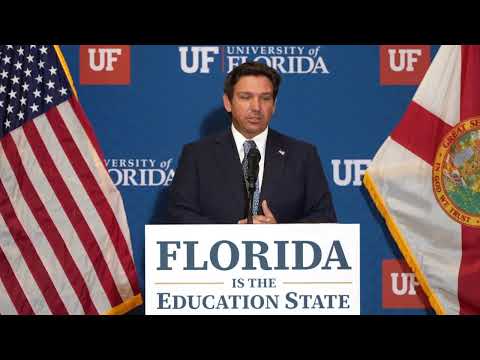
DeSantis highlights decade of No. 1 ranking, introduces Donald Landry as UF interim president
Summary
Governor Ron DeSantis praised Florida—s State University System for a decade at the top of national rankings, introduced Dr. Donald Landry as the interim president of the University of Florida and reiterated state policies on tuition, faculty review and curricular reforms.
Governor Ron DeSantis on Friday celebrated a 10-year stretch in which he said Florida has been ranked the nation's top public higher-education system and introduced Dr. Donald Landry as the new interim president of the University of Florida.
"For 10 years in a row, Florida has been ranked number 1 in public higher education in The United States Of America," DeSantis said, noting his administration has kept in-state tuition for Florida residents at the same level "as it was the day I took office." He also highlighted the Bright Futures scholarship program and the Florida Prepaid program as reasons many in-state students graduate without loans.
Landry, who DeSantis said was dean of Columbia's medical school and physician-in-chief at Columbia Presbyterian, addressed the crowd after his introduction and described his early weeks on the job as "an opportunity beyond imagination." "This state is nothing less than extraordinary," Landry said, praising faculty recruitment and investments in research at UF.
Chancellor Ray Rodriguez and other university presidents appeared alongside DeSantis and Landry. Rodriguez pointed to recent legislation and institutional changes he said contributed to the rankings, including Senate Bill 266, which he said removed "indoctrinating concepts" from general education requirements, and state support for initiatives intended to increase academic rigor and public debate.
DeSantis and campus leaders described multiple state measures aimed at strengthening academic outcomes and workforce connections. DeSantis cited recurring investments to recruit faculty, post-tenure review reforms that require regular review of tenured faculty, and state-funded centers such as UF—s Hamilton Center and Florida International—s Adam Smith Center as elements of the state—s strategy to raise national standing.
The governor and system leaders also noted metrics on student debt and outcomes. DeSantis told the audience that roughly "77% of undergrads in Florida are loan free," while Chancellor Rodriguez provided an updated figure for the system: "the latest number for percentage of students we have enrolled without a loan is now 79.8 percent." Both speakers credited state scholarships, prepaid plans and legislative funding for those outcomes.
Speakers said the state—s university ranking success reflects multiple factors: targeted state appropriations, board and trustee involvement, recruitment funds, and policy changes intended to emphasize core curricula and civic education. Richard Corcoran, president of New College of Florida, credited a shift away from diversity-equity-inclusion programming and toward a core curriculum emphasizing civics and liberal arts as contributing to that improvement.
DeSantis emphasized affordability for in-state students: "If you're somebody who is, Florida high school student, Florida resident, and you get into the University of Florida, chances are if you're able to get in here, you qualify for Bright Futures... that gives you 100% tuition or 75% depending on the level that you're doing." He also described the Florida Prepaid program and said some prepaid families have received refunds because actual tuition stayed flat rather than rising as projected.
Several presidents described institutional improvements: Marva Johnson said Florida A&M—s retention and graduation rates have risen and noted FAMU was again ranked the top public HBCU; Ray Rodriguez summarized systemwide outcomes and administrative-efficiency comparisons against peer institutions; Landry pointed to UF—s investments in AI and research infrastructure as a competitive advantage.
The event concluded with remarks that leaders said reflected ongoing work to sustain academic quality and to recruit faculty and researchers. DeSantis said he hopes the legislature will authorize further recruitment funding in a future session and thanked trustees and volunteer board members for their work.