Get Full Government Meeting Transcripts, Videos, & Alerts Forever!
Get email alerts on the Historic Preservation topic
No spam. Unsubscribe anytime.
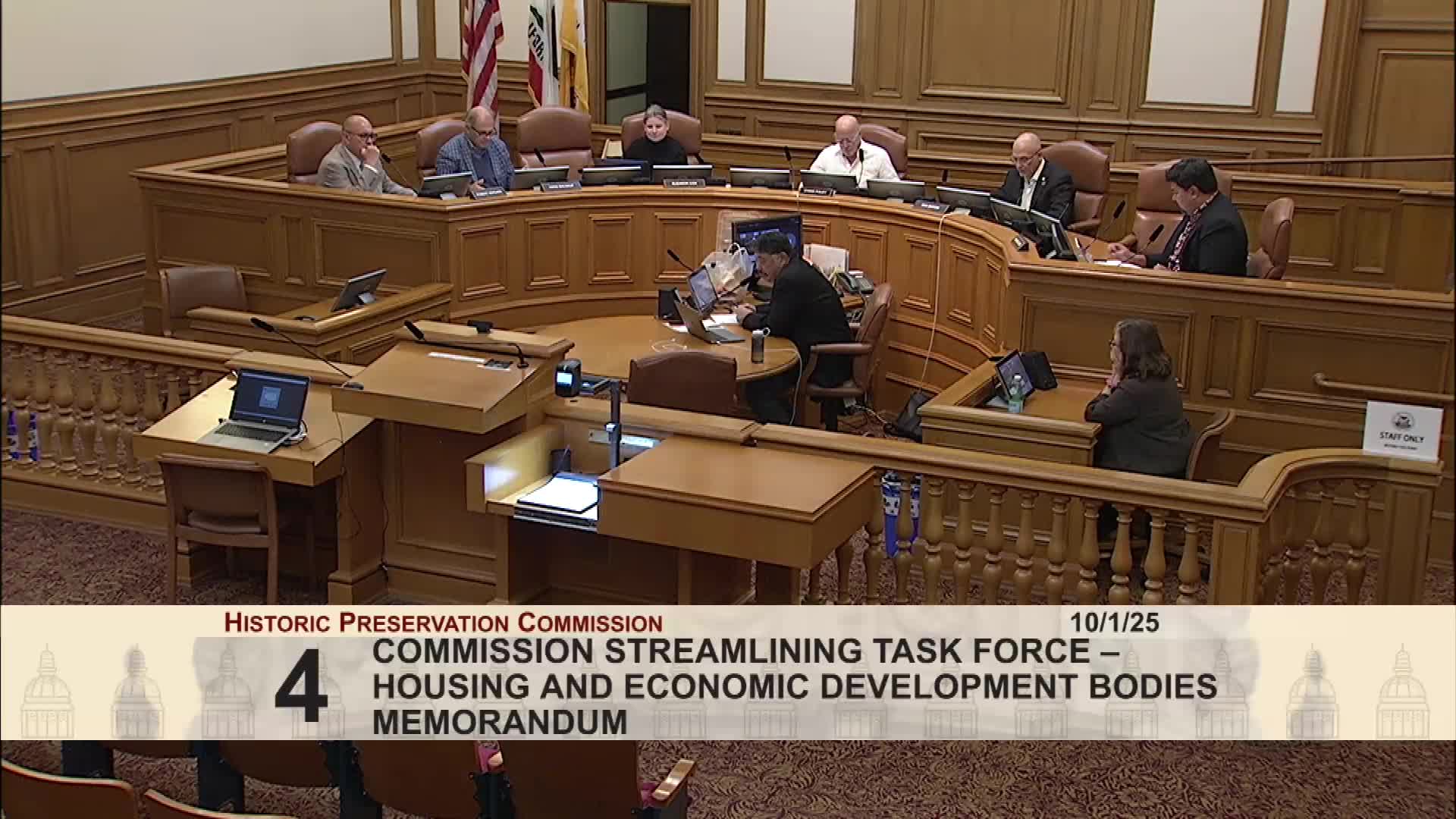
Historic Preservation Commission adopts letter urging task force to preserve local review role
Summary
The San Francisco Historic Preservation Commission on Oct. 1 approved a comment letter to the city's Streamlining Task Force urging retention of the commission and warning that losing Certified Local Government status and a programmatic agreement with the state could slow federally funded housing reviews.
The San Francisco Historic Preservation Commission on Oct. 1 voted unanimously to send a comment letter to the city's Streamlining Task Force urging the task force to preserve the commission's distinct review role and retain the city's Certified Local Government (CLG) relationship with the state.
The letter, edited and finalized during the meeting, was framed by commissioners and staff as a defense of the commission's capacity to conduct timely historic-resource reviews, particularly for projects that use federal funds. Rich Chukre, department staff, told commissioners the department is conducting outreach tied to individual landmark proposals and flagged the importance of the commission's review work as the task force considers consolidation of city bodies.
The commission said the CLG designation and a programmatic agreement with the California Office of Historic Preservation (OHP) allow city staff to carry out Section 106 review under the National Historic Preservation Act for some projects, including many affordable-housing initiatives. Commissioners and staff told the commission that if the city "decertifies" or loses the programmatic agreement, those reviews would shift to the state OHP and could face longer timelines because of staffing and procedural constraints at the state level.
Why it matters: Local CLG status and the programmatic agreement narrow the layers of review for projects that use federal money, commissioners said, and are therefore tied to housing development timelines. Several commissioners argued that eliminating the Historic Preservation Commission or folding its duties into the Planning Commission would not eliminate the substantive work the city must do; instead, it would reassign those responsibilities and likely leave them on staff or the Planning Commission with only nominal budget savings.
Discussion and edits: Commissioners discussed drafting language highlighting the commission's equity work and the breadth of its historic-context statements, noting published work on single-room-occupancy apartments, early residential architecture, and neighborhood commercial corridors. Commissioner Cox asked that the letter reflect efforts to expand the commission's focus beyond "high style" architecture to include working-class and vernacular resources.
Commissioners also debated how to convey the commission's history and public purpose. Members sought to add a brief history noting that the commission grew out of an earlier Landmarks Preservation Advisory Board (LPAB) formed to advise the Planning Commission on historic-resource matters. The commission recorded that the LPAB was formed in 1967 and that the city's first landmark was established in 1968; commissioners asked that an appendix listing significant buildings lost prior to the LPAB be attached to the letter.
Process and background: The discussion referenced Proposition E (the initiative that created the Streamlining Task Force review process), the earlier Proposition D, and staff analyses prepared by members of the City Administrator's Office and the Controller's Office. Commissioners were repeatedly reminded that the task force's recommendations would likely be adjusted by the Board of Supervisors and, if charter amendments are required, decided by voters.
Staff clarification: Commissioners and staff emphasized that the Planning Department was not proposing elimination of the Historic Preservation Commission; rather, the staff analysis provided to the task force included options such as combining or transferring functions to the Planning Commission. Commissioners warned that the memo to the task force acknowledges the possibility that the Planning Commission could be asked to absorb historic-preservation duties, and several commissioners said that the combined workload would be substantial.
Action taken: After live edits and the addition of appendices submitted by Commissioner Vergara, the commission voted unanimously, 5-0, to adopt the comment letter and related amendments and to authorize staff to deliver the letter to the task force.
Votes at a glance: - Motion to adopt draft minutes for the Sept. 17, 2025 closed session: Passed unanimously, 5-0. (Mover/second: not specified in the record excerpt.) - Motion to adopt the edited comment letter to the Streamlining Task Force with the day's amendments and attachments: Passed unanimously, 5-0. (Mover/second: not specified in the record excerpt.)
What to watch next: Commissioners said the Streamlining Task Force meeting was scheduled later the same day and that the Board of Supervisors ultimately could modify any recommendations and place charter amendments on a ballot for voter approval. The commission asked that staff deliver the finalized letter and appended exhibits to the task force and offered to report back to the commission on any developments.