Get Full Government Meeting Transcripts, Videos, & Alerts Forever!
Get email alerts on the Social Determinants Of Health topic
No spam. Unsubscribe anytime.
State senators hold San Diego hearing on social determinants of health; panel spotlights ACEs, school screening and environmental injustice
Summary
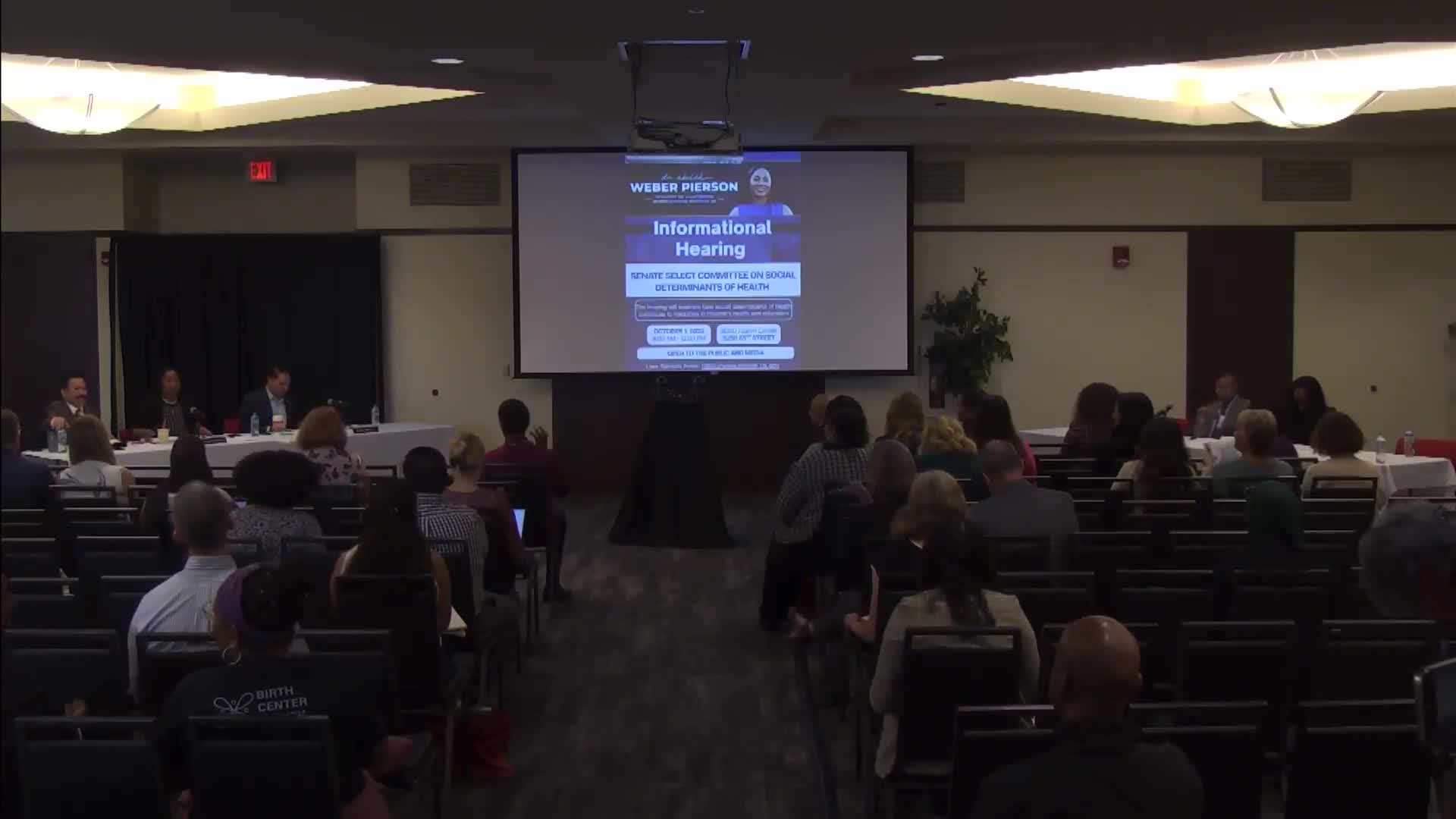
A California State Senate select committee hearing in San Diego on Oct. 25 examined how nonmedical conditions — housing, air quality, education, income and trauma — shape children’s physical and mental health and what state and local programs are doing in response.
A California State Senate select committee hearing in San Diego on Oct. 25 examined how nonmedical conditions — housing, air quality, education, income and trauma — shape children’s physical and mental health and what state and local programs are doing in response.
Senator Dr. Weber Pearson, chair of the select committee on the social determinants of health, opened the session by describing persistent inequities in life expectancy across San Diego, saying some neighborhoods experience differences of more than a decade in life span. The hearing assembled physicians, researchers and community leaders to present evidence and explain recent state initiatives.
The key message from panelists was that place, exposure to trauma and long-term racialized policies matter as much or more than clinical care. Dr. Rodney Hood, a board‑certified internist and health equity educator, reviewed historical scientific and medical racism and cited studies showing measurable provider bias and higher physiological stress among Black and Native American populations. "Zip code remains a stronger predictor of health than your genetic code," Hood said, and outlined how chronic toxic stress and structural racism raise allostatic load and disease risk.
Dr. Nadine Burke Harris, California’s first surgeon general (2019–2022), summarized decades of ACEs (adverse childhood experiences) research and described the state’s ACEs Aware model for early detection and referral. Burke Harris said the original ACEs study and follow‑up work show a dose–response relationship between childhood adversity and later health and behavioral outcomes; she added, "ACEs are not destiny," and described California actions that attach Medicaid‑covered services to high ACE scores, expand provider training and shorten referral times in pilots. The panel cited statewide ACEs Aware figures: more than 49,000 providers trained and over 4.5 million screenings, with roughly 7.5% of Medicaid members aged 0–20 screening at ACE score 4 or higher in program data presented.
Researchers and policy experts highlighted programmatic and upstream responses. Dr. Vickie Mays (UCLA) summarized population research linking concentrated poverty, pollution and school disadvantage to worse cognitive and mental‑health outcomes for children and urged economic and housing policies (including mixed‑income neighborhood strategies and guaranteed‑income pilots) aimed at upstream change. Director Sohil Sood of California’s Children and Youth Behavioral Health Initiative described the initiative’s multi‑billion‑dollar, multi‑pronged effort to expand workforce capacity, reimburse school‑based behavioral health services and scale community and digital supports; he said more than $1.3 million in new insurer payments had reached schools so far and that 20,000 school‑delivered services have been reimbursed under early implementation.
Panelists also described digital and community access tools. Katie Kursnick, a youth ambassador, and Director Sood reported that Soluna — a state‑supported digital behavioral health platform — and related programs now engage hundreds of thousands of children, youth and families (presenters cited roughly 360,000 statewide users and about 30,000 in San Diego County), and that online coaching and moderated peer spaces aim to reach young people who cannot access in‑person care quickly.
Environmental justice advocates linked neighborhood pollution to health and school attendance. Maritza Garcia, program manager at the Environmental Health Coalition, used CalEnviroScreen maps and local examples from Barrio Logan and Logan Heights to show disproportionate diesel and industry exposure, higher asthma ER visits and shorter local life expectancy. Garcia reviewed the city of San Diego’s 2008 lead‑safe housing ordinance and described local mitigation work including air‑purifier distributions and home lead remediation efforts for qualifying households.
Education advocates framed literacy and school supports as social determinants. Dominique Dannette of EdVoice Institute said reading proficiency is tightly linked to mental and long‑term health outcomes and praised recent state policy moves to expand evidence‑based reading instruction and teacher training. Panelists agreed that school‑based screening, better funded school health services and trauma‑informed teacher supports help link education and health interventions.
Public commenters described barriers to care and environmental harms. Speakers included representatives of community health networks, patient‑advocacy groups and local residents who cited language access gaps, fragmented provider networks, lead and industrial exposures, and lingering mistrust of medical systems. UC San Diego Health’s chief health equity officer noted a federal requirement to screen hospitalized adults for social drivers of health but emphasized that screening without community capacity and "closed‑loop" referral systems leaves needs unmet.
The hearing produced no formal votes. Committee members and speakers emphasized prevention and systems change as priorities, including investments in prevention that alter underlying economic or housing structures, expansion of ACEs screening and care pathways, strengthening school‑based mental‑health billing and workforce development, and targeted environmental remediation in overburdened neighborhoods.
The committee said it will make submitted materials and testimony available after the hearing and signaled follow‑up work with state agencies, local partners and community groups to track implementation and funding gaps.
(Ending) The San Diego hearing collected scientific evidence, program evaluations and community testimony that state and local policy — from ACEs screening and school‑based billing to environmental remediation and guaranteed‑income pilots — are central to narrowing health and education gaps rooted in place and racialized policies. Committee members closed by urging continued multisector coordination and community engagement to turn the presented evidence into measurable improvements for children and families.