Lifetime Citizen Portal Access — AI Briefings, Alerts & Unlimited Follows
D.C. committee hears wide-ranging debate over proposed bottle bill
Loading...
Summary
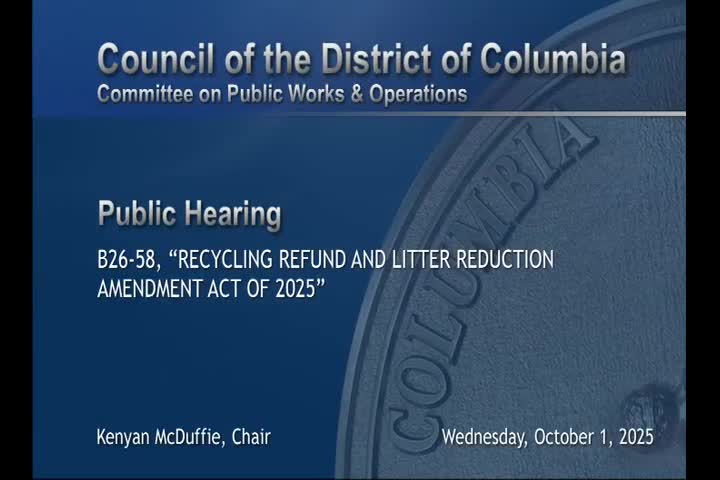
The Committee on Business and Economic Development on Oct. 1 held an extended public hearing on Bill 26‑58, the Recycling Refund and Litter Reduction Amendment Act of 2025 — commonly called the D.C. bottle bill — which would require a 10¢ deposit on most beverage containers sold in the District and establish a nonprofit stewardship organization to run returns and recycling.
The Committee on Business and Economic Development on Oct. 1 held an extended public hearing on Bill 26‑58, the Recycling Refund and Litter Reduction Amendment Act of 2025 — commonly called the D.C. bottle bill — which would require a 10¢ deposit on most beverage containers sold in the District and establish a nonprofit stewardship organization to run returns and recycling.
Supporters said the bill would sharply reduce litter, raise recycling rates and create economic opportunities for people who collect containers; opponents — wholesalers, some retailers and small producers — warned the measure would impose new administrative, storage and fraud‑prevention costs that could be passed on to consumers and harm small businesses. No formal vote was taken at the hearing.
The bill, introduced in January by Councilmember Rhiannon Nadeau and co‑sponsored by 10 colleagues, would amend the District’s Sustainable Solid Waste Management Act (2014) to create an extended‑producer‑responsibility style program overseen by the Department of Energy and the Environment. Supporters at the hearing cited examples from 10 U.S. states and other countries where deposit systems have produced large increases in redemption rates and reductions in litter. “There is a solution,” Councilmember Nadeau said at the start of the hearing. “The deposit return program has been implemented in 10 states and is highly and measurably successful in every one of them.”
Environmental and community advocates including the DC Environmental Network, Sierra Club’s District chapter, the Anacostia Watershed Society and volunteers from neighborhood clean‑ups described streets, parks and riverbanks choked with beverage containers and urged action. “Plastic bottles alone account for 60 percent of the weight of all trash retrieved from the Anacostia River,” Nadeau told the committee, citing audits and cleanup totals. Witnesses described health and ecological concerns from microplastics and leaching chemicals, and said unclaimed deposits could fund lead‑filter distribution for residents who still rely on risky service lines.
Opponents included regional distributors, alcohol wholesalers and some grocery and liquor store managers who told the committee the proposal as drafted would create real costs and operational burdens. “Neighborhood shops and grocery stores would be forced to act as garbage depots, paying out cash for unknown volumes of containers,” testified Brendan Williams Keefe, speaking for district wholesalers. Retail witnesses said reverse‑vending machines or bag‑drop centers require space, new labor and sanitary controls — a particular problem at small sites with limited back‑of‑house room. Several distributors and wholesalers warned of fraud and cross‑border redemptions, saying containers purchased outside D.C. could be returned here to capture the 10¢ deposit. Representatives from Connecticut and other states with recent experience said fraud and enforcement are real concerns that require resources and technology to address.
Council members and agency witnesses pressed for detail on the bill’s design and impacts. Committee Chair Kenyon McDuffie and others asked whether the Department of Energy and the Environment could administer the program as drafted and how the city would manage cross‑jurisdiction risks. Deputy Mayor Nina Albert told the committee the executive supports the goals but does not support the bill in its present form, citing current economic stress on businesses from federal workforce reductions and recent revenue pressures. DOE staff said the agency would need additional staffing to administer a program of this scope and warned that enforcement and fraud‑prevention would be significant new tasks.
Several possible compromises and design changes were discussed openly at the hearing: exemptions or higher thresholds for micro‑producers, an elevated handling fee to offset retailer costs, staged rollouts, limits on per‑transaction redemptions to reduce fraud, and regional coordination with Maryland and Virginia. A number of witnesses said stewardship organizations and reverse‑vending technologies can reduce burden on small retailers if the program is properly funded and regulated; business witnesses countered that the stewardship model must be tightly specified and that start‑up and ongoing costs remain uncertain.
The committee received hundreds of in‑person and virtual testimonies. Supporters ranged from neighborhood residents, school groups and faith leaders to conservation nonprofits; opponents included small distributors, some liquor and grocery store owners, hospitality industry representatives and trade associations. Several witnesses recommended that unclaimed deposits be targeted to community‑benefit uses such as cleaning grants, lead‑filter distribution or infrastructure for convenient redemption sites. The hearing record will remain open for written testimony through Oct. 10, 2025.
The hearing produced no formal vote. Committee members asked agencies to produce additional analyses on implementation costs, fraud mitigation, and the administrative roles of DOE and DPW. McDuffie closed the hearing after nearly 10 hours of testimony and invited follow‑up materials from witnesses and agencies.
D.C. is now in the middle of a policy choice seen in other states: adopt a deposit return program and the infrastructure to run it — or preserve the current mix of curbside recycling, enforcement, cleanup contracts and community collection. The committee’s next steps include additional briefings with agencies and stakeholders and potential bill revisions to address the operational and regional concerns raised at the hearing.
Ending: The Committee on Business and Economic Development adjourned the hearing after receiving testimony from more than 200 witnesses and pledged further analysis and stakeholder conversations before advancing legislation.