Get Full Government Meeting Transcripts, Videos, & Alerts Forever!
Get email alerts on the Housing Finance topic
No spam. Unsubscribe anytime.
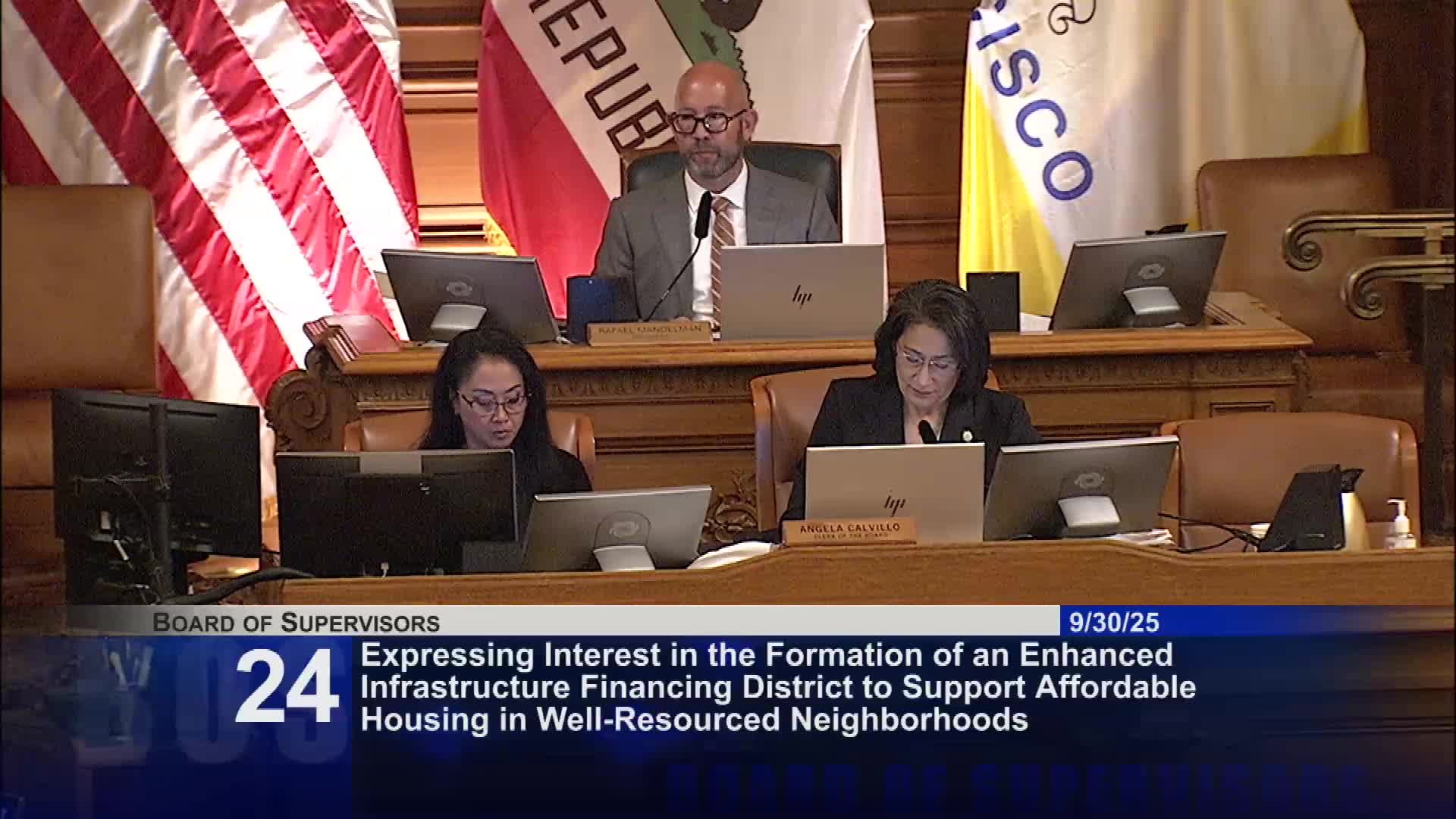
Supervisors back study of Enhanced Infrastructure Financing District to support affordable housing; vote 10–1
Summary
A resolution expressing interest in exploring an Enhanced Infrastructure Financing District (EIFD) to support affordable housing and well-resourced neighborhoods passed 10–1. Supervisors debated whether EIFDs would divert tax capacity from other city needs and whether bonds or regional financing should be prioritized.
San Francisco — The board adopted a resolution on Sept. 30 asking the Controller’s Office, the Office of Economic and Workforce Development and the Mayor’s Office of Housing and Community Development to study options for forming an Enhanced Infrastructure Financing District (EIFD) to support affordable housing production in well-resourced neighborhoods.
The measure passed 10–1, with Supervisor Chan recorded as the sole no vote. The resolution is an expression of interest that directs departments to analyze EIFD structures and report back with options; it does not create or form a financing district by itself.
Why it matters An EIFD would allow the city to use increments of property-tax growth for a defined period to fund infrastructure and housing projects in targeted areas. Supporters said the tool could be “countercyclical” — providing financing during downturns — and would be one of multiple financing mechanisms to expand affordable housing. Critics cautioned that EIFDs divert a portion of future tax revenue that would otherwise flow into the city’s general fund, bond capacity, or regional financing pools.
Debate highlights - Supervisor Melgar (sponsor) argued EIFDs could help produce affordable housing on the West Side and other neighborhoods and said formation of an EIFD would not preclude use of bonds or regional financing: "By voting on this resolution, it does not bind us to do any particular formation of EIFDs. But it simply urges the departments to put forward their thinking so that we can evaluate our options in the future."
- Supervisor Chan said she opposed the resolution because she prefers pursuing affordable-housing bonds and regional financing mechanisms rather than diverting local tax increment: "I really think that the better venue to really, invest in affordable housing is to continue to, figure out ways like affordable housing bond... I really would not be in support of that today."
- Supervisor Chien warned that EIFDs can reduce city tax revenue capacity for other priorities and said the board should weigh debt capacity and revenue impacts when considering EIFDs.
Action and next steps The resolution instructs the Controller’s Office, OEWD and the Mayor’s Office of Housing to explore EIFD options and report back "later this fall" so supervisors can weigh the choices as rezoning and other housing initiatives proceed. Departments are expected to return with analysis of legal requirements, fiscal impacts, boundaries, projected revenues, and potential uses of increment.
Context San Francisco policymakers are weighing multiple financing tools to boost affordable housing production, including bonds, regional mechanisms and tax-increment financing such as EIFDs. The resolution frames EIFDs as one part of a broader financing toolbox rather than a sole solution.
Ending The board’s study request sets a timetable for departmental analysis and signals that supervisors will review financing options alongside rezoning and capital planning work in the coming months.