Lifetime Citizen Portal Access — AI Briefings, Alerts & Unlimited Follows
Council roundtable flags denials, prior‑auth delays and credentialing gaps in DC Medicaid managed care
Loading...
Summary
The Committee on Health heard from MCO executives, providers and families about denials, prior‑authorization delays, credentialing backlogs, high inpatient/readmission costs and gaps in behavioral‑health and pediatric home‑health networks in the District’s Medicaid managed care program.
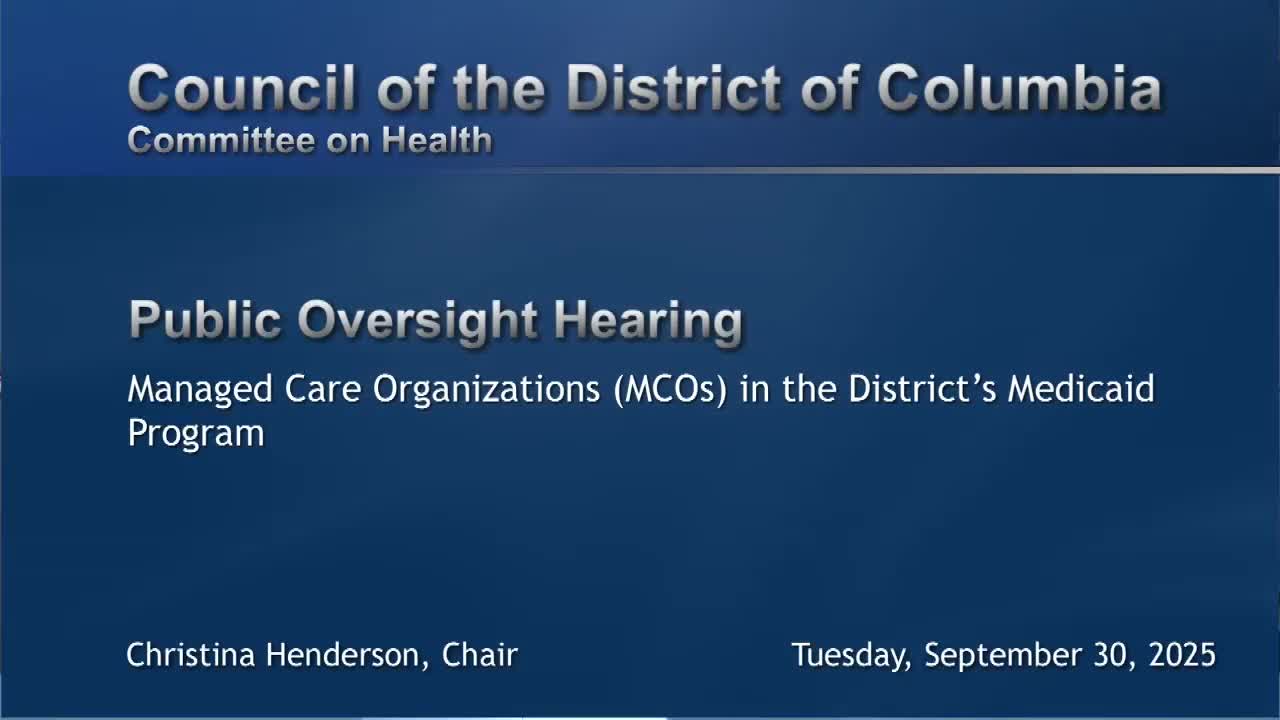
Councilmember Christina Henderson, chair of the Committee on Health, convened a roundtable Sept. 30 to examine performance and provider experiences with the District’s Medicaid managed‑care organizations (MCOs). The hearing gathered testimony from the three MCOs that contract with the Department of Health Care Finance (DHCF), provider groups, legal advocates and families.
The committee opened with context about scale and spending: “As of June 2025, there were over 240,000 people — approximately 88 percent of all Medicaid enrollees — enrolled in these managed care plans,” Henderson said. The council noted that the District spent nearly $2,000,000,000 in 2022 on services administered by MCOs and that two‑thirds of provider payments were delivered through managed care by FY2024.
Witnesses described recurring operational problems. Community providers and doulas told the panel that credentialing and contracting times vary widely across plans, that paperwork is sometimes lost, and that claims denials and inconsistent coding practices have led to delayed or missing payments. “After a lengthy process, I did establish a contract with two other MCOs, which took about six months,” Crystal Jackson, owner of Aqui Grama Doula Services, testified. Gina Vallow, owner of BirthingKind, said her firm had “around $44,500 to $45,000 unpaid” and described thousands of dollars in postpartum claims denied because contract code sets omitted postpartum care.
Medicaid providers and the Medical Society of the District of Columbia raised concerns about “downcoding,” a billing practice they described as automated reductions of evaluation-and-management codes without adequate clinical review. Dr. Flint Peebles, chair of the MSDC advocacy committee, urged the council to require reviewer credentials and deny automatic downcoding without physician review. “Downcoding is not just a billing tactic. It is a barrier to care,” said MSDC testimony.
MCO executives said denial rates and prior‑authorization delays are priorities for improvement. WellPoint (formerly Amerigroup) reported that clean‑claim performance had been strong in 2023 and that the plan achieved NCQA accreditation; MedStar Family Choice said average credentialing processing times were about 28 days and that it had addressed a spike in member appeal inventory by adding staff and vendor support. AmeriHealth Caritas noted that incomplete provider applications — expired CAQH records, missing state DEA/DC licensure documents — are a frequent cause of credentialing delays.
Committee members pressed MCOs for data. Councilmember Zachary Parker asked the plans to provide counts of: (a) claims initially denied and overturned on appeal and (b) claims initially approved and later reversed during audits. WellPoint reported that about 2.5% of denied claims were overturned on appeal in the reported year; the chair asked all plans to supply full reversal counts and timelines. The council also requested plan‑level detail on pharmacy denials (the DHCF reporting excludes pharmacy claims), out‑of‑network payments, and a breakdown of high‑utilizer (“frequent flyer”) populations responsible for a disproportionate share of readmissions and cost.
Several witnesses and council members discussed readmissions and avoidable inpatient spending. MCOs said they run monthly risk and readmission rounds, identify small cohorts of high utilizers (plans reported roughly 20–100 members depending on plan size) and deploy care coordination, community health workers and partnerships (for example, med‑respite or longer‑acting injectable medications) to reduce repeat admissions. Behavioral‑health conditions and homelessness were repeatedly cited as drivers of repeat hospital use.
The panel also examined prior‑authorization practices after the District’s recent prior‑authorization reform law. MCOs said clinical reviewers — nurses and physicians licensed in the tristate region and matched to specialties — handle requests; some plans are piloting AI to accelerate approvals but said AI is not used for denials. Committee members pressed plans on weekend staffing for urgent determinations after seeing weekend turnaround delays.
Committee staff flagged next steps: follow‑up data requests to each MCO on claim reversal counts, out‑of‑network reimbursement timelines, the universe of members without a claim in 36 months, and plan responses to credentialing centralization proposals. Councilmember Parker said the committee will hold a follow‑up oversight hearing on Medicaid/Alliance program changes on Nov. 20 and solicited written public testimony through Oct. 14.
Why this matters: the MCO model concentrates Medicaid spending and care management responsibilities in three contractors; the council’s oversight aims to ensure timely payment to providers, adequate networks for specialized services and transparent adjudication of claims so enrollees get medically necessary care.
The committee will continue to monitor denial trends, prior‑authorization timeliness, credentialing reforms and pilot programs that target frequent users of high‑cost services.