Get Full Government Meeting Transcripts, Videos, & Alerts Forever!
Get email alerts on the Municipal Budgeting topic
No spam. Unsubscribe anytime.
Olympia council directs staff to pursue hybrid budget plan combining public‑safety sales tax and altered business tax
Summary
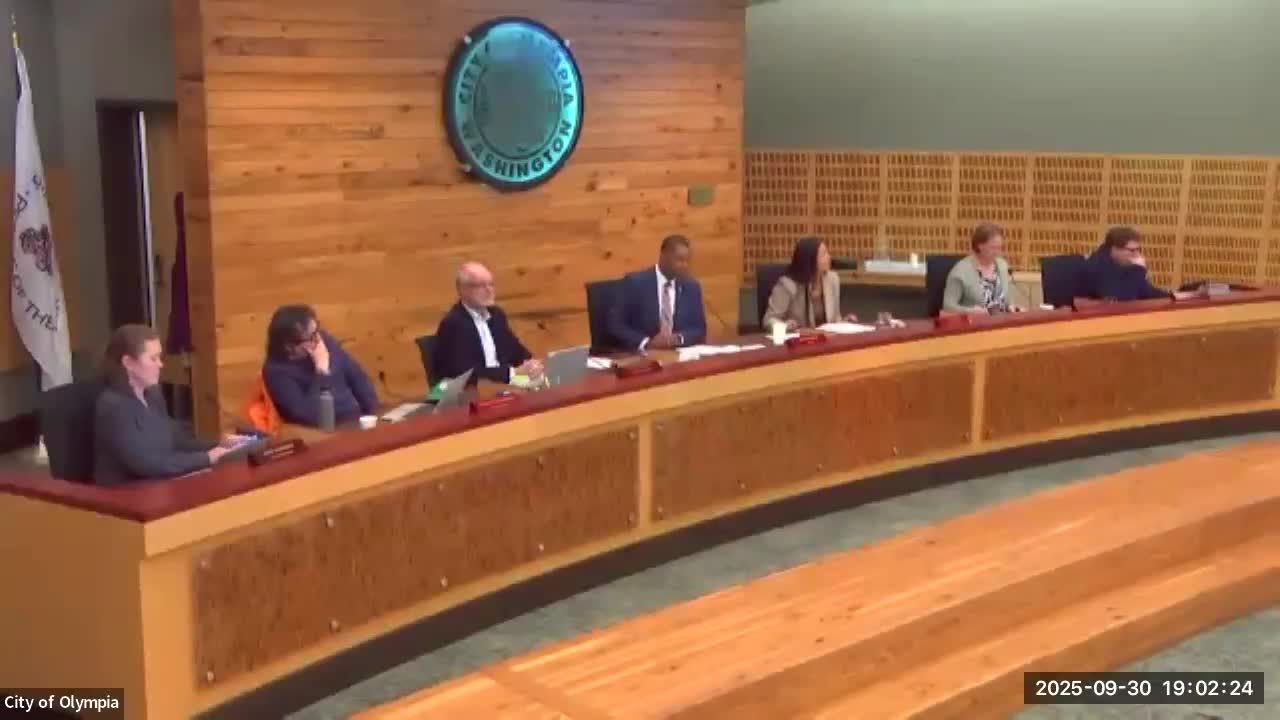
The Olympia City Council voted 5–2 on Sept. 30 to direct staff to pursue a budget‑balancing approach that combines a 0.1% public‑safety sales tax with adjustments to the city’s business‑and‑occupation tax, and to return Oct. 14 with more detailed revenue and reduction scenarios.
Olympia — The Olympia City Council on Sept. 30 voted to direct staff to advance a budget-balancing approach that combines a councilmanic 0.1% public‑safety sales tax with revisions to the city’s business‑and‑occupation (B&O) tax, and to return with more detailed scenarios and reduction options in mid‑October.
City Manager Jay Birney framed the issue for council and the public, saying: “This is your really your first meeting and first touch point on the budget for the year.” Birney told the council the administration has identified a roughly $6.5 million gap in the 2026 general fund baseline and presented revenue and reduction options to close that gap.
Why it matters: The council’s decision puts a revenue path on the table that staff say could produce roughly $3.0 million a year from a full year of a 0.1% public‑safety sales tax (staff estimated $1.5 million for the partial 2026 year) plus about $1.9 million from a proposed retail B&O change as modeled. Even if both revenue options are adopted, staff told council a gap would remain and additional reductions would still be required.
What council discussed and decided: Finance staff and the city’s tax unit walked the council through the proposal options and community outreach findings. Brandy Andrews, tax and license audit lead, reviewed Olympia’s existing B&O structure and presented modeled revenue outcomes for different rate and filer‑threshold combinations. Economic development staff reported they reached 49 businesses and partners in targeted outreach; many business respondents described any added cost as “a tipping point” amid stacked cost pressures. Finance Director Mike Givens walked through House Bill 2015 (the 2025 state legislation that created a public‑safety sales tax pathway and a related competitive grant program) and the local requirements for eligibility.
Public comment was strongly focused on services many asked the council to protect from cuts. Multiple speakers urged the council not to reduce crisis/crisis‑response and climate positions. Jaden Farce said cuts to crisis programs would harm people experiencing homelessness; Paris McCluskey of Thurston Climate Action Team told the council climate staff “oversee Olympia’s existing climate programs and the implementation of Olympia’s goals.” In a tense on‑camera exchange earlier in the meeting, Eric Callison described a recent family mental‑health emergency and urged maintaining crisis response capacity.
Council direction and votes: After extended deliberation, Councilmember Madrone moved that staff move forward with a revenue package aligning with “scenario 1” and to modify the B&O proposal as discussed; the motion passed 5–2. Councilmembers who stated support during deliberations cited the need to avoid cutting frontline public‑safety services and to preserve programs that residents depend on.
Next steps: Staff will return to council at a study session on Oct. 14 with the modified B&O scenarios that council asked for, additional revenue modeling, and a refined reduction list to close any remaining gap. Birney told council that the Oct. 14 meeting will be a pivotal session for shaping specific reductions if they remain necessary.
Votes at a glance (formal council actions from Sept. 30): - Motion to direct staff to advance scenario combining public‑safety sales tax and a modified B&O approach (mover: Councilmember Madrone; second: not specified): passed 5–2 (tally not recorded by name on the record). The council instructed staff to return Oct. 14 with refined revenue and reduction proposals. - Consent calendar (as published, including appointments and interlocal agreements): adopted (voice vote recorded as “aye”). - Note: Council requested staff return with additional B&O variations that spread increases across more business categories and different $0‑filing thresholds; staff will present those on Oct. 14.
What the staff emphasized: Staff repeatedly warned the council that the structural revenue problem — a long‑term mismatch between the city’s revenue growth and expense growth (notably the 1% property‑tax cap) — will require continued attention beyond 2026. Birney said the city could still need further revenue options or reductions in future years unless more durable structural fixes are adopted.
Context and constraints: The council heard that roughly 55% of the general fund is dedicated to police and fire and that about 70% of the general fund budget is “people” — salaries and benefits. Staff and councilors said that means potential reductions will increasingly fall on positions and programs rather than on small operating line items.
Council members and staff who appeared prominently in the discussion: City Manager Jay Birney; Finance Director Mike Givens; Tax & License Lead Brandy Andrews; Economic Development Director Jenica Machado; Mayor Dante Payne; Mayor Pro Tem Nguyen; Councilmembers Madrone, Gilman, Vanderpool, Cooper and Green; and public commenters including Jaden Farce, James Sims, Eric Callison, Richard Burgess, Paris McCluskey and Whitney Weinstock.
What to watch: Staff’s Oct. 14 study session for detailed revenue scenarios, the range of reductions staff will recommend, and any council decisions on whether to put a public‑safety sales tax into effect for 2026 collections (implementation timing requires state review and a Department of Revenue filing timeline).