
Ketchikan Gateway Borough planners hear public concerns on draft 2035 comprehensive plan; set public hearing
Get AI-powered insights, summaries, and transcripts
Subscribe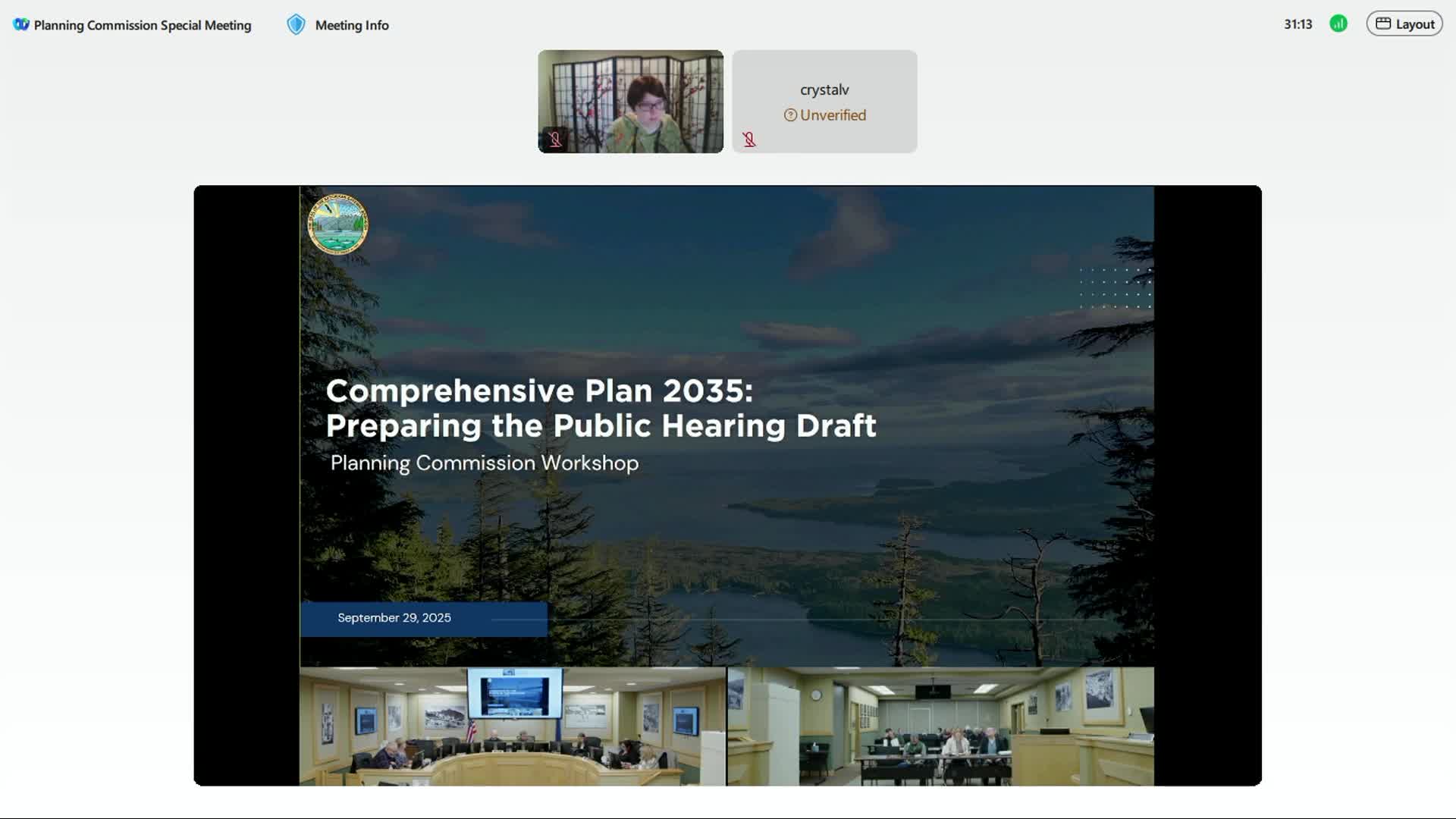
Summary
The Ketchikan Gateway Borough Planning Commission held a work session on the public-review draft of the borough'2035 Comprehensive Plan on Sept. 24, receiving extended public comment and direction for staff before setting a public hearing.
The Ketchikan Gateway Borough Planning Commission held a work session on the public-review draft of the borough'2035 Comprehensive Plan on Sept. 24, receiving extended public comment and direction for staff before setting a public hearing.
Community members and nonprofit leaders told the commission they felt underrepresented in outreach and that the draft plan omitted or downplayed key local priorities such as historic preservation, the arts and nonprofit services. Planning staff and the consultant team reviewed revisions they recommend to address hundreds of public comments and described how the comprehensive plan will relate to the borough's separate strategic plan and implementation work.
Why it matters: The comprehensive plan will guide land-use decisions, capital priorities and policy direction for the borough over the coming decade. Speakers said the current draft, if unchanged, may make it harder for community organizations to win grants, for officials to manage tourism impacts and for residents — especially elders and people with limited internet access — to see themselves reflected in the plan.
Public comments. Dozens of residents and nonprofit leaders said outreach was uneven and the plan omitted priorities important to on-the-ground providers. Michelle Zerbet Scott, project lead for the U.S. Customs House and Pioneer Hall restoration and a member of Ketchikan Pioneers of Alaska, said she was disappointed the draft lacked explicit historic-preservation language and worried that omission could hurt local grant applications. "If I don't have anything that says historic preservation, there's not much I can say where the borough is supporting our project," Scott said.
Connor Pope, executive director of Rendezvous Senior Day Services, said elders and homebound residents were not reached by the draft's outreach and urged more direct engagement: "Elders don't necessarily have Internet access...their means of communication is limited." Several speakers from the arts, library and other nonprofits echoed that nonprofits are "boots on the ground" and called for the plan to acknowledge the sector as an economic and community-stability driver.
Staff and consultant presentation. Italia Steck, the borough's associate planner, opened staff remarks and introduced the consultant team from Agnew Beck. Planning Director Frank Maloney summarized the process and explained how the comprehensive plan (the statutory land-use and visioning document) is intended to inform — but not duplicate — the borough's strategic plan (the management-driven implementation tool). Maloney emphasized that once the public-review draft is released, the process requires commissioners to consider all comments and that the commission cannot simply "stop and rewrite" before the public-review step; instead the work session is the forum to direct revisions for the public-hearing draft.
Consultant recommendations and key topic revisions. Meg and Holly of Agnew Beck outlined proposed substantive edits drawn from the comment tracker (they said the project received hundreds of comment sets and detailed responses are in the tracker). Major recommended changes the team presented and commissioners discussed included: - Historic preservation: adding stronger language and a recommendation to support a comprehensive historic-preservation plan so nonprofit-led restoration and grant applications can document borough support. - Nonprofit sector and arts: adding explicit recognition of nonprofits as economic drivers and partners across chapters (economic development, quality-of-life/culture/wellness, and housing) while avoiding an exhaustive list of named organizations. - Tourism and quality of life: clearer cross-references between the borough's draft and the 2023 Ketchikan tourism strategy, and additional language to address resident concerns about visitor impacts, workforce housing and infrastructure (broadband, shore power and utilities). Commissioners debated how strongly the plan should prioritize resident quality of life versus tourism industry growth; staff said the tourism strategy exists but has not been fully implemented and that the plan can identify borough-led items. - Land use and waterfront: minor corrections to future land-use map designations, a recommendation to add a downtown sub-area study focused on resident–visitor balance, and a proposal to elevate waterfront-dependent uses in map and strategy language. - Transportation and paratransit: suggested edits to improve coordination of airport/ferry schedules with borough transit and paratransit services and to strengthen emergency-transportation and hazard-mitigation language after the recent landslide. Commissioners asked to add specific actions such as coordinating airport/ferry schedules and outreach to travelers and vulnerable residents. - Indigenous place names: staff proposed an optional layer on the future-land-use map showing traditional place names; commissioners asked that any such names be historically verified with local tribal entities (Ketchikan Indian Community and Saxman) before inclusion. - Short-term rentals and housing: maintain monitoring of short-term rental data and its housing-market impacts, with cross-reference to housing strategies and any recent assembly actions on transient-occupancy tax exemptions. - Governance and consolidation: public comments raised the question of city–borough consolidation. Consultants proposed nonprescriptive language to "facilitate community dialogue on potential service or government consolidation...including exploring models used in other Alaska communities and evaluating potential benefits, challenges and cost implications." Staff noted the sensitivity of this topic and recommended keeping the language focused on study and public dialogue rather than advocacy.
Process, timeline and next steps. Meg presented the comment-tracker metrics (the team reported ~394 comment sets; staff said those were parsed into topic-level entries, with roughly 51 sets labeled as individual respondents and 45 from community organizations). Commissioners discussed whether the draft should be retitled or reorganized; debate centered on whether to rename the "Culture, Wellness and Education" chapter "Quality of Life" or to split the contents into two distinct chapters.
Commission votes and direction. The commission directed staff to prepare a public-hearing draft incorporating the agreed changes and set a public hearing. The commission also voted on internal structure for the plan: Commissioner Trevor Shaw moved to split the plan chapter currently labeled culture/wellness/education into two separate sections (Health and Wellness; and Culture and Education). The motion passed on a roll call of six yes votes. The commission set a special meeting for Oct. 28 to consider a public-hearing draft and conduct the public hearing; staff and the consultant will prepare the draft and post it with adequate public notice.
What wasn't decided. Commissioners left open several implementation questions — such as how and when specific tourism strategy items would be funded or assigned, how to operationalize coordination with the city and tribal governments, and the precise language for short-term-rental monitoring and potential regulation — for further deliberation during the public-hearing phase and in subsequent planning/assembly coordination.
The Planning Commission is expected to review the public-hearing draft at the special meeting on Oct. 28; if the commission approves a public-hearing draft, the item will move to the assembly adoption process. Staff asked commissioners for clear direction on any remaining edits and said they would return the revised draft and the comment-tracker responses in time for the special meeting.
Quotes in context. "A group of people representing a large segment of economic drivers in the town was told that they didn't matter," said Michelle Zerbet Scott, describing public frustration that some voices were not reflected in the draft. "Elders don't necessarily have Internet access...their means of communication is limited," said Connor Pope of Rendezvous Senior Day Services, urging targeted outreach. Planning Director Frank Maloney explained the two-step role of the documents: "The comprehensive plan provides a visionary framework, but the implementation piece goes in the strategic plan." Meg of Agnew Beck told commissioners the team had "sorted" the 394 comment sets into topic-level entries so revisions could be tracked and responded to in the draft.
Ending note. Commissioners, staff and the consultant agreed to continue revisions and to publicize a formal public-hearing draft in advance of the Oct. 28 public hearing so residents and organizations can review the revisions and provide further comment before the assembly considers adoption.