Get Full Government Meeting Transcripts, Videos, & Alerts Forever!
Get email alerts on the Zoning Housing Size topic
No spam. Unsubscribe anytime.
Debate continues over minimum-unit-size rule and proposed hotel-motel tax allocation for housing trust
Summary
Commissioners debated shrinking the minimum square footage for single-family lots and a proposal to dedicate a portion of the hotel-motel tax for an affordable housing trust. The committee deferred several items to allow administration review and legal refinement.
Commissioners and the public debated two contentious policy tools to expand housing choice: lowering minimum single-family unit sizes in R-75 and R-85 zoning districts, and dedicating a portion of the hotel-motel tax revenue to a county affordable housing trust fund.
Developers, real-estate professionals and housing advocates urged commissioners to reduce minimum single-family home sizes to make new and renovated homes more attainable, arguing smaller footprints increase options for first-time buyers and allow retrofit of existing small-lot housing. Developer and public speakers said many existing homes in neighborhoods are under current minimums and forcing larger replacements increases costs and reduces feasible entry-level product.
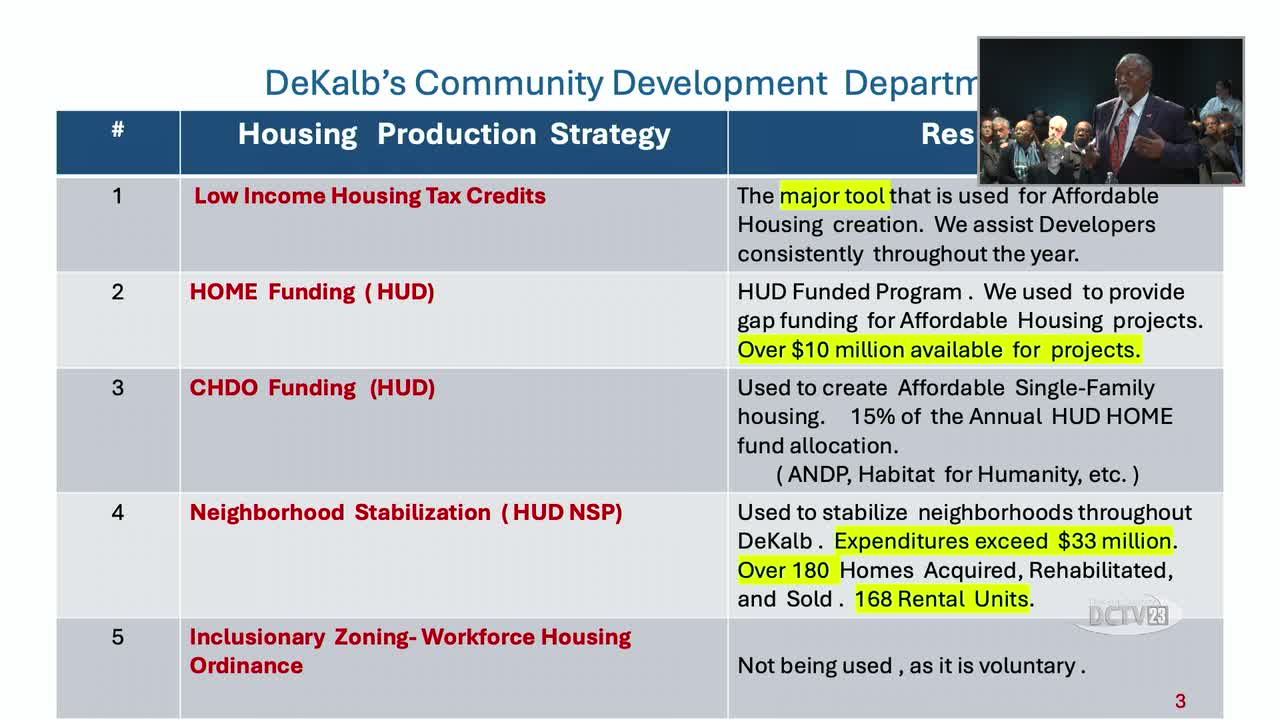
Commissioners raised equity concerns and asked for safeguards: several speakers and commissioners requested that any change include explicit affordability requirements so smaller homes do not simply become smaller, higher-priced units. Chief Housing Officer Alan Ferguson cautioned that reducing minimums alone does not guarantee affordability and recommended incorporating affordability standards or a waiver process that includes public benefit requirements.
On the funding side, Commissioner Terry and others proposed dedicating one-eighth (12.5 percent) of the eight-percent hotel-motel tax revenue to an affordable housing trust fund, an amount county staff estimated could deliver roughly $650,000 annually under recent collections. Ferguson recommended precise drafting and a feasibility analysis to determine impacts on existing allocations and to structure the trust so county contributions could be leveraged with other public and philanthropic capital.
After extended discussion the committee deferred related resolution items (2024-0935 establishing a trust, 2024-1548 designating hotel-motel revenues, and 2025-01064 a separate item) for two weeks so administration, legal and budget staff could refine language and analyze fiscal and operational impacts. Commissioners asked for a feasibility review, legal language on allowable uses and capitalization options, and for the administration to recommend governance options before final board consideration.