Get Full Government Meeting Transcripts, Videos, & Alerts Forever!
Get email alerts on the Public Safety Facilities topic
No spam. Unsubscribe anytime.
Jonesboro task force weighs downtown Washington site versus Caraway Road for new E‑911 center and future police headquarters
Summary
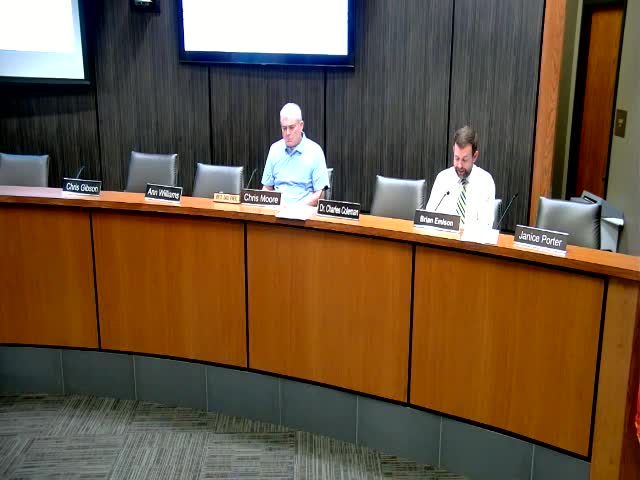
The Capital Improvement Bond Task Force in Jonesboro discussed placement of a new E‑911 dispatch center and the longer‑range police headquarters, weighing a downtown Washington Avenue site against a Caraway Road site and reviewing a structural‑engineer report on the city’s Justice Complex.
The Capital Improvement Bond Task Force in Jonesboro discussed placement of a new E‑911 dispatch center and the longer‑range police headquarters, weighing a downtown Washington Avenue site against a Caraway Road site and reviewing a structural‑engineer report on the city’s Justice Complex.
The task force was told a structural‑engineer report obtained by the city’s insurer concluded “the damage to the building was not caused by [a] weather, incident. And so they're not willing to pay … towards any of the repairs to the building, because of that,” said Craig Latt, a city staff member who presented the engineer’s findings. Latt said a local structural engineer estimated $115,000 to repair a single damaged roof truss but warned other trusses could fail and the repair might not be long‑term. “I can't — I hope that we don't put any more money into that building. Just my own opinion,” he added.
That assessment framed much of the task force’s discussion because it affects whether the city should invest in renovating the existing Justice Complex, build the E‑911 facility downtown at Monroe and Madison (the Washington site), or acquire and develop a new site on Caraway Road. Members reviewed a site‑cost comparison included in a DPZ analysis provided to the committee. One council member summarized the financial comparison by saying the Washington site is roughly $654,000 cheaper for the immediate (phase 1) E‑911 work once demolition and drainage are included; on a full phase 1+2 build the Washington estimate was $30,949,000 and still about $1 million less than the Caraway option when site acquisition and road work are included.
Police leaders urged the task force to consider operational impacts as well as construction costs. Police Chief Elliott said building at the Washington site would displace patrol parking during construction and could fragment department operations while later phases are completed, but he also acknowledged the E‑911 facility could be built there without demolishing the other buildings first. “We're already spread out due to this structural failure… I'm already displaced,” Elliott said, describing ongoing operational strain from the current condition of patrol and justice facilities.
Lieutenant David McDaniel, administrator of the department’s real‑time crime center, told the task force the center’s daily work requires close, face‑to‑face interaction with detectives. He warned that separating the real‑time crime center from investigators during a long, phased program of construction would hamper investigations: “Those investigators know things… they need to come look at that footage with their own eyes.” McDaniel said keeping E‑911 and related analytical functions in the same parking lot as investigators would minimize transition friction.
Public commenters raised budget and land‑acquisition concerns. Patty Licht noted the bond allocation and asked where additional money would come from: “We have $5,500,000 from the bond money. That's all we have or we allotted for, but both of these estimates are way above there.” Another resident, Jim Matero, urged compromise but emphasized taxpayer scrutiny of a seller’s asking price, saying “a million dollars is a ton.” Several speakers noted an outstanding contract to buy property from a private owner identified in the meeting as Mr. Parker and questioned paying roughly $880,000 per acre (a figure cited in the discussion) to acquire that land.
Task force members also discussed non‑cost considerations: preserving about 130 downtown parking spaces if the city keeps the Justice Complex parcel, the possibility of using ARPA funds to assist demolition, and whether the city might instead use an existing city‑owned parcel on Johnson as an alternative. Members differed on whether downtown location would better anchor downtown economic activity or whether Caraway would be operationally more efficient because of proximity to the motor pool and four‑lane access.
The committee did not vote on site selection at the meeting. The chair said a formal vote must be held when all members are present and scheduled the task force to reconvene to vote and forward a recommendation to the Public Safety Commission at 4:00 p.m. on Tuesday, Oct. 21. The meeting record shows the group approved the meeting minutes at the start of the session and later adjourned by motion.
Next steps: the task force will reconvene Oct. 21 for a formal vote to create a recommendation for the Public Safety Commission; city staff and police leaders were told to continue providing line‑item estimates, drainage and asbestos remediation figures, and any updated acquisition terms for the Parker property prior to that meeting.