Get Full Government Meeting Transcripts, Videos, & Alerts Forever!
Get email alerts on the Mod Tree Clearing Grading topic
No spam. Unsubscribe anytime.
Residents and farmers press county on tree-clearing, grading and septic rules in mountainside areas
Summary
Speakers at a Loudoun stakeholder meeting asked the county to simplify tree-clearing and grading rules in the Mountainside Overlay District and to rethink permitting requirements for drain fields and small accessory structures while conservation speakers urged strict protections for mature canopy.
Residents, conservationists and farm owners debated Loudoun County’s tree-clearing and land-disturbance limits within the Mountainside Overlay District (MOD), focusing on the practical effect of percentage-based clearing limits, grading-permit thresholds, and septic/drain-field permitting.
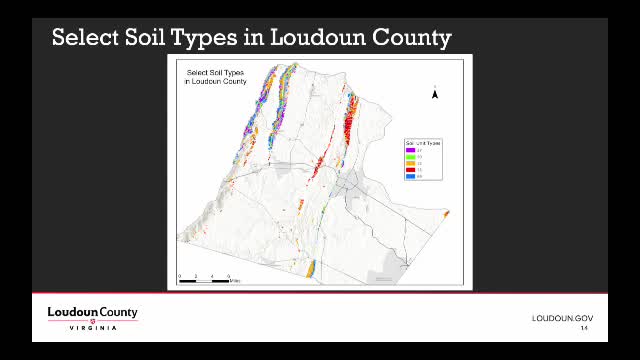
Staff reviewed tables in the zoning ordinance that set percentage caps on clearing in somewhat sensitive, sensitive and highly sensitive MOD areas, and described the current grading-permit thresholds and geotechnical study requirements. David, a county planner, summarized the rules: in some areas "selective clearing of tree cover to the extent necessary to locate the use of up to 25% is permitted" while in highly sensitive locations allowed clearing is smaller and special studies or geotechnical reports are required. He also noted grading-permit and soils-report triggers for steeper slopes and certain soil mapping units.
Farmers and vineyard owners told the committee the current thresholds and study requirements are costly and difficult to navigate. Steve Bozzo and other farm business owners described drain fields and small buildings needed for production and said the expense and time to comply can be prohibitive. One speaker said the drain-field footprint is often substantial and that requiring full grading permits for typical septic work "layer[s] a lot of stuff" onto what are modest projects.
Conservation commenters urged caution in loosening standards. Soil and water professionals reminded the committee that replacing mature canopy with new plantings does not restore ecosystem services quickly, and that erosion and aquifer recharge depend on intact forest cover. Peter Weeks told the committee that the MOD changes ‘‘raise the standards for future residential and commercial development’’ and that "once development occurs, it forever changes the landscape."
Committee members asked staff to consider process simplification and objective thresholds. Suggestions included clarifying exemptions for small landscaping projects, aligning grading-permit thresholds with a 5,000-square-foot minor-project threshold for certain activities, and exploring whether offset requirements (replanting) would provide appropriate ecological equivalence. Staff said they would return with options for simplified administrative processes, clarified thresholds for minor disturbances, and guidance on when full geotechnical studies are required.
No ordinance text was adopted; the discussion will inform staff-drafted options for the board.