Get Full Government Meeting Transcripts, Videos, & Alerts Forever!
Get email alerts on the Mountainside Overlay Flexibility topic
No spam. Unsubscribe anytime.
Committee weighs adding flexibility, tiered reviews to Mountainside Overlay rules
Summary
Loudoun County's Transportation and Land Use Committee heard wide-ranging input on whether the Mountainside Overlay District should allow more administrative flexibility and a tiered review process to reduce costs for small residential and farm projects while keeping environmental protections.
Loudoun County transportation and land use committee members heard arguments for and against adding flexibility to the Mountainside Overlay District (MOD) rules, with staff and stakeholders urging a more tiered, administratively efficient approach for small, low-impact projects.
Committee members and staff said the current MOD standards are prescriptive and have raised costs and delays for residents and small agricultural operations. The committee framed the question as whether to permit more administrative approvals or a tiered review based on use type (residential vs. commercial) and the amount of land disturbance.
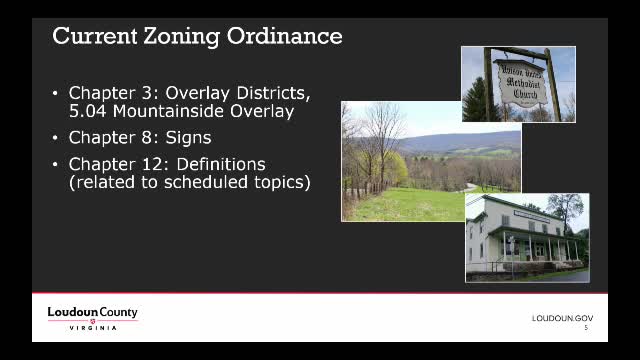
The staff presentation summarized the scope of covered activities under Section 5 0 4 of the zoning ordinance and the development standards that now apply in somewhat sensitive, sensitive and highly sensitive MOD areas. David, a staff presenter, told the meeting the sections under review include "section 5 0 4 for the Mountainside Overlay District, chapter 8 for the sign regulations, and chapter 12 for the corresponding definitions" and defined covered activities that trigger MOD review. Brian, another staff member, outlined staff’s suggested approach to the discussion: "consider whether greater flexibility should be allowed based on the type of use, commercial versus residential uses. And if a tiered review process should be implemented based on the amount of land disturbance." (staff presentation)
County elected officials and stakeholders split over how much discretion to allow. Several vineyard and winery owners described the economic constraints of small agricultural businesses that operate on hillsides within the MOD. Tremaine Hatch, who identified himself as a third-generation farm operator and a viticulture extension associate, said his family "cannot subdivide more than 3 lots without a special exception" and described special-exception costs as "cost prohibitive." Steve Bozzo, a winery owner, told the committee: "We need to expand, or maybe die," describing limits that prevent modest winery expansions needed to process grapes and host visitors.
Opponents warned that broad discretion could become a slippery slope and weaken protections for the mountain resource. Conservation speakers urged preserving canopy, minimizing clearing and keeping strict environmental standards. Planning Commission members framed the issue as a balancing test: protect natural resources while avoiding unnecessarily punitive procedural burdens on property owners.
Staff and several committee members said the discussion could focus on administrative process changes rather than changing the standards themselves. Vice Chair Turner summarized that many of the staff’s suggestions are administrative: "consider introducing administrative approvals or minor special exception processes for legally established residential properties to streamline compliance" and other streamlining measures; he said those measures would not necessarily change the underlying standards but could speed lower-impact approvals.
Next steps: staff will return with draft language and options, including a proposed tiered review system and clarifications of which disturbances would qualify for expedited administrative review versus full special-exception review. Committee members asked staff to propose objective thresholds (for example, land-disturbance square footage and use-type definitions) that could form the basis of an administratively expedited pathway.
The committee did not act on any ordinance text at this session; the meeting was an input session for staff to prepare future draft amendments.