Get Full Government Meeting Transcripts, Videos, & Alerts Forever!
Officials outline timetable, funding and design for Lake Houston dam gates and related flood projects
Summary
City, state and regional officials updated Kingwood residents on an 11-gate design for Lake Houston Dam, associated dredging and a package of local drainage and bridge projects; detailed design is underway with construction permits and additional funding still required.
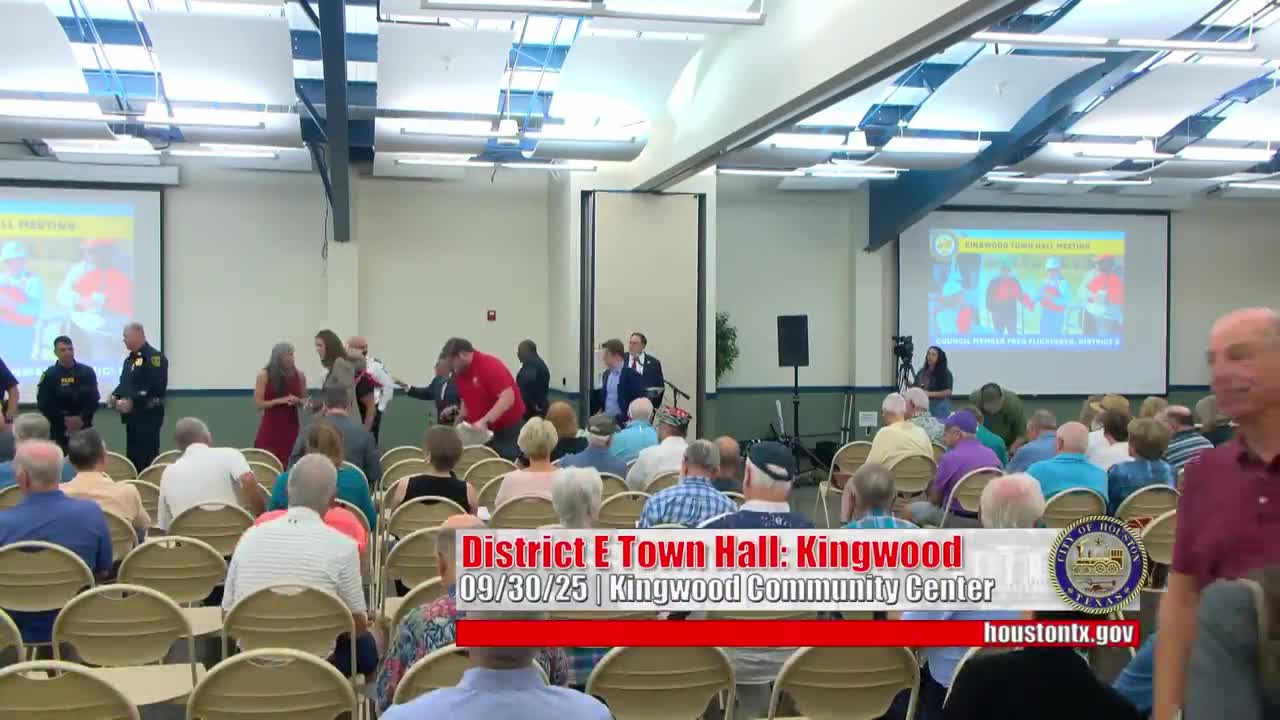
City and state officials told residents at a Kingwood town-hall Sept. 30 that detailed design work is under way for a new gate structure at the Lake Houston Dam, and they described a bundle of dredging, diversion and drainage projects meant to reduce flood risk for Lake Houston-area neighborhoods.
Coastal Water Authority Chief Engineer Greg Olinger said the authority completed preliminary engineering in August and is now moving into detailed design. “The message that I wanna provide to you is that we are moving forward on delivering this project,” Olinger said, describing an 11-gate radial (Tainter) structure to be built on the eastern embankment. The new gates are sized roughly 20 by 22 feet each and the design team estimates the structure could pass about 78,000 cubic feet per second; the existing gates pass about 10,000 cfs.
Why it matters: Lake Houston is a water-supply reservoir for a large portion of the Houston region and a choke point for storm flows. Officials said the gate work, paired with ongoing and planned dredging, regional sediment management and local drainage projects, is intended to reduce downstream flood impacts and support long-term water-supply reliability.
Project scope and schedule
Greg Olinger and Coastal Water Authority staff described the near-term schedule. The authority finished the 15% (preliminary) design in August and will advance detailed design to 30%, 60% and 100% milestones: 30% by the end of the calendar year, 60% by May 2026, and 100% design by 2026. Olinger said permitting will follow and that permitting reviews with multiple regulators typically take about 18 months; construction was described as roughly a 2½-year effort after permits are secured. On that schedule, officials called 2030 an optimistic but feasible completion horizon.
Funding and approvals
Multiple speakers said substantial public funding…
Already have an account? Log in
Subscribe to keep reading
Unlock the rest of this article — and every article on Citizen Portal.
- Unlimited articles
- AI-powered breakdowns of topics, speakers, decisions, and budgets
- Instant alerts when your location has a new meeting
- Follow topics and more locations
- 1,000 AI Insights / month, plus AI Chat