Get Full Government Meeting Transcripts, Videos, & Alerts Forever!
Get email alerts on the Housing Discrimination Source Of Income topic
No spam. Unsubscribe anytime.
Guam committee hears bill to ban source-of-income housing discrimination; enforcement and scope debated
Summary
Bill 29-38 COR would make it unlawful in Guam for landlords to deny housing, raise price, or otherwise discriminate because a tenant’s income comes from vouchers, veterans’ benefits, disability payments or other lawful sources. GURA, nonprofits and disability services supported the intent but disagreed on enforcement mechanisms and gaps such as “
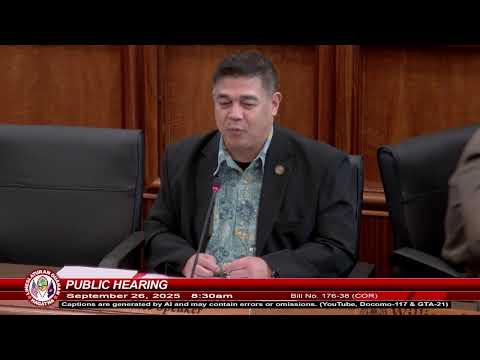
The Guam Legislature’s committee on land and housing heard testimony Friday on Bill 29-38 COR, which would add a prohibition on housing discrimination based on a person’s source of income, including federal housing vouchers, Veterans Affairs supportive housing vouchers, Social Security benefits, guardian or trust payments and other lawful sources.
Senator Sabina Perez, the bill’s author, said the measure seeks to expand equitable access to housing for families, veterans and people with disabilities. The bill cites national research and local needs, noting that Guam had 2,718 authorized Section 8 vouchers and a 97% lease rate reported in testimony; a 2020 Guam housing study cited in testimony reported that 74.7% of needed units are for households below HUD income eligibility thresholds.
Guam Housing and Urban Renewal Authority (GURA) Deputy Director Fernando Steves told the committee that GURA supports the bill’s intent but recommended amendments to address enforcement and common practices that could evade the statute — for example, “bait and switch” pricing where advertised rents change after a landlord learns a prospective tenant’s income source. Steves said such practices have appeared in rapid rehousing and disaster-relief placements and argued the bill should consider consumer-protection approaches to require advertised prices be clear and not adjusted because of a tenant’s income source. GURA also said administering enforcement would require staff time and suggested an initial budget request of about $50,000 to start baseline investigations and rulemaking if the legislature assigns enforcement to an agency.
Nonprofit WestCare Pacific Islands and the Department of Integrated Services for Individuals with Disabilities (DISID) testified in strong support. WestCare said clients seeking housing are often denied despite having a lawful means to pay rent and argued the bill will promote stability and reduce long-term public costs by preventing homelessness. The acting DISID director said source-of-income protection would address equity and break down stigma faced by people with disabilities.
The Attorney General’s Office, represented by Deputy Attorney General Lee Miller, warned the committee that many protections described by proponents already exist under federal Fair Housing law, the Americans with Disabilities Act and other federal statutory schemes. He recommended narrowing the bill or considering enforcement via executive agency processes rather than relying primarily on the courts. Miller also suggested removing certain tenant transfer fees and other transaction charges from statute and urged the committee to consider consumer-facing enforcement methods rather than making the judiciary the principal enforcement channel.
Committee members raised implementation questions about enforcement pathways (judicial vs. executive), how complaints would be documented and resourced, and whether other laws — including Guam consumer-protection statutes (cited in testimony as Section 32103q, Chapter 32, Title 5, Guam Code Annotated) — should be integrated into the bill to prevent bait-and-switch practices. Witnesses and senators discussed a possible markup to refine enforcement language, exemptions (testimony suggested excluding temporary lodging, commercial rentals and sales of real property), and whether GURA would be the logical administrative agency if enforcement is handled by executive staff.
No vote was taken at the hearing. Committee members asked for possible amendments to address advertised-pricing protections and enforcement mechanisms and encouraged nonprofit providers to report instances of discrimination so the extent of the problem can be documented for lawmakers.