Get Full Government Meeting Transcripts, Videos, & Alerts Forever!
Get email alerts on the Rail Crossings topic
No spam. Unsubscribe anytime.
Palo Alto advances design options for Churchill crossing; Meadow and Charleston remain council priorities
Summary
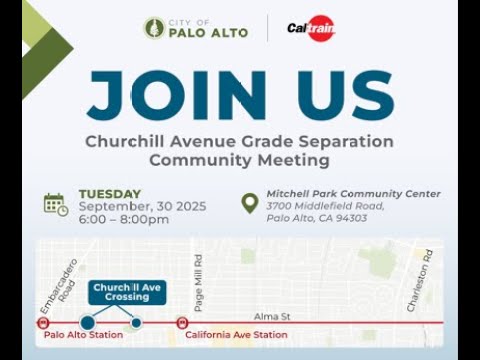
City staff and Caltrain presenters outlined design refinements on Thursday for three Palo Alto rail crossings, saying the City Council has already prioritized Meadow and Charleston for construction and has identified a partial underpass as the preferred concept for Churchill Avenue.
City staff and Caltrain presenters outlined design refinements on Thursday for three Palo Alto rail crossings, saying the City Council has already prioritized Meadow and Charleston for construction and has identified a partial underpass as the preferred concept for Churchill Avenue.
City officials said the work aims to improve safety and mobility while minimizing environmental and property impacts during a conceptual refinement phase that will feed 15% and 35% design milestones. Project staff said they plan to report refined concepts to the rail committee in November and to the City Council on Dec. 8 for direction on which alternatives to advance into 15% design.
"With partnership with the City of Palo Alto, we've been able to implement additional fencing really to ensure that we can close major gaps across the corridor," Caltrain government and community affairs manager Navi Alimwal said. "The most important thing about this is that it's sending instant alerts to train operators and control centers when something is in danger, and it can really trigger warning signs, even audible alarms at the crossing itself." Alimwal described near-term safety measures already deployed and said Caltrain will continue to roll out additional measures at other Palo Alto crossings over the coming weeks and months.
Arvin, the city's senior engineer for the project, described the council-endorsed direction for Churchill Avenue as a "partial underpass with pedestrian/bike crossing" and noted a street-closure concept would remain as a backup alternative. Under the partial-underpass concept, Churchill would not pass through at-grade; instead the roadway would form a T intersection with Alma Street and provide a separate crossing for people walking and biking at an adjacent location.
Staff presented two variations for the Churchill underpass alignment: one that includes a landscape strip adjacent to the northbound lane and one that omits the landscape strip to reduce potential private-property impacts. Staff said the landscape-strip option could require sliver acquisitions from approximately 16 to 18 properties, generally on the order of about 2 feet. Without the landscape strip, staff said property acquisitions would be limited to the immediate intersection areas needed to meet Americans with Disabilities Act (ADA) requirements.
For the pedestrian and bicycle connection, staff described a ramped tunnel concept running from Seal Avenue beneath Alma Street and the tracks to Stanford Avenue and Park Boulevard. Staff said that option would likely remove on-street parking on Seal Avenue and could require narrow sliver takes of roughly 1.5 to 2 feet on both sides of the street for ramp alignments; they estimated 14 to 16 properties could be affected by those slivers.
Project staff emphasized the work is in a conceptual refinement stage before 15% design. The schedule staff outlined calls for completing 15% design by the end of the second quarter of next year and finishing 35% design and environmental documentation by 2027, though they said construction programming and timetables will depend on future funding allocations. "We will try to get it done ASAP," the city's project lead said, but added that construction timing depends on federal and state funding and other approvals.
Jill Gibson of the project team said the project team will synthesize workshop feedback in October, present revised concepts to the rail committee in November and seek City Council direction on Dec. 8. "That council meeting is scheduled for the December 8, in which we will be presenting alternatives and recommendations and community feedback that we've heard," Gibson said. She added that presentation materials and an online comment form will be posted and that staff will take roughly a two-week public comment window following the workshop.
Staff also described technical constraints that shaped the concepts: a requirement to maintain a 20-foot clear width for fire access on Alma Street, drainage and geotechnical considerations, and the need to limit potential property impacts where possible. Officials said detailed traffic, utility and constructability analyses will continue as the designs advance.
The presentation concluded with a transition to a hands-on workshop in which attendees could leave written feedback on comment cards and interact with technical team members stationed at topic tables. Staff encouraged residents and nearby stakeholders to submit online comments during the posted two-week comment period so the team can incorporate community input ahead of the November rail committee review and the December City Council briefing.
Votes at a glance: none recorded. No formal motions or votes on project selection were taken at the workshop; staff described prior Council direction and upcoming decision points.