Get Full Government Meeting Transcripts, Videos, & Alerts Forever!
Get email alerts on the Animal Waste Ordinance topic
No spam. Unsubscribe anytime.
Marathon County staff present draft animal-waste ordinance changes, propose buffers and seasonal limits
Summary
County conservation staff presented draft changes to the animal-waste ordinance that would add a winter-spreading permit, seasonal spreading limits for medium farms, and 35-foot buffers along streams; staff proposed phased implementation and outside counsel review.
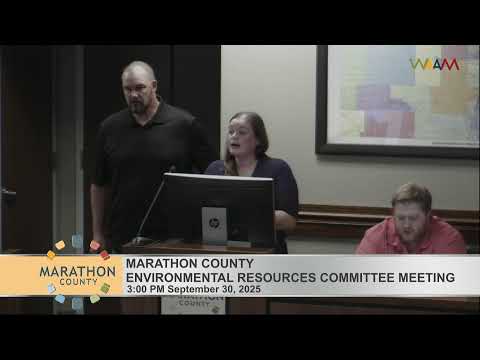
Marathon County conservation staff on Sept. 30 presented draft changes to the county animal-waste ordinance that would require winter-spreading permits or nutrient-management plans, impose a 60-day seasonal spreading limitation for medium-sized livestock operations, and establish 35-foot buffers along perennial and intermittent streams.
Kirsty Heidenreich, county conservationist, told the Environmental Resources Committee the draft is the product of more than a year of work with a farmer work group and statewide research. The draft proposes a $200 fee for a four-year winter-spreading permit, while offering a county-supported nutrient-management plan alternative for producers who prefer it. Heidenreich said the county and partner technical colleges provide nutrient-management coursework at little or no net cost to participants.
Under the draft, medium-sized operations (defined in the presentation as 300 to 999 animal units, consistent with Environmental Protection Agency medium-farm definitions used in discussion) would face a 60-day restriction on winter spreading, intended to reduce high-risk nutrient applications. Staff said large farms (1,000+ animal units) are already subject to spreading restrictions under existing rules. Heidenreich said the county’s estimate is that roughly 40–60 farms fall in the 300–999 animal-unit range and that approximately 6–10 of those still perform daily manure hauling and would need support to transition.
The draft also proposes a 35-foot perennial-grass (or equivalent) buffer adjacent to perennial and intermittent streams in which nutrient application and tillage would be restricted; staff described the buffer as likely to be sited on marginal soils in many cases and suggested landowners could manage and harvest the buffer if at least 50% is grass. Heidenreich said naturally occurring wooded stream corridors would count as compliant buffers and that staff would not require landowners to remove existing trees or vegetation.
Staff recommended contracting with outside counsel for legal review before bringing a final draft forward. Heidenreich said the county engaged attorney Jane Lindretti of Stafford Rosenbaum in Madison to review the draft; Lindretti is a former lead counsel for DATCP. Heidenreich also said the county expects to coordinate review with the incoming corporation counsel and with state agencies once ERC action is complete.
Timing and implementation outlined by staff calls for public education and outreach in November, a special ERC meeting Oct. 14 for deeper discussion, another ERC discussion Dec. 4 and potential ERC vote in December. If ERC approves, staff said the ordinance package would then be submitted to state agencies (DNR and DATCP) where the review process could take up to 90 days; staff estimated a potential County Board vote in March 2026 assuming that schedule.
During the committee question-and-answer period supervisors asked about staffing and mapping. Heidenreich said staff do not anticipate hiring new personnel and plan to reallocate existing staff time and leverage completion of other projects (for example, winding down a Fenwood Creek watershed project) to provide capacity for outreach and permit work. Garrett Poggle described a county map that overlays DNR perennial/intermittent stream data with a 35-foot buffer to show where buffers would apply, and staff said they would share the map with landowners and through county mapping services.
Committee members asked for more meetings with the farmer work group and for the county to share materials repeatedly with supervisors so they can answer constituent questions. Heidenreich said the farmer work group will continue meeting and staff will host open houses and education sessions. She emphasized the county intends a phased implementation period (discussed informally as roughly three years) to allow operations time to plan and seek cost sharing and technical assistance.
Direct quotes from the meeting include farmer Kevin Jean Schmiedke: "I was completely against it at first... I'm in support of it... it's a doable thing, and we gotta try." Dean Beck, Town of Easton chairman, said of regulatory escalation: "These type of programs start with this framework and build from there with more and more regulation... it's gonna force a lot of small farmers out," reflecting concern about costs for manure storage and hauling.
What’s next Staff asked ERC members to review the draft before a special meeting Oct. 14 and signaled outreach will ramp up in November. If ERC votes to advance a revision, the county plans to submit the ordinance package to DNR and DATCP for review; that review could take up to 90 days before the County Board considers final adoption.