Get Full Government Meeting Transcripts, Videos, & Alerts Forever!
Get email alerts on the Municipal Budget topic
No spam. Unsubscribe anytime.
Wausau finance committee frames 2026 budget, flags gap for SAFER-funded public-safety positions
Summary
City staff presented a 2026 budget that meets state levy and expenditure-restraint limits but relies on one-time revenues and program deferrals to cover shortfalls, and staff outlined a possible referendum to fund public-safety positions after FEMA SAFER and ARPA grants expire.
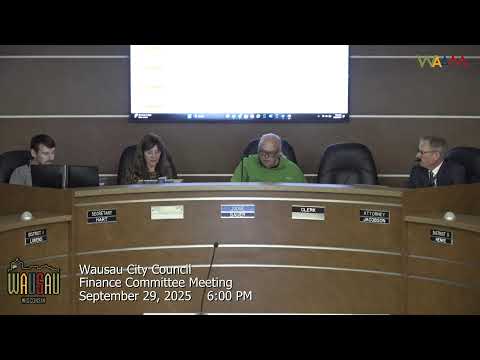
The City of Wausau Finance Committee reviewed a proposed 2026 budget at a Finance Committee meeting at City Hall, where staff said the plan meets state levy- and expenditure-restraint requirements but uses one-time revenues and program cuts to cover rising costs and an impending grant cliff for public-safety positions.
City staff summarized why the budget matters and the immediate risks. Mary Anne, a City of Wausau staff member, told the committee the proposed levy is roughly $38.0 million — an increase of about $738,946, or about 1.98% over the prior year — and that the package “meets both” the levy‑limit and expenditure‑restraint requirements. She said the budget includes a 3% cost‑of‑living adjustment for nonrepresented employees, 4% for public‑safety employees per union contracts, and a 9.5% rise in health‑insurance costs.
Why it matters: staff said the city faces an approximately $4 million increase in external costs driven by inflation, higher health‑insurance and garbage‑contract costs, and the scheduled expiration of grant funding that currently covers 15 public‑safety positions. Without a revenue change, staff proposed a mix of vacancy savings, one‑time revenues and service reductions to balance 2026 and outlined a potential referendum for an ongoing levy increase to sustain the positions.
Most important details
• Public‑safety positions and grants: Staff said 15 public‑safety positions created since 2021 are currently grant‑funded: 12 firefighters (nine funded by the FEMA SAFER grant and three funded by ARPA), plus a community outreach specialist and two downtown police officers funded by foundation donations. Mary Anne said the SAFER grant expires on Feb. 6, 2026, and that the total payroll for these 15 positions is “just shy of $1,500,000,” with the SAFER grant contributing roughly $154,000 toward 2026 payroll. To cover the shortfall in 2026 staff assembled about $1.3 million in one‑time revenues (ARPA carryover, supplemental Medicare EMS payments and investment income) but warned that ongoing funding in 2027 would require about $1.2 million of new, sustained revenue.
• Possible referendum and communications RFP: Staff described plans to issue an RFP to hire professional assistance to explain to residents why a levy increase could be needed to continue those public‑safety positions beyond grant expiration. Mary Anne said, under state timing requirements, a referendum approved by council would need to be submitted by Jan. 27 to make an April ballot.
• Vacancy and spending cuts: The budget carries a $300,000 vacancy allowance and mandates specific vacancies and reduced hours across departments (examples cited: half FTE at the police department, one assistant city‑attorney position held open, half FTE accountant, half FTE parks administrative coordinator, one vacant division chief in fire, and one CCITC analyst FTE). Departments also proposed cuts to training, tuition reimbursement, software subscriptions and deferred equipment replacements (radios, one aerial fire truck, one ambulance) and some small service reductions (rotating pool operations so only two pools operate per day).
• Revenue changes and offsets: Staff listed new or increased fees proposed for 2026, including an alley‑clearing charge, a pet license, EMS transport rate increases, a police lockout fee, expanded inspection and license fees, a special‑assessment exam fee and weights‑and‑measures fees. Staff said supplemental Medicare payments for EMS could provide roughly $280,000 annually when fully realized; investment income and available ARPA carryover were cited as other one‑time offsets.
• Capital and lead‑service work: Staff described major capital items including the lead service‑line projects. The 2025 lead project was described as a roughly $14 million program (about $9 million private/homeowner side; $5 million utility side) with principal forgiveness expected to cover most private costs; the 2026 application under the state program was described as a larger, roughly $20 million request with an estimate of principal forgiveness in the $12–14 million range on the private side and a $6 million utility revenue bond on the public side. Staff noted uncertainty in final state loan/forgiveness amounts and in loan‑closing timing.
• Deferred projects and borrowing: The budget defers about $8 million of capital projects, including roof replacements, playground equipment, parking‑lot reconstructions and the aerial truck and ambulance replacements; staff said the city plans some borrowing (noted a proposed general obligation promissory note of about $6.4 million and other borrowing for fleet replacement) and described total capital projects near $22 million with multiple funding sources identified.
Committee questions and next steps
Committee members asked staff for more departmental detail on the cuts and for clearer line‑item backup. Alder Alden Watson and Alder Aldo Henke asked which software subscriptions and contracts were cut; staff said a software product called Guardian Tracking used by supervisors for personnel documentation was removed but that email archives remain available for records. Alder Tierney asked about pool savings; staff said operating two pools per day instead of three would save about $30,000 annually, while fully closing a pool for the season would save about $60,000.
Staff said departments are prepared to give brief presentations at the next scheduled meeting to explain their specific reductions and the decision process. Mary Anne told the committee the budget, as presented, is balanced under state levy and expenditure restraints and could be scheduled for the public‑hearing process, but additional committee review and public outreach are planned before final adoption.
Ending
The meeting closed with procedural business; a motion to adjourn was moved by Alder Tierney, seconded by Alder Henke and approved by voice vote. Committee members signaled that additional meetings and department presentations will be scheduled as they digest the details and prepare for public hearings in November or a possible referendum timeline early next year.