Get Full Government Meeting Transcripts, Videos, & Alerts Forever!
Get email alerts on the Data Centers topic
No spam. Unsubscribe anytime.
Calvert County holds 'Data Centers 101' session; officials outline zoning rules, local impacts and next steps
Summary
County officials told residents at an informational session that no data center applications are on file, described a new zoning framework that limits where data centers could locate and answered community questions on water, energy, noise, traffic and jobs.
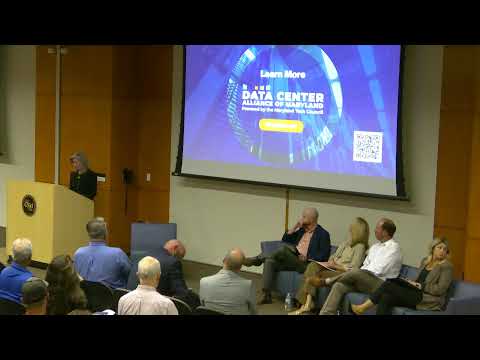
Calvert County officials and outside experts held an informational “Data Centers 101” session at the College of Southern Maryland to explain what data centers are, how they operate and how the county would review any future proposals. County Administrator Linda Turner opened the session by saying, “This is an informational session, not a public hearing,” and confirmed, “At this point in time, there are no data center applications submitted or under review by the county.”
The meeting was intended to educate residents and describe local and state processes that would apply if a project were proposed. Kelly Schultz, CEO of the Maryland Tech Council, told attendees that data centers support growing demands for cloud services and analytics and said, “Data centers drive economic growth.” Schultz used projects in Frederick County as examples for potential economic and tax impacts and workforce connections.
Jason Brinkley, Calvert County director of planning and zoning, described a new zoning ordinance the county adopted in March that defines where and under what conditions data centers may be sited. He said heavy industrial areas (shown on the county map provided to attendees) would allow data centers subject to conditions; light-industrial areas would permit them only through a special-exception process requiring Board of Appeals approval. The ordinance requires at least a 400-foot setback from an existing residential structure (200 feet from a property line) and mandates a developer-hosted public meeting in the applicable election district before the project proceeds to the planning commission.
Officials emphasized process steps and environmental and technical reviews. Brinkley outlined a three-stage review (concept, detailed site plan and final) and said the county moved more review to the detailed stage so planning commissioners and the public would see projects with more specific information. He listed agencies that commonly review large sites — county departments, Maryland Department of the Environment and the Soil Conservation District — and said state or federal reviews could be triggered depending on the site’s environmental impacts.
Speakers addressed common local concerns. On water and cooling, Dusty Rood, co-chair of the Maryland Tech Council’s Data Center Alliance, and Schultz explained that many modern projects rely on treated wastewater (gray water) or air-cooling alternatives; Rood said the industry is “looking at other sources to cool the servers” and that many operators increasingly prefer recycled water to reduce demand on groundwater. On energy, Schultz noted that Maryland “purchases energy, over 40% of the energy that we use, from outside of the state,” and that state law now requires developers to pay for any electrical-grid upgrades needed to serve large new loads.
Noise, light and visual impacts were also discussed. Rood and other panelists said commercial-scale sites can produce noise from HVAC and backup generators, and they described common mitigation measures — siting noisy equipment between buildings, requiring sound studies, establishing landscaped buffers and enforcing local noise ordinances. On lighting, Planning Director Brinkley said the county’s lighting standards require exterior lighting to limit off-site glare and reduce light pollution.
Public-safety and security questions drew a description of typical measures: gated single-access points, guarded entrances, layered perimeter fencing and restricted internal circulation. J.R. Cosgrove, director of public works, answered traffic questions, saying past major construction projects produced temporary impacts and that the county’s infrastructure “can handle the temporary impact doing a construction purpose,” while permanent roadway impacts would be evaluated in site-specific traffic studies.
Panelists also described potential economic and workforce effects using Frederick County as an example: Schultz cited a large Frederick campus she said could generate substantial recordation taxes and estimated annual property tax revenue (she described $40 million annually in her example) and said construction and apprenticeship programs have produced hundreds of local electrical and trades jobs. Julie Oberg, Calvert County director of economic development, said the county has existing education and workforce partnerships (Calvert County Public Schools, College of Southern Maryland, University of Maryland Southern Maryland and the Tri-County Council) and would pursue training if a project advanced.
County Attorney John Norris described a separate board direction to pursue additional tools from the Maryland General Assembly to make incentive agreements available. Norris said the Board of County Commissioners “asked that we ask the Maryland General Assembly for a tool to put in our toolbox” (he referred to a board action on 10/22/2024) that would allow the county to offer payment-in-lieu-of-taxes arrangements for transformational projects if the commissioners choose to pursue and present those deals to the public.
Turner closed by reiterating that no permit applications exist and that the county will host more outreach. She asked attendees to complete a survey and posted answers and updates to choosecalvert.com/datacenters. The county said it will respond to unanswered questions within 7–10 business days and continue quarterly informational sessions.
Questions remained on specifics that can only be resolved if a developer files an application: precise site layouts, final engineering for water reuse, any new on-site substations or transmission work, exact construction timelines and the ultimate mix of tenants and operations. Officials repeatedly emphasized community review opportunities guaranteed by the county’s procedural requirements and by state utility and environmental review processes.