Get Full Government Meeting Transcripts, Videos, & Alerts Forever!
Get email alerts on the Surveillance topic
No spam. Unsubscribe anytime.
Council probes NYPD access to NYCHA cameras tied to Big Apple Connect
Summary
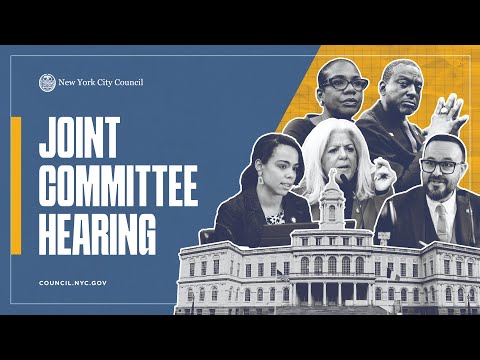
Council members pressed city agencies at a joint oversight hearing over the use of surveillance in New York City Housing Authority developments and the role of the mayor's Big Apple Connect broadband program in expanding NYPD access to building cameras.
Council members pressed city agencies at a joint oversight hearing over the use of surveillance in New York City Housing Authority developments and the role of the mayor's Big Apple Connect broadband program in expanding NYPD access to building cameras.
Council Member Jennifer Gutierrez, chair of the Council's Committee on Technology, opened the hearing by calling for transparency and resident input on the trade-off between affordable Internet access and privacy. "It's like handling out free umbrellas in a storm but never fixing the roof," Gutierrez said, arguing that the administration's outreach around Big Apple Connect failed to disclose the surveillance implications for many NYCHA residents.
The hearing brought together officials from the city's Office of Technology and Innovation, the New York Police Department and NYCHA to explain how existing NYCHA cameras are being connected to the NYPD's Domain Awareness System (DAS) and how that access is governed. Brett Saikoff, executive director for franchise administration and broadband at OTI, described Big Apple Connect as a large, city-subsidized broadband program and defended the program's extension through June 2028, saying it has connected hundreds of thousands of residents to low-cost service. "Big Apple Connect is the nation's largest municipally subsidized broadband program," Saikoff said.
Inspector Anthony Masia of the NYPD's Information Technology Bureau told the committees that live access to cameras helps detectives respond more quickly to crimes: "When crimes are captured on video, NYPD detectives can use that video to identify and apprehend the perpetrators." He said the NYPD has had direct fiber access to some NYCHA cameras for years and that the Big Apple Connect connection is providing the department a lower-cost way to obtain remote access to additional preexisting NYCHA cameras.
What the agencies said - Scope and numbers: NYCHA officials and NYPD witnesses confirmed there are about 20,000 cameras across the NYCHA portfolio. The NYPD said it already has live access to cameras at 37 fiber-connected sites (about 7,118 cameras) and that one Big Apple Connect site is currently live with 68 cameras. The department said a plan would bring about 1,905 additional cameras online across 19 more sites by November 2025 and that planning envisions a larger buildout to roughly 119 sites and about 17,897 cameras in total.
- How access works: NYPD witnesses said the Big Apple Connect method uses modems and routers in common areas to enable remote login to NYCHA's existing camera recorders. For the Big Apple-connected sites, video is stored locally on NYCHA hard drives; NYPD personnel log in to view or pull video via the department's DAS. NYPD and NYCHA officials said cameras are sited in public common areas (lobbies, building exteriors, elevators and some laundry or mailbox areas) and not inside private living units.
- Retention and auditing: Agencies testified that retention on the local NYCHA camera systems generally ranges from 14 to 21 days before recordings are overwritten. NYPD described DAS as permission- and role-based and said access is auditable: "If you ran an officer by tax number, you'd see everything that they accessed," the department said. NYPD witnesses also said the department does not run real-time biometric facial recognition across these feeds.
Council concerns Council members across the four committees repeatedly raised three themes: (1) lack of disclosure to NYCHA residents and tenant leaders about the linkage between Big Apple Connect and NYPD access to cameras; (2) inconsistent public statements by agencies and long delays in releasing the Big Apple Connect contract (the contract was produced after FOIL litigation and an Article 78 filing, members said); and (3) whether technical and policy safeguards are sufficient to prevent misuse, including unauthorized viewing or sharing with outside agencies.
Council Member Chris Banks, chair of the Council's Committee on Public Housing, said many residents feel they were promised broadband but not informed that the same infrastructure could enable greater police access. "Our public housing residents should not be forced into a trade off between violation of privacy and expectation of safety," Banks said.
What the hearing did not resolve Committee members asked the agencies for multiple follow-ups that officials either could not provide on the record or said they would deliver later in writing. Among the unresolved items the committees requested are:
- A site-by-site list of the 20 developments currently planned for integration and the criteria used to prioritize them. - Copies of the contract language and any franchise/provider privacy or cybersecurity provisions that govern how providers handle resident data and browsing information. - Vendor and camera model details and whether any cameras are manufactured outside the United States. - The detailed audit logs showing who has accessed camera footage and how often; written policies on when DAS searches are permitted; and whether non-NYPD agencies have ever received camera footage (responses so far say access to others would be handled through the NYPD legal bureau when required by law).
Public testimony and civil-rights concerns Dozens of public witnesses, civil-rights groups and legal advocates urged the Council to halt or limit the expansion of live NYPD access to NYCHA cameras. Witnesses from the Legal Defense Fund, Legal Aid Society, Surveillance Technology Oversight Project (STOP), Brooklyn Defender Services and other organizations argued that the expansion maps onto historic patterns of discriminatory policing and that linking NYCHA cameras to DAS enables suspicionless, neighborhood-wide surveillance that disproportionately affects Black and Latino residents.
Legal advocates highlighted the NYPD's gang database and social-media monitoring as compounding risks, recounted cases in which youth were repeatedly tracked on camera, and urged the Council to require stronger transparency, an impact assessment, independent audits, and restrictions on the use of DAS for noncriminal or First Amendment-protected activity.
Next steps requested by Council Committee chairs used the hearing to press the agencies for written follow-ups and documentation. Counsel asked for the Big Apple Connect contract and change orders, camera inventories and the precise list of sites targeted for integration. Members also asked the NYPD and NYCHA to provide cybersecurity and retention details, to confirm whether non-NYPD personnel have any access, and to clarify how residents will be notified going forward.
No formal vote or legislative action was taken at the hearing. Committee chairs said they would continue oversight work and seek additional written responses, and multiple council members expressed interest in policy or legislative remedies pending the agencies' responses.
Ending The hearing underscored a split in priorities: advocates and many council members pressed for stronger privacy protections, notice to residents and independent oversight; NYPD and OTI officials emphasized crime-fighting benefits and cost efficiencies from leveraging the Big Apple Connect contract. The committees left the hearing with a list of required follow-ups and several outstanding questions the agencies must answer in writing before the Council decides whether legislative steps are warranted.