Get Full Government Meeting Transcripts, Videos, & Alerts Forever!
Get email alerts on the Special Session topic
No spam. Unsubscribe anytime.
House Republicans say they will attend governor's special session but insist bills go through committee process
Summary
House Republican leaders said they will attend any governor-called special session after the shooting at Annunciation School and Church but objected to proposals that would fast-track bills without committee hearings, and reiterated that firearm restrictions lack bipartisan support in their caucus.
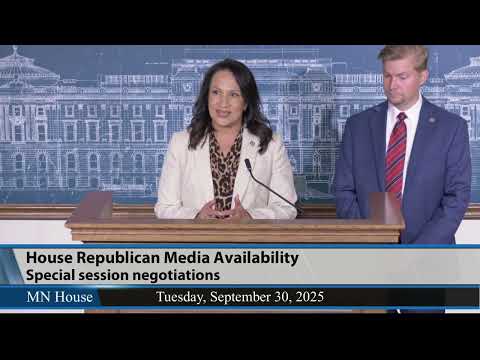
House Republican leaders said Friday they will attend any special session called by the governor in response to the shooting at Annunciation School and Church, but they urged that any bills be introduced and vetted through the regular committee process rather than fast-tracked.
A House Republican leader said the governor is "the only person in the state that can call a special session" and that "bills will be introduced. Determinations would be made" through the committee and floor process. The leader added, "House Republicans will be there. We will not deny quorum in the house."
Leader Harry Niska said the governor's push for a special session has been "a partisan political stunt from the beginning," arguing that the governor was seeking to fast-track legislation without releasing bill language or allowing committee hearings. "That's never been the way we govern in Minnesota," Niska said, calling for a bipartisan process to address school safety, public safety and mental health.
Both leaders said they support addressing school and community safety and mental-health supports but said they had not been given specific bill text by the governor's office. "We didn't have anything specific as far as any bill language or any specifics on that," the House Republican leader said, adding that the topics discussed "include school and community safety, mental health supports, public safety," and that public safety "also includes guns, firearms, and any type of law that goes around that."
When asked whether any Republican in the House would back bans on assault-style weapons or high-capacity magazines, the House Republican leader said, "I don't think that there are any Republican house votes, in favor of, of those kind of proposals," and that such measures lacked majority support in either chamber as currently constituted. Niska said some bills introduced previously "didn't even bother having committee hearings," and criticized proposals that would bypass the committee process.
The leaders also noted unfinished legislative work that could be taken up if requested, pointing to an "OIG bill" that "did not get over the finish line in the house" earlier in the year and saying a special session could provide an opportunity to finish such items. They repeatedly emphasized that the governor alone controls whether a special session is called and that House Republicans will attend and participate if he does so.
The statements came during a brief press briefing after meetings between the governor and legislative leaders. Reporters asked about a proposal reportedly circulated from a closed-door meeting of the four leaders and the governor; the House Republican leader declined to describe specific provisions from that internal outline and suggested questions about the proposal should be directed to those who produced it.
The leaders said talks among the four leaders and the governor had continued in recent weeks and that they expected discussions to continue either before any special session or when the Legislature reconvenes for regular session on Feb. 17. "We will lead with integrity, and we look forward to doing the work for the people of Minnesota," the House Republican leader said.
No formal motions or votes were recorded in the briefing. Reporters asked about whether the House would deny quorum; the leaders said they would not. The leaders repeatedly distinguished between discussion, direction and formal legislative action, saying only the Legislature can pass bills and the governor can sign or veto them.
Looking ahead, the leaders said implementation of any measures would depend on whether the governor calls a special session and on the content of any bills introduced; specifics on proposed language, funding or timelines were not provided in the briefing.