Get Full Government Meeting Transcripts, Videos, & Alerts Forever!
Get email alerts on the Impact Fees And Development topic
No spam. Unsubscribe anytime.
Commissioners review draft transportation impact fee; developers urge lower rates or incentives
Summary
County staff and consultant Kimley‑Horn presented a revised transportation impact‑fee draft; developers warned the proposed commercial fees could make projects infeasible and urged incentives or phased implementation.
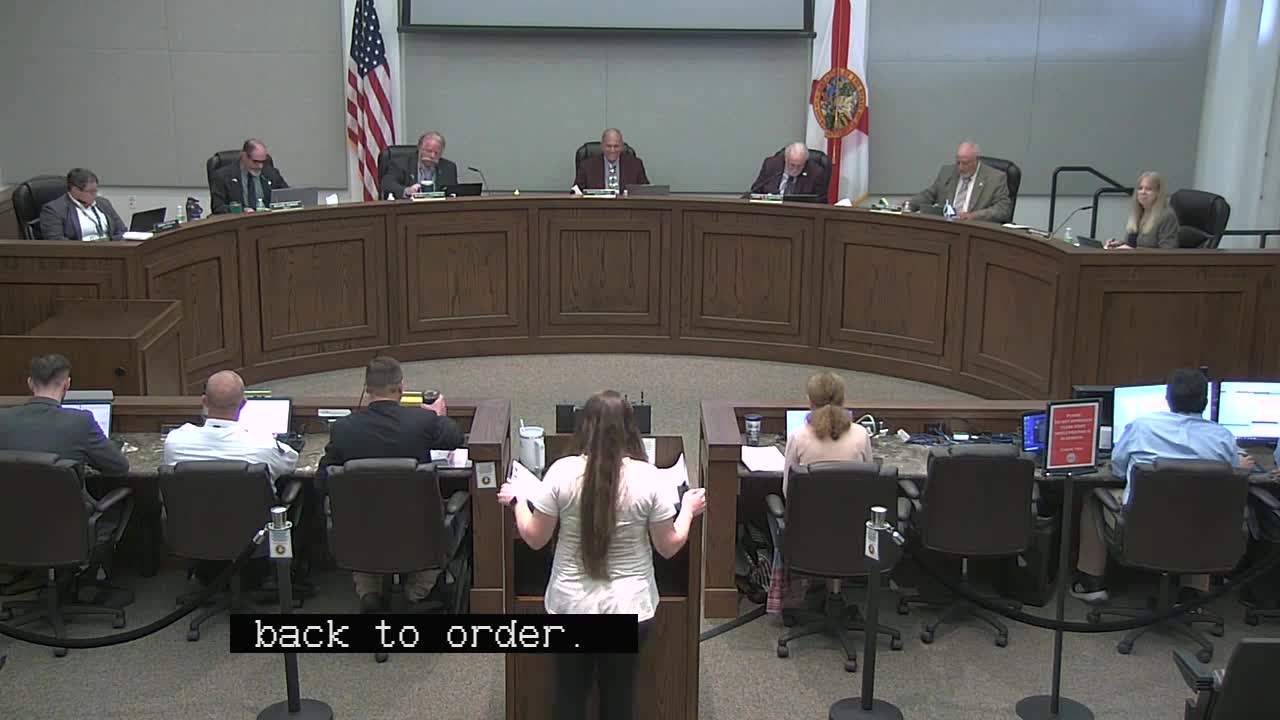
The Okeechobee County Board of County Commissioners spent substantial time reviewing a revised draft transportation impact fee prepared by Kimley‑Horn and presented by county staff. The consultant and staff provided two cost scenarios based on differing interest/discount rates for the gas‑tax credit (4.7% and 2.75%). Staff asked the board for policy direction on unit choices for selected land uses, the interest rate used for crediting, and whether certain land uses should remain in the fee schedule.
Jessica (county staff) described edits made from a prior draft: removal of land uses not in the county’s land‑development code, consolidation of single‑family house size categories to match the code minimum (1,000 sq. ft.), and a revised methodology that reduced fees by isolating local trips and refining external travel demand assumptions. She said the difference in the chosen interest rate for the gas‑tax credit notably affects commercial fees; the draft provided both a 4.7% scenario (reflecting a recent county bond) and a 2.75% scenario (used by some neighboring counties), producing materially different fee totals.
Developers and site investors urged caution about setting high commercial fees. Greg Lyon, a local developer, told commissioners he and other investors are moving into the I‑27/US‑27 corridor because of affordability but that heavy fees could make projects infeasible. Lyon said a convenience store with pumps and several fueling positions could face tens of thousands of dollars in transportation fees under several options and asked the county to "incentivize development and not discourage it." He asked for a phased approach or credits that would allow projects to proceed. A second commercial real‑estate speaker, Jared with ECP Partners, offered the practical developer perspective that large impact fees make it hard to underwrite deals and asked the county to consider simple, transparent incentives or phased implementation.
Commissioners and staff discussed policy options raised by the consultants: (a) keep the 2.75% or 4.7% credit‑rate option (or pick an alternate rate), (b) choose measurement units for specific land uses (for example, convenience stores: fueling positions vs. thousand‑sq‑ft; movie theaters: seats vs. sq. ft.; hospitals: beds vs. sq. ft.), (c) add or remove land uses from the schedule (staff suggested removing uses that are not in the local code), and (d) consider an economic‑development credit program to reduce fees for projects tied to local priorities (jobs, capital investment) or allow developer‑constructed traffic improvements to be credited against impact fees.
Board members asked staff to refine comparisons to nearby counties and to examine a per‑capita comparison for a practical market reference. Commissioners expressed particular interest in being competitive with neighboring jurisdictions (Indian River, Martin, St. Lucie, Highlands) and in protecting smaller developers from sudden fee increases; some commissioners said they prefer starting with the lower interest/credit rate (2.75%) or a phased schedule to avoid disrupting projects already underway. Several commissioners requested that staff and the consultant: (1) confirm unit choices for convenience stores, car washes and hospitals (the board indicated a staff preference for fueling positions for convenience stores and thousand‑sq‑ft units for car washes), (2) return with comparative per‑capita calculations and an explanation of why commercial fees are higher relative to residential fees in the draft, and (3) outline implementation timing and vesting rules (site plan vs. building permit) so developers can assess risk.
Following public testimony, the board did not vote to adopt rates and instead directed staff and Kimley‑Horn to revise the draft using the board’s feedback and to return with a proposed ordinance at a later meeting. Staff said the consultant will be asked to clarify trip lengths, external‑zone assumptions, and credit calculations that drive the high commercial numbers in the draft.
Why it matters: transportation impact fees can materially affect the feasibility of commercial projects and the cost of development. Commissioners must balance the need to fund transportation improvements with incentives that sustain private investment and jobs.
What to watch next: staff will return with a revised draft and further analysis of units, alternative interest rates for the gas‑tax credit, and implementation options (including phased introduction and developer crediting) for the board to consider before any formal adoption process begins.