Get Full Government Meeting Transcripts, Videos, & Alerts Forever!
Get email alerts on the School Safety topic
No spam. Unsubscribe anytime.
Seattle board hears heated public comment on SPD memorandum of understanding; staff propose one‑school pilot at Garfield
Summary
The Seattle School Board heard extensive public testimony and staff briefings about a proposed memorandum of understanding with the Seattle Police Department that could place a sworn School Engagement Officer at Garfield High School, but took no formal vote.
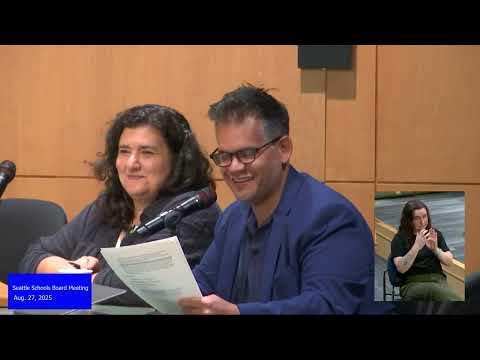
The Seattle School Board heard extended public testimony at its August meeting about a proposed memorandum of understanding (MOU) between Seattle Public Schools and the Seattle Police Department that would authorize a School Engagement Officer (SEO, similar to an SRO) at Garfield High School.
More than a dozen public speakers — students, parents, community organizers and service providers — urged different outcomes. Several speakers, including student leaders from Garfield and groups such as the Seattle Alliance Against Racist and Political Repression, opposed any return of sworn police to campus and urged investment in counselors and violence‑prevention services instead. Other speakers, including Garfield alumni and community members, said they support a limited officer presence if the community selects the officer and if strict training, role clarity and accountability are established.
Why it matters: The discussion touches on safety, race and trust in public institutions. Board policy and a prior board resolution (commonly referenced as a moratorium) have limited agreements with SPD; staff told the board any pilot that would restore a sworn officer to a school will require an amendment to that policy framework or a board vote because the moratorium currently prevents SRO/SEO agreements.
What public testimony said - Opponents: Dre Se (Seattle Alliance Against Racist and Political Repression) said, “This MOU suggests SPS should invite cops into classrooms ... SPS staff should be educating our youth and not cops,” and Sonia Herrera Perez said she did not trust SPD to protect BIPOC students at Garfield, citing concerns about bias and accountability. - Students: Garfield graduates and current students urged immediate action on safety measures. Ryland (Rylan) Springer, a recent Garfield graduate, described repeated losses to gun violence and told the board: “We need intervention specialists and counselors. My school cannot keep relying on the few counselors who care. We need more and we deserve better.” Athena McDermott, another Garfield graduate, said prior engagement officers had been from the surrounding community and that students wanted concrete steps before school opens. - Supporters of a local agreement said a carefully negotiated MOU, a jointly selected officer, and strong training could help. Marie Hunt, commander for the Seattle recruiting company (Army), urged clarity about recruiter access and policy adherence; others asked for transparency and measurable safeguards.
Staff presentation and board discussion District staff described a process of community engagement at Garfield, a draft MOU under negotiation with SPD, and operational investments the district is implementing across schools: visitor management kiosks, upgraded camera and access-control systems (Verkada), a new incident-management tip line (SaferWatch, with a 206-202 tip line), expanded safety and security staffing, and private‑security perimeter patrols at peak times. Staff said the district is also exploring weapon‑detection kiosks and better emergency notification tools; all of those operational investments are separate from a decision about an SEO.
Accountability, training and pilot design Accountability and training were the most frequently raised requirements. Staff described training provided through Puget Sound Educational Service District (for SEOs and SROs), restorative‑practice and de‑escalation training and state law requirements on agreements. The district proposed that any SEO agreement be limited to one school at a time, be revisited annually, and require building‑level engagement with students, staff and families to determine whether the community wants the officer and to set selection and accountability terms.
Legal/policy constraints Board staff and counsel explained the practical constraint: a board moratorium and language in policy 43.11 currently preclude entering into SRO/SEO agreements without board action. Staff said that to run a pilot they would either ask the board to amend the moratorium/policy for one school or seek explicit board authorization for the Garfield pilot. Staff also said they would bring a near‑final draft of the MOU to the board after continued negotiations with SPD and after follow‑up community sessions.
Data, metrics and monitoring Directors and staff discussed how to measure pilot outcomes. Staff said existing incident data are inconsistently recorded and that a new incident‑management system is being rolled out; staff cautioned that establishing a reliable baseline will require standardized reporting and training. Staff said they plan to use climate surveys, focus groups and event data (for example, incidents requiring 911) to evaluate a pilot, but they emphasized the difficulty of isolating the impact of any single intervention when multiple safety investments roll out at a school in the same year.
Decision status and next steps No formal board vote on the MOU or on policy changes occurred at the meeting. Staff said they would hold a follow‑up virtual meeting with the Garfield community on Sept. 9 and that the board could take up a vote on a final MOU or policy amendment at a later meeting (staff mentioned a possible discussion or vote around Sept. 17). Staff emphasized the pilot approach: a one‑year, school‑level agreement requiring community engagement, joint selection of the officer, training, and annual review.
Ending: Board members said they will continue engagement with the Garfield community and the district’s safety team before any formal authorization. The conversation illustrated sharp divisions among students, families and community groups about whether a sworn officer’s presence in campus buildings improves safety or increases harm.