Get Full Government Meeting Transcripts, Videos, & Alerts Forever!
Get email alerts on the Budget topic
No spam. Unsubscribe anytime.
Oshkosh Area School District adopts 2025-26 budget, approves short-term line of credit
Summary
The Oshkosh Area School District board approved the district's 2025-26 budget and renewed a short-term borrowing line of credit on Aug. 27, citing the need to maintain cash flow until state aid and property tax collections are certified in October.
The Oshkosh Area School District Board of Education voted Aug. 27 to adopt the district's fiscal year 2025-26 budget and to renew a short-term line of credit to cover cash-flow needs until state revenue figures are certified.
The adopted spending plan projects a total tax levy of just over $68 million, including about $44 million in local revenue-limit levy, $21.5 million for referendum-approved debt (Fund 39) and roughly $2.7 million for community service. District finance staff told the board the district currently expects roughly $84 million in state aid and about $44 million in local levy based on the revenue-limit calculation; those figures will be certified by the state on Oct. 15 and could change.
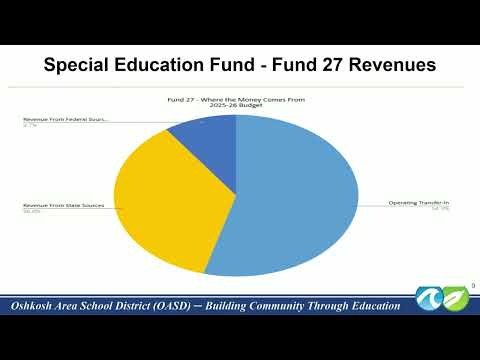
Board members heard a detailed presentation from Drew Neehan, district finance staff, who told the board that the district must approve a budget now in order to short-term borrow for operating cash. "We need to approve it tonight to short term borrow," Neehan said. He explained the budget uses a three-year rolling average for resident membership (9,230 FTE in the presentation) and noted special-education reimbursement increases from roughly 30% to 42% that reduced transfer needs from the general fund.
Why it matters: board members and staff said the timing reflects cash-flow constraints rather than final state numbers. The district will not receive certified enrollment and state-aid figures until mid-October; administrators said approving a budget now allows the district to access short-term borrowing while preserving the option to amend the budget after certification.
Board discussion centered on financial risk to taxpayers and the district's limited flexibility. Board member Kelly criticized the budget's timing and its impact on taxpayers, saying, "Many in our community are hurting financially ... I cannot go down this budget." Board member Michael Ford and others argued the budget is a "bridge budget" needed to maintain operations, replenish fund balance and preserve services while the district works on longer-term efficiencies.
Board members asked several clarifying questions during and after the presentation: when state aid will be certified (Oct. 15), the expected mill rate calculation in staff's estimate (about $7.86 per $1,000 of equalized value in the presentation), and the components of the levy and where district costs are concentrated. Neehan outlined that salaries and benefits represent roughly 63% of the general fund line items on the public slide, but when transfers to special education (where 90% of costs are personnel) are included, the district's combined personnel share is nearer to commonly cited 80% of operations.
On procedural matters, the board and district leaders repeatedly emphasized the ability to amend an adopted budget after state certification. Dr. Davis, the superintendent, and staff noted that policy allows amendments and that an amended budget will be prepared if actual state aid or property-tax collections differ materially from current estimates.
Votes at a glance - Consent/resolution agenda: approved by roll call (motion and second on the consent agenda were recorded; roll call indicated approval). (Transcript roll call recorded at the meeting.) - Approval of the 2025-26 budget: motion to approve moved by Herzog and seconded by Kelly; the motion passed by roll call. (Transcript records extensive discussion and a roll-call vote; specific vote counts were not recorded verbatim in the transcript excerpts.) - Renewal/approval of short-term borrowing (line of credit): motion to approve moved by Herzog; the motion passed by roll call. (Transcript indicates discussion and approval; detailed tally not specified in the available transcript excerpt.)
What the budget includes and key details - Total projected levy: just over $68 million (presenter's estimate). This combines local revenue-limit levy (~$44 million), referendum debt levy ($21.5 million for Fund 39), and community service levy (~$2.7 million). - State aid estimate: staff estimated roughly $84 million pending Oct. 15 certification. - Mill rate example in presentation: about $7.86 (staff estimate based on equalized value figures shown in the slide deck). Staff cautioned values could change after state certification and property assessments. - Special education: a sizable transfer from the general fund to fund 27 was noted in previous years (about $20 million), expected to decline to nearer $17 million as state special-education reimbursement increased. - Community service fund: staff said about $3.4 million in spending, with roughly $2.5 million directed to community programming such as after-school and recreation programs.
Board direction and next steps - Staff will return after the state certifies enrollment and aid on Oct. 15 with updated numbers; the board may amend the budget if necessary. - Staff recommended and the board approved renewing a line of credit (short-term borrowing) to maintain payroll and operations through the revenue gap between late summer tax collections and fall certification.
Ending: The board approved the budget and the short-term borrowing authorization on Aug. 27, 2025, while multiple board members urged continued work on structural changes, cost controls and transparency to limit future tax impacts. Staff and the board said they will present updated, certified figures after Oct. 15 and prepare any necessary amended budget for audit reconciliation.