Get Full Government Meeting Transcripts, Videos, & Alerts Forever!
Get email alerts on the Comprehensive Plan topic
No spam. Unsubscribe anytime.
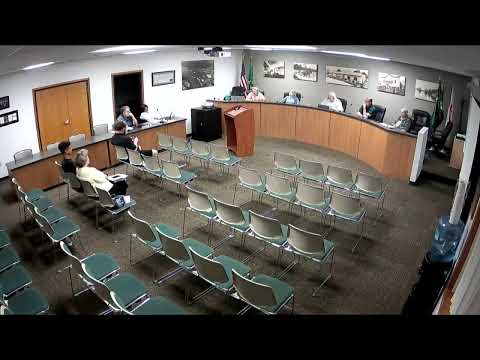
Woodland planning commission forwards 2025 comprehensive plan to council after staff clarifications on jobs, housing and flood language
Summary
The Woodland Planning Commission voted to send the draft 2025 comprehensive plan to City Council with staff-recommended edits after a public hearing that highlighted industrial job projections, permanent supportive housing figures and suggested edits to flood-history language and the pipeline project table.
The Woodland Planning Commission on Wednesday voted to forward the draft 2025 comprehensive plan to City Council with amendments after a staff presentation that corrected data and answered commission questions about industrial projections, supportive housing counts and flood history.
Travis Goddard, Woodland community development director, told commissioners the staff report corrects several items raised at a prior hearing and that a Port of Woodland–commissioned study estimates the city’s 426-acre industrial area could support about 5,000 permanent jobs and roughly 10,000 construction jobs over 20 years. Goddard said the industrial job capacity figure had been cited from the wrong table in an earlier staff draft and was clarified in the current packet.
The commission’s action follows public hearing procedures and a staff presentation; commissioners asked for several clarifications before deciding the draft was ready to go to the council. Commissioner Georgoff, Commissioner Matson, Commissioner Simpson, Commissioner Watt and Commissioner Rob recorded “yes” votes during the roll call to forward the plan as amended.
Goddard also described the city’s multifamily housing inventory and permanent supportive housing stock under Washington state law (RCW). He said the staff review identified 437 multifamily units in buildings of five units or more; of those, 144 units (about 33 percent) are market-rate and 293 units (about 67 percent) are owned by the Longview Housing Authority or Catholic Charities, which the staff classified as meeting the permanent supportive housing criteria cited in the RCW. Goddard summarized: “In a sense, what we have is almost 14% of our entire housing stock…that would meet that criteria simply because it is, low barrier and supportive housing.”
Commissioners raised concerns that the concentration of subsidized units in Woodland could make it appear the city is carrying a disproportionate share of countywide affordable housing; Goddard said the figures partly reflect the small local housing stock and the ability of nonprofit housing providers to buy or build larger projects in town. He noted the Growth Management Act and state social equity standards would be points of argument if the city needed to show an unfair burden in future annexation or funding discussions.
Commissioners also discussed projects in the development pipeline listed in the staff packet and on the city website. Goddard reviewed several active or approved projects: an 85-lot single-family phase of the Lewis River subdivision (previously an apartment plan), the Fifth Street (Swar) apartments (23 units across a nine- and 14‑plex), Alder and Ash (planned three-phase, 150 single-family lots), Riverwalk (48 lots plus 17 recent approvals), a 30-unit project addressed as 1776 North Gorrig (access off Scott Street), a three‑lot short plat at 1039 Park designed for accessory dwelling units (up to 11 units total), 720 Sandalwood (39 units) and Logan’s Landing, a mixed-use site that has site-plan approval for up to 272 residential units if a developer chooses to build structured parking. Goddard noted that Logan’s Landing “is included in the multifamily numbers” but that the site is for sale and the approved project has not moved forward; he recommended a clarifying note or asterisk in the pipeline table beside that project to indicate permits have not been applied for.
Commissioners asked about vesting and expiration for large site approvals. Goddard said typical timelines require building permits within three years and construction to start within four, and that vesting can leave an approved site plan viable under older regulations for a time. He advised the commission to mark pipeline entries where permits or activity are lacking to avoid overstating available capacity when the county and Department of Commerce review urban growth and housing capacity.
The commission also reviewed the plan’s flood-history language. Commissioners asked whether the draft overstated past flooding or might encourage expanded flood-insurance requirements. Goddard recommended removing a judgmental phrase (“not a major flood”) and instead sharpening the language to say flooding occurred and that residential development since the 1990s increased exposure in the East Woodland floodplain; he offered an alternate sentence that would remove the subjective assessment. Commissioners agreed staff should make those edits.
After discussion, a motion to forward the draft comprehensive plan to City Council “as amended” passed on roll call. The commission asked staff to prepare a redline of the agreed edits — including the industrial job-table correction, the asterisk or note for Logan’s Landing, the revised flood-history sentence and the minor grammar fixes — to accompany the plan to council.
Goddard closed the staff portion noting the packet contains a longer list of grammar and minor edits that staff will incorporate and that the ordinance to transmit the plan to council includes a clerical authorization allowing the city clerk to make grammar or punctuation fixes prior to publication.
The commission’s recommendation now moves to City Council review; the council must decide whether to adopt, revise or return the plan for additional work.
Speakers included: Travis Goddard, community development director; Commissioner Whitney (first name recorded in the transcript as Whitney); Commissioner Matson; Commissioner Simpson; Commissioner Georgoff; Commissioner Rob; Commissioner Watt; Commissioner Dave (first name recorded informally as Dave); Sharon (commissioner); Brian (commissioner).