Get Full Government Meeting Transcripts, Videos, & Alerts Forever!
Get email alerts on the School Budget topic
No spam. Unsubscribe anytime.
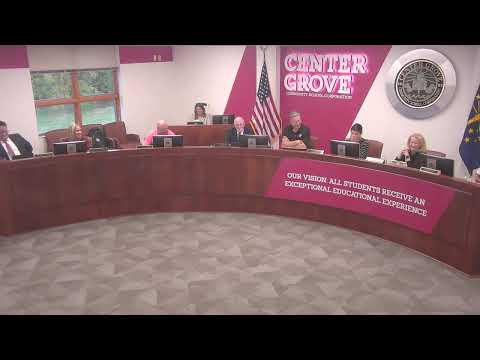
Center Grove board holds public hearing on 2026 budget, projects balanced budget amid statewide tax changes
Summary
Center Grove school officials presented a proposed 2026 budget, bus‑replacement plan and capital projects plan and warned that state changes in Senate Bill 1 will reduce future revenue; board opened the public hearing and scheduled final approval for Oct. 20.
The Center Grove Community School Corporation opened a public hearing on its proposed 2026 budget, bus‑replacement plan and capital projects plan on the evening the board met, with Chief Financial presentations noting the budget is currently balanced but faces significant revenue pressure from recent state legislation.
At the hearing Dr. Taylor summarized key impacts from Senate Bill 1 and the state biennial budget (House Bill 1001), saying the packages are intended to lower residential tax bills but will shift revenue pressure to taxing units, including school districts. He told the board the district expects roughly 1.8% revenue growth for 2026 (1.6% in 2027) when enrollment growth is included and about 1.3% in both years if growth is excluded.
The administration said new statewide elements will reduce some categorical grants the district historically received, notably academic performance and certain special grants, and will add a post‑tax‑cap credit (the lower of 10% of a taxpayer's bill or $300) that will significantly reduce collections to the debt service fund. Dr. Taylor said that credit could reduce debt service receipts by “2 plus million” dollars, creating a new cash‑balance pressure the corporation will need to manage.
Why it matters: board members and administrators said the changes are not unique to Center Grove and will require taxing units across Johnson County to rethink rate and fund allocations to maintain services. Dr. Taylor and other staff outlined how the district proposes to absorb the loss by a combination of expense reductions, reallocations and a modest advertised tax increase.
Major details and proposed adjustments
- Tax and levy: The administration recommended advertising a levy increase that amounts to approximately a 4¢ increase (reported as about 3.856¢ in discussion) to help offset losses from the new state credits and levy caps. The administration noted the operations fund increase is constrained by the state maximum levy growth quotient (estimated at 4% for the year), and stressed that shifting some costs into debt service is a tool they plan to use because of statutory limits on operations funding.
- Grant changes: Dr. Taylor said changes to the state budget reduced funding for career and technical education (CTE), special education and the academic performance grant, with the academic performance line seeing the largest relative drop for Center Grove. He also said the teacher appreciation granthas been restructured and will now reach a much smaller subset of teachers.
- Curriculum materials: The state moved curriculum‑materials funding into basic tuition support and will distribute it monthly. For Center Grove this represents about $1.5 million in revenue that the district expects will largely be expended for the same purposes the money previously covered.
- Bus replacement and capital plan: The board heard the required bus replacement plan, which proposes replacing eight buses annually (seven standard buses and one activity bus) in most years but temporarily stepping down to replace seven buses in 2029 to accommodate projected funding impacts. The capital plan continues the district's use of lease revenue bonds (G.O. bonds / debt service) and geo‑bonding approaches to fund equipment and larger projects (about $8.1 million in planned bond‑funded items were cited for the 2026 plan).
- Expense reductions and savings: Dr. Taylor said administrative and secretarial reductions since 2023 total roughly $351,000 and cited savings from energy projects — solar and geothermal — and lower fuel costs as producing about $500,000 in utility/fuel savings. He said the district built a budget that would permit a 3.3% teacher compensation increase and a 2% increase for other employee groups, subject to collective bargaining.
Board process and next steps
Board members had questions but no public comments were offered during the hearing, and the public hearing was formally closed. Dr. Taylor said the board will consider final approval of the budget, bus replacement plan and capital projects plan at the Oct. 20 meeting, after which the county will certify tax rates. He also noted the district posts all budget documents on its website and encouraged public review.
Ending: Administrators emphasized the district faces a multi‑year adjustment period as Senate Bill 1 phases in through 2031 and beyond, and said the district aims to spread revenue losses across several years while protecting classroom services and staffing.