Get Full Government Meeting Transcripts, Videos, & Alerts Forever!
Get email alerts on the Municipal Finance topic
No spam. Unsubscribe anytime.
New Haven finance office projects modest surplus; flags debt-service and utility risks
Summary
Finance staff told the Aldermanic Finance Committee that property-tax receipts are strong and an extra $3 million in state aid raised projected revenues, leaving a projected $1.7 million surplus for the fiscal year; staff warned of debt-service and utility cost pressures and described steps to lock energy pricing and audit bills.
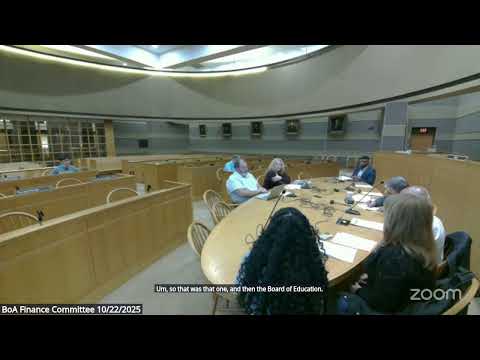
Shannon McHugh, a finance department presenter, told the New Haven Aldermanic Finance Committee that the city currently projects the fiscal year will end with a modest surplus after early revenues and recent financing moves.
"All in all, we believe based on what we're seeing right now that the year will end in a surplus and we're currently projecting $1,700,000 in surplus," McHugh said during the committee's review of the August 2025 monthly financial report.
McHugh said property-tax receipts are coming in "as expected" and noted an uptick in collection of delinquent taxes. The August packet includes $3,000,000 in additional state aid that the administration has not yet appropriated; McHugh said that extra state aid is reflected in the report and is one reason revenues appear above the adopted budget.
On the expenditure side, McHugh told the committee there are items to watch: financing charges are expected to produce a small overage in the debt-service line, and the administration does not expect to receive revenue tied to one specific agreement, which will reduce receipts. Taken together with the additional state aid, McHugh said revenues appear about $2,300,000 above budget before anticipated expenditure pressures.
The finance office reported a net present-value savings of about $3,600,000 from a recent bond refunding. McHugh described the refunding as a multiyear benefit: "we were able to go to market and refinance those bonds for lower interest rates. And so that lower interest rate gave us $3,600,000 in savings," she said, and added the savings were distributed across the life of the bonds to avoid concentrating budget relief in a single year.
McHugh said the medical insurance fund is tracking below last year's claims so far in fiscal 2026 and the workers' compensation fund is showing a small surplus, but the department is monitoring high-cost claims from the prior year. She said the city is working with Anthem and outside consultants to manage health-care cost growth.
Utilities were a frequent topic in questions from aldermen. McHugh described a multi-pronged effort: a usage audit to identify savings, consolidation of many city utility accounts, and short-term hedges to lock electricity prices for the winter. She said the city is "looking at doing a summer hedge as well" and is coordinating with United Illuminating (UI) and Southern Connecticut Gas to reduce costs.
Committee members asked about several other restricted or special funds. Finance staff reported the city has received roughly $765,000 from the bottle-deposit (NIPS) program since 2022 and has about $600,000 available to spend on defined recycling and related activities. Committee members also asked for a follow-up report on cannabis-related receipts and on other federal and state grant changes; McHugh said the administration will provide additional detail.
McHugh noted several federal grant reductions and uncertainties in special funds, including a recently rescinded EPA award mentioned at the meeting; she said staff track grant impacts monthly for the mayor's office and are implementing a grant-management system (OpenGov) to improve tracking and future applications.
Committee Chair Alderman Adam Marchand and members pressed staff for historic monthly patterns to compare year-to-year spending pace, particularly for the Board of Education's budget, and McHugh said the department will provide additional quarterly detail and line-item breakdowns on request.
The committee did not vote on any ordinance or appropriation during the discussion of the monthly report; the item was reviewed in workshop form and staff were asked to provide follow-up materials.
Ending: McHugh and finance staff left the committee with a short list of follow-ups: a line-item breakdown of departmental surpluses (personnel versus nonpersonnel), a written update on the status of the $3,000,000 state aid appropriation, a report on NIPS and cannabis-related receipts, and documentation of utility-audit progress and hedging plans.