Get Full Government Meeting Transcripts, Videos, & Alerts Forever!
Get email alerts on the Rail Safety topic
No spam. Unsubscribe anytime.
Caltrain outlines near-term safety upgrades at Churchill and Broadway crossings
Summary
Caltrain staff described immediate safety measures at Churchill Avenue and Broadway crossings — high-security fencing, surface markings, wider crosswalk gates, solar markers and an AI LiDAR pilot — and said the measures have reduced incidents at pilot locations.
Caltrain highlighted a package of near-term safety measures for crossings in Palo Alto, saying the work already piloted at Churchill Avenue and Broadway has reduced incidents and will be expanded as a program.
"We've incorporated a high security fencing," Caltrain government and community affairs director Navi Nalewal said at a public workshop, describing measures intended "to close a lot of the major gaps" along the corridor. Nalewal said the agency has also installed surface markings, wider crosswalks with gates and nighttime solar-powered markers.
The agency is piloting an AI LiDAR device called RealCentury that Nalewal described as "walking the crossing 24/7" to detect cars, bikes or objects on tracks and "send instant alerts to our train operators." Nalewal said triggered alerts also produce audible alarms at crossings.
Caltrain said it has coordinated with navigation apps including Waze and Google to reduce instances where routing directs vehicles toward the tracks. Nalewal told the workshop the combination of fencing, RealCentury and other changes has produced "a major reduction at the crossings" where the pilot systems are installed.
Nalewal credited collaborative work with Palo Alto staff and named staff member Ken Duper for helping the agency identify and close corridor gaps. She also said agency and city partners, plus local funding, have supported the near-term work: "We're really thankful and appreciative of ETA and their contribution in a September retro fee funds that allow us to do some of these ... enhancements at the crossings in Palo Alto." The transcript did not specify what "ETA" stands for.
Caltrain staff encouraged attendees to use boards and comment forms at the workshop and to contact staff directly with questions. Nalewal invited participants to find her at the meeting for follow-up: she said she was wearing a "light blue, sage shirt" and offered to answer additional questions.
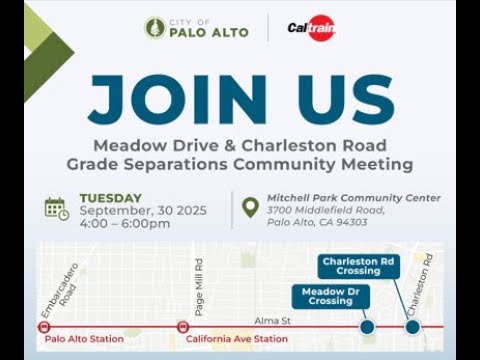
Staff said the near-term measures are separate from the larger Meadow Drive and Charleston Road grade-separation design work being discussed at the same workshop; the safety devices are already in place or piloted at Churchill and Broadway and are being refined as the Caltrain–city program proceeds.