Lifetime Citizen Portal Access — AI Briefings, Alerts & Unlimited Follows
Cochise County supervisors review draft vaccine policy; no action taken
Loading...
Summary
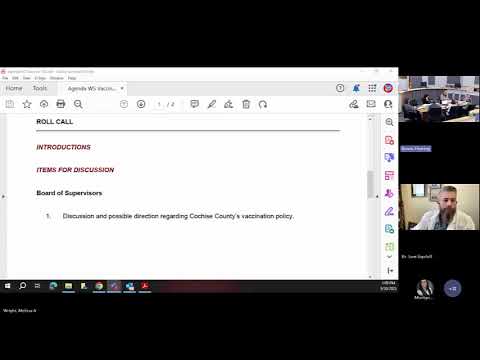
During a Sept. 30 work session the Cochise County Board of Supervisors reviewed a staff draft of a county vaccination policy, heard a remote physician express concerns about emergency-use vaccines and contact tracing, and agreed to circulate the draft for further review rather than adopt policy at the meeting.
Cochise County supervisors on Tuesday reviewed (but did not adopt) a staff-drafted county vaccination policy and heard a remote physician urge the county not to offer products under Emergency Use Authorization.
The discussion in the Sept. 30 work session focused on whether the county should limit which vaccines the health department provides, protect individual choice, and place limits on contact tracing and use of emergency-authorized products. County staff said the draft already exists but has not been reviewed by legal counsel and will be circulated to the board and the public for additional feedback.
The draft is intended to address vaccination services the county health department provides to the general public and to clarify that any county employee vaccination policy would be voluntary, a county staff member told the board. A county official said, “We do as far as what vaccines we carry and implementation, but it's not a mandate. People have freedom of choice to incur a vaccine or not.”
The board heard from Dr. Sam Sigaloff, a physician who joined the meeting remotely and identified himself as working at “Carnet Clinic in Sierra Vista.” Sigaloff raised multiple concerns about what he described as insufficient long-term safety data for vaccines and argued that the county should avoid providing products under U.S. Food and Drug Administration emergency-use authorizations (EUA). “I firmly believe that the county should not ever offer anything under emergency use authorization,” he said.
Sigaloff told supervisors he had trained in chemical, biological, radiological and nuclear (CBRN) preparedness and cited package-insert language and other sources to argue that some vaccine documents state that carcinogenesis, mutagenesis and effects on fertility were not evaluated. He also urged the board to treat religious or “deeply held belief” exemptions as accommodations and to ensure contact-tracing calls are explicitly voluntary and may be ended by the contacted person.
Supervisors and staff discussed several specific policy elements raised during the session: whether the county should adopt a blanket prohibition on providing particular vaccine categories; how to protect the privacy and voluntary nature of contact tracing; how the county should serve underserved border and migrant populations who may lack private access to vaccinations; and whether the county’s role should be limited to facilitating access rather than providing vaccinations directly.
Board members noted competing concerns: the public-health benefits of vaccination programs in preventing diseases such as polio and measles, and community vulnerabilities where residents may lack access to private providers or insurance. One supervisor cited a personal experience with Cochise County contact tracing after a hospitalization to illustrate how tracing can identify transmission sources.
County staff said the draft policy has not yet been finalized or reviewed by counsel. The board did not vote on or adopt any policy at the Sept. 30 meeting; instead staff said the draft will be circulated for board and public review and that the item will return for further discussion at a future work session.
The board also scheduled a work session for Thursday, Oct. 2, to review agendas for the week of Oct. 6. The vaccination-policy draft will be provided to supervisors and made available for public comment before any formal action is taken.