Get Full Government Meeting Transcripts, Videos, & Alerts Forever!
Get email alerts on the Detention Facility Finance topic
No spam. Unsubscribe anytime.
Adams County staff present financing options after poll shows low voter support for a standalone jail bond
Summary
Adams County staff and the sheriff’s office on Tuesday briefed the Board of County Commissioners on a financing and outreach strategy for the county’s aging detention facility, reporting that recent polling found majority opposition to several ballot funding scenarios and presenting multiple funding and phasing options for addressing current compliance and life‑safety needs.
Adams County staff and the sheriff’s office on Tuesday briefed the Board of County Commissioners on a financing and outreach strategy for the county’s aging detention facility, reporting that recent polling found majority opposition to several ballot funding scenarios and presenting multiple funding and phasing options for addressing current compliance and life‑safety needs.
Staff said polling conducted in April and presented in May showed the strongest tested position — a combined bond tied to multiple public‑safety projects and behavioral‑health‑linked programming — still garnered roughly 36% support versus 60% opposition in initial findings. Alex Dunn of Aspect Strategic, the firm that conducted the poll, told the board the results showed “opposition clearly outpaces support” and advised that a multiyear public‑education effort may be needed before placing a funding measure before voters.
County presenters outlined four broad approaches to the jail’s capital needs: - Continue annual “band‑aid” repairs with roughly $10 million per year while scoping larger projects for later financing; - Complete a near‑term, large renovation package that staff estimates at about $262 million–$280 million to address statutory compliance (including ADA and other legislative requirements) and major systems; that package would likely require Certificates of Participation (COPs) financing and will reduce some existing bed capacity because compliance work increases space per cell; - Phase the renovation across multiple smaller COP issuances over five years to spread cost and preserve capital‑funding capacity for other county projects, at the cost of longer construction timelines and more operational disruption; or - Delay major work and continue incremental repairs using cash, accepting cost escalation risk and deferred compliance.
Finance staff said the county’s capital facilities fund receives roughly 40% of sales‑tax receipts (about $40 million per year) with roughly $20 million annually available for capital after existing debt service; fund balance was projected to end the year with about $13.6 million available for one‑time projects. Financial advisers’ rough estimate of COP capacity was described as just over $300 million in the general fund and approximately $276 million in the capital facilities fund, but staff emphasized those are point‑in‑time estimates that change with interest rates and revenues.
Presenters said the $262–280 million renovation package would aim to address current statutory requirements and major deficiencies — examples cited included ADA improvements, suicide‑prevention retrofits, booking area remodels, medical and mental‑health space upgrades, and a major grading and drainage project (staff noted $16.4 million in grading and drainage included in the estimate). Staff acknowledged the renovation would not achieve “best practice” or long‑term capacity in the way a new, purpose‑built facility could, and said the county should plan a parallel longer‑term effort to add bed capacity and program space.
Sheriff representatives warned that renovation work will reduce usable bed space and could further strain staffing and operations during construction. The sheriff summarized the county’s position: engineering and financing work should proceed, outreach and education must be launched, and eventual voter consideration requires strong community backing.
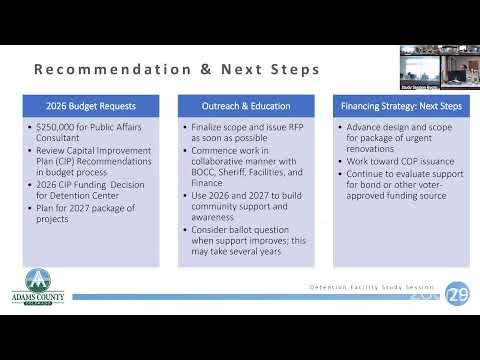
To build that backing staff proposed a public‑affairs/outreach program and asked the board to consider a $250,000 budget request for 2026 to hire consultants to lead polling, coalition building, message testing, paid media and stakeholder outreach. County staff said any education or outreach would need strict legal guardrails until the county formally decides to pursue a ballot measure; consultants would focus initially on public education about the system and its public‑safety impacts rather than on a specific ballot question.
Staff proposed next steps: continue high‑priority repairs in 2026, advance design and scoping for a larger renovation package, pursue a COP issuance in 2027 for the renovation work if directed, and use 2026–2027 for public education and coalition building before returning to the board to evaluate public support. They recommended quarterly study‑session updates to the board and continuing collaboration among facilities, finance, and the sheriff’s office to align CIP priorities and preserve capacity for other county projects.
Commissioners stressed the need for coordinated messaging, long‑term planning for a new facility, and clear accounting of opportunity costs: staff presented a list of other capital projects that could be delayed if the capital facilities fund is committed to a large COP issuance. Several commissioners and the sheriff said voter support is unlikely in the immediate term and urged a multiyear effort combining outreach and targeted repairs so the county can both reduce immediate safety risks and build the public case for any future ballot measure.
No formal vote was taken. Staff asked for direction to include the public‑affairs budget request in the 2026 budget process and to continue design and scoping work for a possible COP issuance in 2027, and said they will return with updates.