Get Full Government Meeting Transcripts, Videos, & Alerts Forever!
Get email alerts on the Affordable Housing Application Redesign topic
No spam. Unsubscribe anytime.
Bend subgroup seeks simpler, clearer affordable-housing application; flags fair-housing and funding alignment
Summary
A City of Bend advisory subgroup reviewed the affordable housing funding application and proposed reorganizing sections, clarifying requirements tied to state and federal rules, and adding clearer funding and affordability tables to help applicants and reviewers.
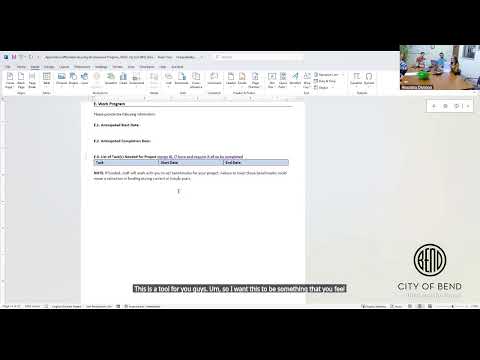
The City of Bend’s Affordable Housing Advisory Committee’s funding-application review subgroup spent its first session reviewing the affordable housing development application and proposed a set of changes intended to make the process clearer and more accessible for applicants and for committee reviewers.
The subgroup, convened by Melissa Kamonya, affordable housing coordinator, and attended by Rachel Baker, Housing Division manager; Chris O’Brien, the city’s grants coordinator; and AHAC members and community representatives, focused on reorganizing the application’s layout, clarifying which items are mandatory because of state or federal funding, and adding summary tables that show requested amounts, total project cost and the number and years of affordable units.
“We are going to be making recommendations for change with these criteria in mind,” Melissa Kamonya said as the meeting opened. She told the group that some application items are nonnegotiable because staff must demonstrate compliance with federal or state rules, but many narrative and formatting elements can be reworked to reduce duplication and applicant burden.
Why it matters: committee members said the current application mixes program descriptions, eligibility rules and narrative prompts in a way that makes it hard for applicants to understand which funds they may qualify for and for reviewers to quickly compare projects. The subgroup recommended moving high‑level numeric data — amount requested, total project cost, number of affordable units, market units and years of affordability — toward the top of the application so reviewers can “do the math” sooner and applicants see program‑specific eligibility at a glance.
Key details and proposed changes
- Funding buckets: Melissa Kamonya told the subgroup that, in the prior cycle, the city had included multiple funds in the combined application: “4,000,000 in PRO housing,” “a million in affordable housing,” and “275 in CVVG” (figures cited in the meeting transcript). She also said there is currently no open funding cycle.
- Reorganize and highlight program eligibility: Members recommended clearer headers and visual cues (for example, shading) to indicate which program each eligibility rule applies to (PRO housing, Affordable Housing Fund, CDBG). Ian and other members suggested the descriptions for each fund be grouped together so applicants can quickly see which AMI levels and applicant types (for‑profit vs. nonprofit) are eligible.
- Tables for quick comparison: The group asked staff to add an early table listing total project cost, amount requested from the city, estimated cost per unit (auto‑calculated if possible), number of affordable units by AMI band, number of market units and the proposed years of affordability. Several members said an auto‑calculated “cost per unit” and a required “estimated date units will be occupied” would help reviewers and future contract setup.
- Fair-housing language and bonus points: Rachel Baker reviewed the history of federal fair‑housing guidance and how the city currently links some fair‑housing items to bonus points in scoring rather than requirements. Rachel said the questions tied to the Analysis of Impediments and the city’s fair‑housing work were added recently and are now tied to bonus points (c13 and c14 in the application). She cautioned that making some items requirements could prompt developer questions or legal challenges because state and federal enforcement and regulatory status have shifted over administrations.
- Equity & inclusion policy: Committee members discussed whether to require an equity and inclusion policy for applicants. Several suggested making it required only when state funding is part of the project or asking applicants to provide the policy if state funds are already secured; otherwise make it an optional submission or bonus point. Rachel said the city will check current state guidance and consider language that requires policies only if state funding is part of the proposed financing.
- Narrative compression and duplication removal: Reviewers repeatedly flagged duplication across sections (for example, project-unit counts and household estimates appear in both ‘‘project description’’ and ‘‘project benefit’’ sections). The subgroup advised condensing repetitive prompts and giving applicants suggested word counts (for example, “recommended 500 words” though maximums can remain large for copy‑paste convenience).
- Project readiness and feasibility: The subgroup asked for clearer, standardized timeline prompts and suggested moving questions about financing commitments and pro forma summaries higher in the application. Members recommended requiring a statement of funding status and making “letters of funding commitment” visible in submitted materials. For rehab projects, members suggested adding language about relocation or URA (Uniform Relocation Assistance) requirements where applicable.
- Loan and grant terms: Staff and committee members agreed to present a standardized table of the city’s default loan/grant terms alongside a column where applicants indicate requested deviations. The city’s “loans and grants” policy governs standard terms; the subgroup asked that this be explicit in the application and that applicants know deviations will require higher‑level approvals.
Process notes and next steps
Committee members agreed to wordsmith the condensed questions together in a shared document and return with tracked changes. The subgroup will meet again in October to review scoring and public‑services application questions; in December they plan to finalize scoring criteria; and in January they will discuss the loans vs. grants policy and bring recommendations to AHAC as a whole. “Don’t be afraid to delete a question,” Kamonya told the group, urging members to remove items that do not yield useful reviewer information.
What was not decided
The group did not change scoring weights at this meeting. Members discussed whether to treat bonus items as requirements, whether partial awards are acceptable for development projects, and how strongly to weigh readiness statements; those topics will be revisited when scoring is discussed in October.
Ending note
The subgroup emphasized accessibility and transparency: make program eligibility and required documents easy to find, highlight changes from the prior cycle, and provide applicants the ability to see only the funds that are available in a given cycle. The group will consolidate edits into a single package and present the proposed application redesign and scoring recommendations to the AHAC body before any changes are published.