Get Full Government Meeting Transcripts, Videos, & Alerts Forever!
Get email alerts on the K12 Curriculum Revisions topic
No spam. Unsubscribe anytime.
Mount Olive supervisors outline wide-ranging K–12 curriculum revisions and new courses
Summary
District supervisors told the school board that summer curriculum work rewrote K–12 sequences, aligned programs to updated New Jersey standards, added new high-school courses and system tools for intervention and multilingual learners.
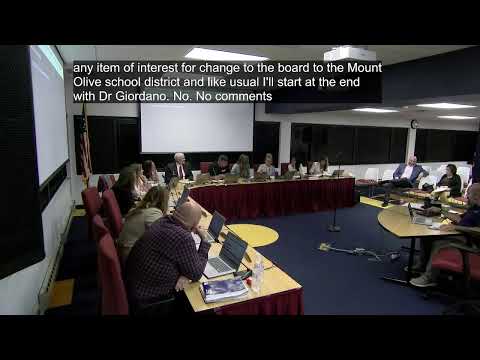
Supervisors and district leaders presented a summary of summer curriculum work at a Mount Olive Township School District Board of Education meeting, detailing K–12 revisions to English language arts, math, music, science, social studies, related arts and support programs.
The presentations described rewrites intended to align curricula with updated New Jersey student learning standards and to strengthen year-to-year sequencing, foundational skills and interdisciplinary connections across grade bands. District staff also described new courses and programmatic changes designed to expand access and inclusion.
Acting Assistant Superintendent Dr. Regan opened the presentations and introduced supervisors who each gave brief overviews of work completed over the summer. The presentations covered nine curriculum areas and multiple operational tools the district plans to use in 2025–26 to track student progress and professional learning.
Music supervisor Melanie said the department revised K–12 music to align with the updated New Jersey visual and performing arts standards and reorganized each grade into unit-based structures centered on rhythm, melody and instruments. "Our program goals continue to focus on cultivating lifelong music literacy and appreciation through active participation," she told the board. Melanie also described two new high-school offerings: Introduction to Guitar and a Unified Introduction to Music Peer Buddies course that pairs general-education and special-education students for inclusive ensemble work.
Secondary math supervisor Brian May summarized rewrites from grade 6 through Algebra II, emphasizing a sequential progression intended to prepare students for Algebra I. He described the district's use of a concrete-pictorial-abstract approach and a district "Conquer Math" initiative to support continuity: "...our math students are gonna be fully supported and prepared to succeed in Algebra 1," he said.
K-5 ELA supervisor Jenny Mastromic said the elementary ELA curriculum was rewritten around a comprehensive literacy framework grounded in the science of reading and aligned to New Jersey standards. The district adopted Benchmark Advance as a core resource and will use i-Ready for diagnostics and the state-mandated universal literacy screener. "We rewrote the K-5 ELA curriculum using a comprehensive literacy framework grounded in the science of reading and aligned to the New Jersey student learning standards," Mastromic said.
Secondary ELA revisions included restoring a survey-style English 4 CP and expanding electives such as film studies (now including documentary film units), horror/mystery units and additional options students may sample before graduation.
Social studies supervisor Tom Ressa said the department added an Introduction to Psychology elective and worked to coordinate ninth-grade world history with eighth-grade material for stronger continuity. He also noted participation in a statewide "Revolution New Jersey" initiative tied to the 250th anniversary of events commemorating the Revolutionary era.
Science supervisor Christopher Jensen and related-arts staff said they rewrote the middle-school innovation and design sequence, updated electives including forensic science and astronomy, and refreshed AP Computer Science offerings to align with recent exam changes. Staff also reported growth in architecture, materials processing and automotive courses.
Programmatic and systems changes included the rollout of Intervention Manager for consistent academic intervention across six schools; hiring a dedicated elementary gifted-and-talented teacher and returning gifted services to the regular school day; and adoption of the Elevation platform to track multilingual learner identification, progress and professional learning. Arturo Rodriguez, who supervises intervention, gifted & talented, multilingual learners and world languages, summarized those operational changes: "Our focus really was on ensuring that we were able to provide support for our students early on whenever it was needed, as well as making sure that we had consistency across all of our schools," he said.
District staff pointed to several implementation supports produced over the summer: a committee of more than 30 teachers and specialists who contributed to the ELA rewrite; teacher curriculum binders and pacing guides (presenters said some binders reached roughly 500 pages because of supplemental materials); newly purchased manipulatives for elementary math instruction; and vertical articulation work in world language to reduce repetition year to year.
Board members thanked supervisors for the work. The board later approved a multi-item consent agenda during the meeting; related routine personnel and program items were included in that vote.
The district said it will continue professional development and monitor the new curricular materials and tools during 2025-26; supervisors identified ongoing review and teacher feedback as part of the next steps.