Get Full Government Meeting Transcripts, Videos, & Alerts Forever!
Get email alerts on the Surveillance Alpr topic
No spam. Unsubscribe anytime.
Ferndale police recommend two-year renewal of Flock ALPR pilot, propose scaling back to nine cameras amid community concern
Summary
The Ferndale Police Department recommended renewing its Flock Safety ALPR contract for two years and scaling the pilot back from 15 to nine cameras, recommending the cost be paid from drug‑forfeiture funds while councilors and residents pressed for stronger contract language, audits and a racial‑equity review.
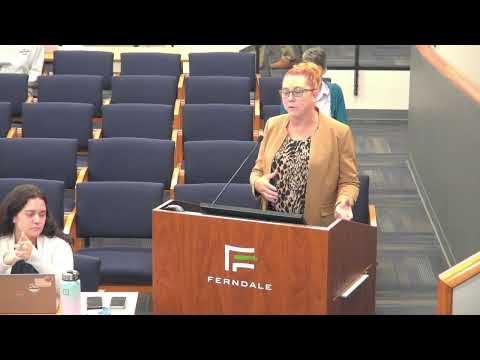
The Ferndale Police Department recommended renewing its Flock Safety automatic license plate reader (ALPR) contract for two years and scaling the system back to nine cameras, the department told the City Council in a lengthy presentation and question-and-answer session.
The recommendation — presented by the police chief and Flock representatives — would reduce the current pilot deployment from 15 cameras (initially 16) to nine placed on major approaches into the city (east‑ and westbound Eight Mile Road, north‑ and southbound Woodward Avenue and Ninth Mile), and fund the two‑year renewal using seized drug‑forfeiture funds. The department provided a per‑camera cost of about $3,000 per year, or roughly $27,000 per year and $54,000 total for two years.
Why it matters: Chiefs and investigators said the network produced investigative leads in violent cases — including homicides, attempted homicides, armed robberies, carjackings and other major crimes — and that the system is a force multiplier for detectives and patrol. Opponents said the contract and Flock’s evolving national policies pose privacy and civil‑liberties risks for Ferndale residents and visitors.
What the department presented
The police chief said the pilot began as a March 2023 council action, with installation delayed by permitting and supply chain problems until February 2024. The department originally installed 16 cameras; eight were purchased with forfeiture funds and eight were paid for by private donations. One donated camera (camera 10) was removed in November 2024 for poor performance, leaving 15 cameras in the pilot. The department’s data review found the highest yield at cameras on state highways and major corridors; the recommendation trims lower‑yield cameras and focuses coverage on inbound approaches.
Department figures presented for a 30‑day sample (July–August) included about 140,000 plate reads per day across the network, roughly 12,000 “hot‑list” hits in that 30‑day window, 123 Ferndale cases investigated that used the system, zero improper traffic stops attributed to misreads (the department said officers verify hits visually before stops), 12 cases cleared by arrest and seven investigative leads generated by Flock data. The chief said other jurisdictions’ uses of Flock contributed to solving homicides and other violent cases where suspects crossed jurisdictional lines.
Policy and technical limits
The department described its local rules: Ferndale’s policy limits archival search access to a small number of investigators and administrators and matches a 30‑day image retention window in the city’s surveillance ordinance. The chief said investigators, not patrol officers, run archive searches; patrol receives only hot‑list alerts in vehicles and must visually confirm before a stop.
Flock and the chief confirmed that in June 2025 Flock changed its national search policy: exact plate matches now return images to searching subscribers to speed critical missing‑person investigations, while the company says it prohibits searches “related to immigration and reproductive health” system‑wide. Flock representatives said aggregated, de‑identified imagery may be retained to train machine‑learning improvements but that jurisdictions own their raw images and that images are “hard deleted” from Flock servers once a jurisdiction’s retention period (here, 30 days) expires.
Community concerns and oversight questions
Residents and civic groups pushed back at the council meeting, citing civil‑liberties risks, Flock’s private ownership and venture‑capital backing, examples from other cities that sought to cancel contracts, and reports that federal agencies had queried networks in the past. Several speakers said they wanted an independent, unbiased evaluation of the pilot’s effectiveness (including a racial equity assessment), more frequent audits of network access and clearer contract language about national lookup and federal access.
Council members pressed multiple technical and contractual questions: what data Flock stores, how the company responds to subpoenas, how national lookup and 1‑to‑1 sharing work, and whether Ferndale can opt out of national lookup. Flock and the chief said: (a) each agency sets retention policy (Ferndale uses 30 days), (b) Flock says it does not “own” jurisdictional images and will notify agencies if served a subpoena (unless a nondisclosure demand prevents notice), and (c) Ferndale can opt out of national lookup at the agency level but that doing so could limit investigators’ ability to follow suspects across state lines. The chief said he is willing to turn off national lookup if the council prefers.
A number of residents urged the council to stop the renewal. Criticisms included reported instances in other jurisdictions where Flock allegedly shared data or resisted uninstall requests, the company’s commercial incentives to expand network access, and the difficulty of ensuring future changes to Flock policy will align with Ferndale’s values. Supporters of renewal said the system has produced leads in serious violent crimes and that it is a legally established investigative tool when used with safeguards.
Next steps
The police department framed the item as a recommendation; the council did not vote on the renewal the night of the presentation. Council members and staff said they expect to review contract language and return the item for decision at a regularly scheduled meeting before Oct. 13, 2025.
Ending: The presentation elicited extensive public comment and numerous follow‑up requests from council for contract text, audit logs, user‑guide screenshots and options to opt out of national lookup. The chief and Flock representatives said they would provide the requested materials and continue conversations with councilors before any renewal vote.