Get Full Government Meeting Transcripts, Videos, & Alerts Forever!
Get email alerts on the Water Resources topic
No spam. Unsubscribe anytime.
UC Cooperative Extension outlines Lake County water and climate program to supervisors
Summary
Dr. Laura Garza Diaz, area water resources management advisor for UC Cooperative Extension (UCCE), presented an overview of the UCCE Lake Water and Climate Change Program to the Lake County Board of Supervisors, describing local outreach, tribal partnerships, regional research on Scott Dam removal, and statewide training efforts.
Dr. Laura Garza Diaz, area water resources management advisor for UC Cooperative Extension (UCCE), presented an overview of the UCCE Lake Water and Climate Change Program to the Lake County Board of Supervisors and members of the public. The presentation described the program’s local, regional and statewide activities, partnerships with tribal nations and agencies, and educational and technical support available to small water districts and community members.
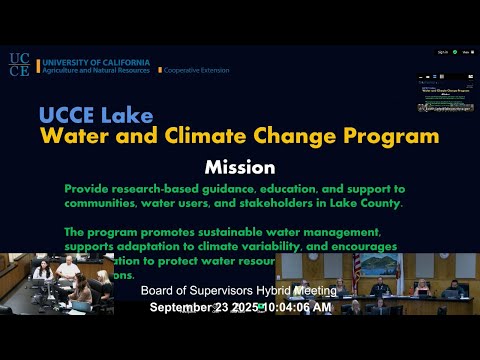
The program’s mission, Garza Diaz said, is “to provide research-based guidance, education, and technical support to community members, water users, and different stakeholders in Lake County,” focusing on three pillars: water quantity, water quality and climate change. She described outreach that includes farm visits, irrigation workshops and drought strategy events for growers, and work with tribes and small water suppliers.
The program operates at four geographic scales, Garza Diaz told the board: local (farmers, tribes and small communities); county (collaboration with Lake County departments and the Big Valley Groundwater Sustainability Agency); regional (shared watersheds such as Cache Creek and the Eel River); and statewide, where the program aligns with broader California initiatives to ensure local voices are represented.
Garza Diaz described a co-developed drought resilience needs assessment with Middletown Rancheria as an early example of the program’s approach to weaving indigenous and western science. She said the program is working with the Lake County Water Resources Department and consultant Stantec on a Lake County Drought Resilience Plan and has attended Big Valley GSA meetings to provide technical support related to the Sustainable Groundwater Management Act (SGMA).
On regional research, Garza Diaz said she is leading a project on the hydrologic, environmental and social resilience implications of removing Scott Dam; that project is funded by the California Institute of Water Resources and the U.S. Geological Survey and will support a UC Davis graduate student.
At the statewide level, she said the program co-developed a bilingual California Water Course for early-career water professionals and community advocates. The pilot intended for 25 students enrolled more than 60. She also described the Well program (Water Education for Latino Leaders), which she said has evolved to include water education for BIPOC community leaders.
During a public-comment period, local residents described community water problems and asked whether UCCE could assist. One commenter, identified in the record as a resident, said, “Water is one of our most precious resources, and it’s been undervalued and neglected for so long,” and expressed interest in the California Water Course.
A representative of a small special district (no name given) said the district serves about 409 active customers and reported losing about 63% of treated water over a six-month period because of breaks and aging pipes. Garza Diaz responded, “I can definitely support the smaller special water districts, in different projects. I am trained to write grants as well. So if we can find some project related to, for instance, the asbestos in the water pipes, I can try to find some funding, and then develop a project to support the water districts.” She offered to share her email for direct follow-up and to assess problems, while stating she cannot “bring water” directly but can help develop assessments and funding proposals.
Another resident from the Nice area said parts of that community do not have water and asked whether the program could provide youth programming. Garza Diaz replied that she could assess the area’s main problems and help organize outreach and programs for youth: “If there’s a need to develop a program for youth or for kids to learn more about water in general, water quality and all of that, that’s something that I could definitely do.”
A supervisor asked whether the California Water Course would be offered again. Garza Diaz said the course was a pilot and the team aims to offer it annually and to establish a Northern California chapter serving Lake and Mendocino counties.
The presentation emphasized outreach, technical support and grant development as primary services UCCE can provide to Lake County communities, tribes and small utilities. Garza Diaz invited interested parties to contact her for follow-up and for access to program materials on a program website she said is still under development.