Get Full Government Meeting Transcripts, Videos, & Alerts Forever!
Get email alerts on the Environment Fisheries topic
No spam. Unsubscribe anytime.
Lake County reports first year of Clear Lake hitch community‑science spawning survey; volunteers document hitch at multiple creeks
Summary
Lake County Water Resources presented preliminary results from a 2025 community‑science spawner observation program for the Clear Lake hitch, reporting detections at multiple creek sites across Clear Lake and describing program design, validation rules and plans to continue annual surveys. Staff and volunteers emphasized training, data validation,
Lake County Water Resources Department officials on March 9 presented preliminary results from the 2025 Clear Lake hitch community‑science spawner observation survey, a volunteer‑driven monitoring effort that covered 33 preselected sites around Clear Lake and ran weekly for 10 weeks beginning March 9, 2025.
The program is intended to track relative population trends over time, support restoration evaluations and involve the public in fish monitoring, Lake County Water Resources Director Pawan Upadhyay told the Board of Supervisors. Chris Childress, program coordinator, and watershed protection technician Taylor Woodruff led the presentation and thanked volunteers for their field observations and training participation.
County staff said the dataset presented excludes sites where no hitch were detected and that observers recorded confidence levels for fish identification; some entries were subject to quality assurance checks in the field. Childress said one Adobe Creek site returned a notably large count that staff double‑checked in the field and validated as reported. "This is just simply those fish were present at the site at the time of the survey," Childress said, explaining that the program records presence at the instant of the weekly observation rather than a comprehensive population estimate.
Why it matters: the Clear Lake hitch (a species listed as threatened under the California Endangered Species Act in February 2014) is a focal point for several local and state conservation efforts. The county declared a local emergency related to hitch declines in February 2023; staff said the county has since worked with tribal, state and federal partners and expanded monitoring to include community scientists this year.
Preliminary, site‑level findings presented by staff show detections at sites in Upper Lake, Big Valley, Forbes Creek and Lakeport. Staff reported site counts (where detected) including: Alley Creek, 9; Clover, 99; Forbes Creek, 16; Kelsey Creek, 25; Manning, 52; Siegler Canyon, 1; Thompson Creek, 50. County staff said one Adobe Creek site was reported with about 1,000 hitch observed and that Taylor Woodruff and program staff validated that count in the field.
Program design and quality control: the survey used 33 preselected sites chosen for repeatability across the lake’s drainage (Bachelor Valley, Upper Lake, Lucerne, Clear Lake Oaks, Lower Lake, Big Valley, Lakeport, Scotts Valley and others). Volunteers attended mandatory annual training with classroom and in‑field components; most repeat sites are at bridge crossings and some sites on private property are sponsored by landowners who are asked to commit to five to ten years to allow multi‑year comparisons. Staff said surveys are not run when visibility conditions prevent reliable identification (dry channels, turbidity, algal blooms or floating vegetation), and volunteers report their confidence in fish identification on each observation form. A random subset of entries undergoes QA/QC checks in the field.
Public comment and collaboration: dozens of volunteers, tribal representatives and members of local organizations spoke in support of the program at the meeting. Michelle Scully, a member of the Fish and Wildlife Advisory Committee, and Angela DePalma Dow, executive director of Lake County Land Trust, described the program as a model for validated community science and said state agencies have expressed interest. Several tribal speakers emphasized longstanding tribal knowledge of hitch presence and thanked the county for incorporating volunteer and tribal observations into formal monitoring.
Next steps and county support: staff invited volunteers to sign up for the 2026 survey (2025 volunteers will be given priority) and said program reports, including external studies such as the U.S. Geological Survey's gillnet study, will be posted to the county website as they become available. Supervisor Paiske noted the board previously funded two positions in Water Resources to support work on the hitch emergency and said those positions helped produce the program being presented.
What the results do and do not show: County staff and public speakers emphasized that the weekly survey is designed to document presence and relative abundance at fixed points in time and locations, not to produce a full lake‑wide population estimate from a single year. Staff said the community‑science dataset is intended to be compared with district and agency surveys over multiple years to detect trends and to inform restoration and barrier‑removal decisions.
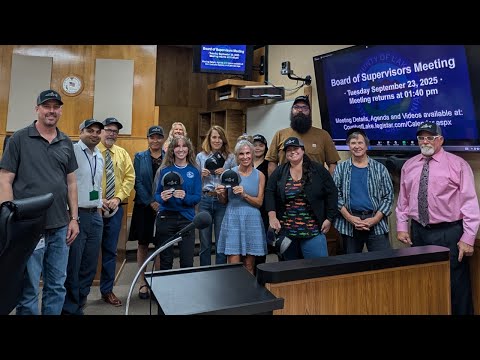
The department closed the presentation by recognizing volunteers and distributing program hats; staff said hats for volunteers who did not attend the meeting are available at the Water Resources front desk.