Get Full Government Meeting Transcripts, Videos, & Alerts Forever!
Get email alerts on the Commercial Cannabis Permits topic
No spam. Unsubscribe anytime.
Lake County supervisors narrowly reject ordinance to deny incomplete commercial cannabis permits pending rewrite
Summary
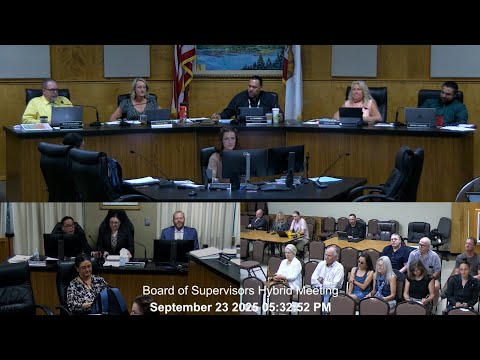
Lake County’s Board of Supervisors on an unsuccessful 3-2 vote declined to adopt on first reading an ordinance that would have denied incomplete commercial cannabis cultivation permit applications in unincorporated areas while the county updates its cultivation rules.
Lake County’s Board of Supervisors on an unsuccessful 3-2 vote declined to adopt on first reading an ordinance that would have denied incomplete commercial cannabis cultivation permit applications in unincorporated areas while the county updates its cultivation rules.
Supervisor Ozo (Ozo) Owen introduced the ordinance as a temporary measure to prevent new permits from becoming “legal nonconforming” under the current rules while the county finishes a multi‑year rewrite of its cannabis ordinance. Owen told the board she brought the measure because of recurring complaints about water use and odors and because the rewrite has taken “roughly 4 years.” She said she wanted new applications paused until the new regulations are adopted.
The proposal drew detailed questions from fellow supervisors and from Community Development Director Maria Turner about how the policy would interact with the California Permit Streamlining Act. Turner said the department currently has 66 pending commercial cannabis projects, 35 of which are in completeness review; of those 35, she said 14 are in active contact with staff and five are amendments to existing permits. Turner warned that if the ordinance were adopted as drafted the department would notify all 35 applicants that incomplete applications would be denied 30 days after the ordinance’s effective date and that she expected a wave of applicants scrambling to complete filings and a rise in appeals to the planning commission.
County counsel and staff told the board they drafted the ordinance to align with the Permit Streamlining Act and cited several Government Code provisions discussed during the meeting. Deputy county counsel Lloyd and other counsel said the ordinance’s “deemed complete” standard was intended to be consistent with the state law definition and that the language in the draft could be amended. Lloyd also noted the ordinance’s recitals can be modified during the first‑reading process.
Public comment was lengthy and sharply divided. Neighbors and local organizations pressed the board to act, citing repeated odor complaints, water concerns, road impacts and alleged failures of annual reporting and permit monitoring. For example, speaker Peter Simon, who identified himself with Pasta Farm, said a sudden denial would “inundate the CDD with applications” and compress staff workload into a short period; others, including members of the Earthtown Council and the Redbud Audubon board, said the county needs stronger oversight of water withdrawals and environmental protections before accepting additional permits.
Opponents — including multiple current and prospective permit applicants who said they had spent tens of thousands of dollars on studies and applications — argued that the county should process complete applications under current rules while revisions are finalized. Businesses and consultants said a pause or denial would chill investment, risk tax revenues derived from the regulated industry and could push activity back into the illicit market. Applicant Autumn Carsey said halting applications “is detrimental to the county’s tax funds” and stressed that other counties revised cannabis rules while continuing to process permits.
Supervisor discussion emphasized two tensions: (1) residents’ repeated complaints about odor and water and a long delay in finalizing a revised ordinance, and (2) the legal and practical constraints of the Permit Streamlining Act and the potential harm to applicants who have already invested in permits. Several supervisors said they favored targeted, quicker changes such as stronger setback, water and odor standards and background‑check requirements for property owners, rather than a broad denial that would remove applicants’ ability to cure incomplete filings under state law.
At the end of the meeting Supervisor Owen moved to approve the ordinance for first reading as amended; the motion was seconded (second not specified in the record). The clerk recorded a roll call: Owen — aye; Supervisor Sabatier — nay; Supervisor Rasmussen — nay; Supervisor Paiske — no; Supervisor Bridal — aye. The motion failed 2‑3. After the vote, the board provided direction to staff to explore narrower ordinance amendments that could be adopted without triggering a full CEQA programmatic environmental review and to return with language options.
What happened next: because the first‑reading motion failed, the ordinance did not advance to a second reading and remains under discussion. Staff indicated they will examine whether limited amendments (for example, revised setbacks, property‑owner background checks and clarified completeness procedures consistent with the Permit Streamlining Act) can be drafted and returned to the board for consideration.
Quotes
“I would like to shut that down at this moment until we have our new ordinance,” Supervisor Owen said, describing water and odor complaints she had received.
“We have 66 pending projects, 35 of which are in that completeness review,” Maria Turner, community development director, told the board. “Of the 35, 14 of these are actually viable projects that we’re having regular contact with the applicant.”
“If this project is denied … it’s denied. That’s done. They would need to reapply as a new permit with all new permit fees,” Turner added when describing the department’s normal practice after a denial.
“If the department’s written determination is not made within 30 days … the application shall be deemed complete for purposes of this chapter,” county counsel Lloyd said when citing the Permit Streamlining Act’s deemed‑complete rules.
“This is not a pause — this is denying the applications,” one supervisor said during debate summing up the difference between a moratorium and the draft ordinance.
Ending
The board did not adopt the ordinance and instead instructed staff to return with narrower amendments that address the board’s principal concerns (water, odor, setbacks and background checks) while minimizing legal exposure and CEQA complexity. The county’s cannabis ordinance rewrite remains under way; staff and supervisors indicated they will continue work on targeted changes and on the longer ordinance rewrite, which staff said has been in process for several years and may require additional environmental review.
(Details from board discussion and public comment are drawn from the meeting transcript; the meeting date and some internal document references were not specified in the public transcript.)