Get Full Government Meeting Transcripts, Videos, & Alerts Forever!
Get email alerts on the County Investments topic
No spam. Unsubscribe anytime.
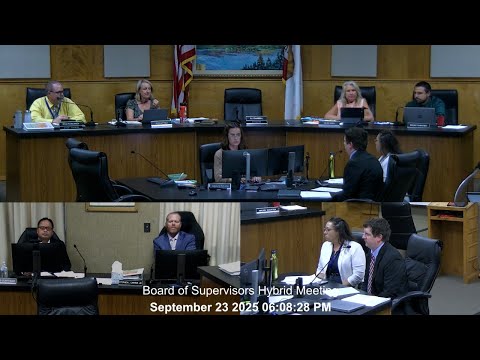
Lake County supervisors back ‘in or out’ approach as fire districts seek to leave county treasury pool
Summary
Lake County Treasurer and Tax Collector Patrick Sullivan told the Board of Supervisors that several special districts, including fire districts, have sought to withdraw funds from the county treasury pool, producing operational risks for the remaining participants.
Lake County Treasurer and Tax Collector Patrick Sullivan told the Board of Supervisors on Oct. 25 that several special districts — most notably fire districts — have recently moved to withdraw funds from the county treasury pool or are actively pursuing that option, a development staff said creates operational and investment risks for remaining pool members.
Sullivan said the county provides combined banking and investment services for the county, school districts and various special districts, and that recent departures have produced a “half in, half out” configuration that is difficult to manage. “You need to either be with us, and it's government code supported. … You're in or you're out, right?” Sullivan said, describing the choice given to a district that left last year.
The nut of the board discussion centered on protecting the pooled investments and ensuring continuity of banking services for agencies that must remain in the pool by law. Sullivan and Sophie Harrington, the county’s auditor-controller, said the relevant government-code sections are old and sometimes contradictory, and that an Attorney General opinion has been interpreted to allow districts to invest independently even while naming the county treasurer as their treasurer.
Sullivan outlined operational concerns: when districts withdraw funds to invest elsewhere, the treasurer’s office may need to sell securities to provide cash, which can force the pool to realize losses or reprice returns for returning members. He said the county typically sweeps checking into investments daily so “no dollar goes uninvested,” and that modern banking has blurred older statutory distinctions between banking and investing.
Board members expressed support for a clear policy approach. Supervisor Pyska said the county must “protect the trust that is given to us” by pool participants and proposed a firm posture: “Either you're in or you're out … I think we need to give them a window of when they can make that so we can make sure we have the liquidity.” Pyska suggested a nine- to 12-month window to allow districts to transition without destabilizing the pool.
Supervisor Owen asked whether the county has legal authority to require an all-or-nothing rule; staff said state government code appears to allow districts to invest separately and that the county likely cannot unilaterally bar districts from doing so. As an operational alternative, Sullivan offered several options the treasurer’s office is considering: creating a separate non-invested district bank account for banking-only services; forming a separate voluntary pool (which staff said would be administratively burdensome); setting a minimum balance threshold for voluntary participants; and increasing outreach and education for pool participants.
Supervisor Sabati and others supported keeping an open path for districts that leave to return to the pool, while assessing costs to a departing district if the county incurs expenses because of that departure. Sullivan said the county’s existing policy allows returns but that the county may assess costs against a returning district if the county incurred expenses due to an exit.
A member of the public, Tom Lasik, spoke in favor of the board’s cautious approach, saying the departing districts should “get the benefit and leave the risk with the county” only if they choose to remain half-in: “You’ll get your checking account, but you’re not gonna get the investment. You’re on your own.”
No formal motion or vote was taken. Sullivan said staff would continue discussions with the affected fire districts, consult the county’s asset manager and county counsel, and bring any recommended policy language back to the board during the regular investment-policy review scheduled for December.
The board’s discussion distinguished between (1) discussion only — concerns about statutory ambiguity and operational risk; (2) direction — staff was asked to engage directly with the fire districts and consult county counsel and the asset manager; and (3) formal action — none taken at this meeting.
Looking ahead, staff said the county will evaluate options including a separate banking account for districts that invest externally, a minimum-balance rule to limit repooling of earnings, and enhanced outreach to pool participants. The board signaled consensus for a policy that discourages repeated short-term exits and returns but preserves an avenue for districts to rejoin the pool, potentially with costs assessed to the returning district if the county incurs expenses.