Get Full Government Meeting Transcripts, Videos, & Alerts Forever!
Get email alerts on the Pay And Compensation topic
No spam. Unsubscribe anytime.
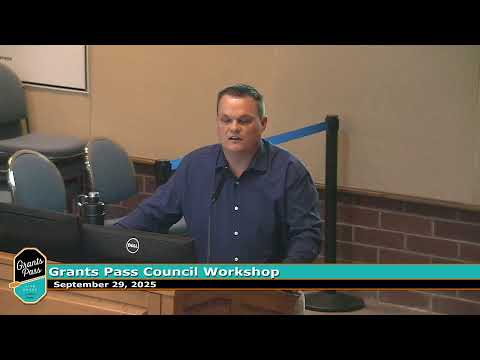
Grants Pass workshop reviews nonbargaining pay schedule, asks staff for multi‑year projections and alternative models
Summary
A task force presented changes to the city’s nonbargaining salary schedule based on a market study and Oregon pay equity law; councilors requested 3–5 year fiscal projections, a baseline cost to fix pay‑equity issues and analysis of a seven‑step alternative before taking action.
A task force presentation to the Grants Pass City Council at a council workshop reviewed a market‑based restructuring of nonbargaining employee pay and classification and proposed next steps, including a revised salary grid, placement rubric and limited increases intended to comply with Oregon pay equity law.
The task force, which reviewed a consultant study by Dr. McGrath, recommended adopting the consultant’s reconfigured salary schedule as modified by the task force (market average at step 6, 4% between steps up to step 6 and 2% between steps 7–10), applying a 3.2% Consumer Price Index adjustment to the grid before placing employees, using a placement rubric based on “substantially similar” experience, and implementing longevity incentives of 1% at 10 years and 2% at 15 years. The task force also recommended five reclassifications and that the schedule and placements take effect July 1, 2025.
Why it matters: The city’s nonbargaining salary schedule had been restructured by a consultant and reviewed because of market misalignment and potential pay‑equity risks. The changes affect payroll costs, internal equity (compression) and recruitment and retention of staff across departments.
Key recommendations and detail
Stephanie Nuttall, a staff member who introduced the topic, said the consultant’s methodology placed market average at step 6 and that the consultant recommended placing employees on the nearest step that would not reduce pay. Tom Bradbeer, task force vice chair, summarized the task force’s modifications, including a recommendation to reduce step differentials to 2% between steps 7–10 and to apply a 3.2% CPI adjustment to the grid before step placement.
The task force described a three‑tier placement rubric: initial placement based on substantially similar experience (0–3 years = step 1, 3–6 years up to step 6, with step 6 used as the initial cap for placement), annual step advancement tied to satisfactory evaluations, and protections so no employee experiences a pay decrease. The task force and staff also said pay‑equity adjustments required by state law would be implemented as needed.
Fiscal implications presented
Staff provided multiple salary snapshots and estimates during the presentation. The current payroll snapshot for the 50 employees reviewed was presented as $5,156,005. The May 21 recommendation previously presented to council was estimated at about $5,950,019. The task force’s modified recommendation was estimated at about $5,857,746 based on initial placements.
Staff also reported an average “grid shift” (how far each classification moved to align with market) of 18.84 percent and an average employee pay shift of 11.71 percent (median about 10.76 percent). Stephanie Nuttall said the task force proposal would be about $92,000 less than the May 21 recommendation and roughly $977,639 greater than the 2024–25 budget baseline (staff characterized that as a roughly 24% reduction in additional cost compared with the May 21 package). The presentation noted that approximately $458,997 of the earlier May 21 projection was projected to come from the general fund and that the task force proposal would reduce the general fund impact by “about $200,000” compared with that earlier figure.
Questions and council direction
Councilors pressed staff for additional analysis before taking action. Councilor Joel said he needed more time and asked specifically for multi‑year projections. Councilor King and other members asked for a clear baseline figure for the minimum funding required to correct pay‑equity or compression issues (the “bare minimum” to meet legal obligations) rather than a full market alignment scenario.
At least two councilors asked the task force and staff to evaluate a seven‑step grid alternative with larger step differentials (for example, market average at step 4 with 5% between steps) and to provide a comparison of budget impacts over multiple years. Councilors also requested that staff provide firm placement calculations (not tentative snapshots), identify the distribution of impacts by fund (general fund versus enterprise or other funds), and project costs out 3–5 years so the council can see revenue assumptions and how ongoing step increases and potential COLAs would affect future budgets.
No formal council vote or ordinance was taken at the workshop. Instead, councilors directed staff to return with the requested analyses and for the task force to assess the seven‑step alternative.
What happens next
Staff said it will re‑run placement calculations, prepare multi‑year budget projections, identify the minimum legal remediation cost for pay equity/compression, and provide comparative scenarios including the task force recommendation and the seven‑step alternative. The council did not adopt changes at the workshop.
Quotes
“This presentation is an updated approach to adjusting the nonbargaining employees’ compensation and classification based on market analysis and Oregon pay equity law,” Stephanie Nuttall said when introducing the topic.
“We arrived at a recommendation that there be a 2% differential between steps 7 and 10,” Tom Bradbeer said, summarizing a task force modification to the consultant’s grid.
“I’m going to need more time personally before I make a decision,” Councilor Joel said after seeing the numbers for the first time, adding that he wanted the multi‑year projections before any final action.
Ending
Councilors praised the task force’s work but stopped short of adopting the proposed salary schedule. Staff will return with firm placement data, a minimum legal remediation cost for pay equity, and 3–5 year fiscal projections; the task force will examine a seven‑step alternative at council direction.