Lifetime Citizen Portal Access — AI Briefings, Alerts & Unlimited Follows
House committee hears bill to add specialized security agents to Puerto Rico custody corps
Loading...
Summary
The House Committee on Public Safety on Sept. 29 held a hearing on Proyecto de la Cámara 455, a proposal to amend the Plan de Reorganización del Departamento de Corrección y Rehabilitación (Law 2 of 2011) to recognize agentes de seguridad y protección (ASP) of the Unidad de Operaciones Especiales as part of the cuerpo de oficiales de custodia.
The House Committee on Public Safety on Sept. 29 held a hearing on Proyecto de la Cámara 455, a proposal to amend the Plan de Reorganización del Departamento de Corrección y Rehabilitación (Law 2 of 2011) to recognize agentes de seguridad y protección (ASP) of the Unidad de Operaciones Especiales as part of the cuerpo de oficiales de custodia.
The bill was presented by Representative Enzo Rodríguez and co‑author Estrella Martínez (excused from the hearing). The Department of Correction and Rehabilitation (DCR) told the committee it supports “apoyamos totalmente que se incluyan conforme al proyecto de la cámara 455 dentro del honroso cuerpo de oficiales correccionales,” citing the ASP’s high‑risk duties and longstanding operational role in juvenile institutions (Nicanor Caro Delgado, secretario auxiliar de seguridad, DCR). The Federation of Custody Officers also urged approval, saying the change would “establece una estructura clara y justa para la clase de agentes de seguridad y protección” and recognize members’ training and risks (Juan Montero Negrón, presidente, Federación de Oficiales de Custodia).
Why it matters: committee members and witnesses agreed the change could affect pay, retirement and death‑in‑service benefits for an estimated group of employees. Several witnesses and legislators said the measure could affect roughly 50 agents in the DCR’s juvenile program and at least 17 similarly classified agents in the Department of Justice, making the total potentially higher than 50.
During testimony, DCR representatives described ASP duties that include high‑risk escorts and transports, disturbance control, transfers between institutions during emergencies, courtroom security for juveniles and, when required, arrests and testimony in court. DCR argued those duties are comparable in risk and function to other officials already in the custody corps and said the agency supports recognizing ASP in a dedicated class within the custody body.
But the administration that oversees job classification and human resources cautioned about scope. The Office for the Administration and Transformation of Human Resources (OATRH) and its director submitted written comments stating that the central classification plan (Law 8 of 2017) created a uniform class of “agente de seguridad y protección” used across agencies, and the bill as drafted could unintentionally extend the custody‑corps designation beyond the DCR to agents in other agencies. OATRH advised that qualifying the bill’s language — for example, adding a department‑specific qualifier or “apellido” to create a separate class exclusive to the DCR — might resolve that conflict.
Fiscal and retirement questions also surfaced. The DCR certified the bill as having no fiscal impact in its submission to the committee. By contrast, the Office of the Comptroller/OPA (as read into the record by a committee member) provided a projection that showed potential fiscal costs in later years (cited figures: $197,115 for 2026; $243,504 for 2027; $271,558 for 2028) tied to retirement/benefit changes if employees were allowed earlier retirement under high‑risk formulas. Committee members asked for formal opinions from the Junta de Control Fiscal, the retirement board, and the Office of Management/OGP to reconcile those differences.
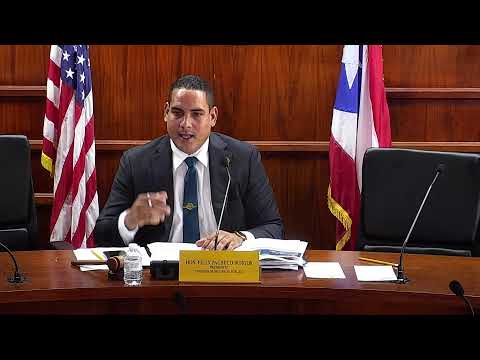
Committee action: the committee did not vote on the bill. Chair Félix Pacheco and members agreed to give agencies a 10‑day deadline to provide clarification and updated data (number of affected positions in the juvenile program, salary and tenure breakdowns, precise classification history), and to request formal opinions from OATRH, the retirement board and other fiscal authorities before further action. Representative José “Junior” Pérez moved that the record request and consultation be made; the chair accepted the recommendation and set the ten‑day term.
Supporters said the bill would correct what they described as a legal and functional omission in the 2011 reorganization law that left ASP outside the custody corps despite exercising equivalent duties; opponents or cautions focused on the bill’s drafting scope and possible fiscal and retirement consequences if the classification were interpreted to apply across agencies. Representative Ramón Torres, the PPD spokesperson, called the proposal “necesaria, es justa y hay que hacer la ley.”
The committee recessed after collecting testimony and directing the agencies’ reports; members said they intend to align the final bill language with Senate counterparts so the measure can proceed without conflicting classifications or unintended fiscal consequences.