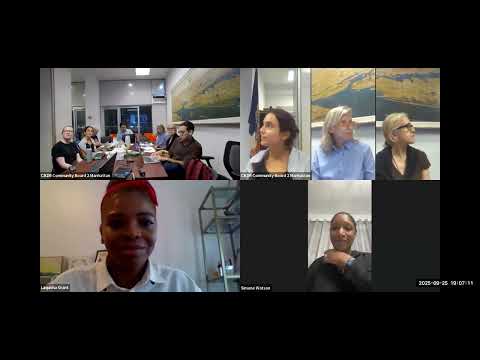
Mayor’s Office outlines Be Heard team, limits and staffing challenges to Manhattan Community Board 2
Loading...
Summary
Officials from the Mayor’s Office of Community Mental Health detailed how the Be Heard 911 mental‑health response works, its eligibility rules, what it can and cannot do, and staffing and data limits as Community Board 2 members weighed whether to request a local team in next year’s budget.
Laquisha Grant, deputy executive director for mental health access at the Mayor’s Office of Community Mental Health, told Manhattan Community Board 2’s Human Services Committee that Be Heard is the city’s mental‑health 911 response pilot and that the office was added to the New York City charter in December 2021.
The presentation explained how Be Heard fits into the city’s broader crisis‑response system and what services are available through 988, 311, mobile crisis teams and support centers. “We like to think of 988 as the best front door into the mental‑health system,” Grant said. She and Simone Watson, senior director for mental health access and crisis response, described Be Heard teams, the eligibility criteria for a Be Heard dispatch and limits on what teams can safely do in the field.
Be Heard teams are three‑person units that respond without NYPD when criteria are met; each team includes two EMTs and one social worker and rides in a specialized vehicle, Grant said. Teams perform a physical assessment first, because medical conditions can appear as behavioral crises, and then a social worker does a behavioral health assessment. If the patient needs hospital care, teams will arrange transport; when appropriate, they will refer or transport people to community‑based options such as the city’s Support and Connection Center in East Harlem.
The teams generally do not respond to violent calls, incidents involving weapons, or active overdoses, Grant said. Mobile crisis teams — a broader category of in‑person responders available through 988 — operate seven days a week, typically 8 a.m. to 8 p.m., and can arrive within two to three hours if the caller provides an address. That address requirement means teams are less effective for persons who are unsheltered and moving around the street, the presenters said.
Committee members pressed presenters about outcomes and evaluation. Grant said crisis counselors handle many calls by phone — “somewhere upwards of 80% of crisis situations” are resolved over the phone, she said — and that the city tracks deployment metrics. She acknowledged gaps in coverage: not all eligible 911 mental‑health calls are routed to Be Heard, and staffing constraints limit how many calls teams can answer. She cited two staffing problems: recruiting social workers willing to work on a vehicle‑based emergency team and periodic loss of EMTs when FDNY promotion exams reduce the EMS workforce.
Ryder Kessler, a committee member, cited a city comptroller’s audit showing substantial portions of eligible calls that did not receive Be Heard responses and asked whether the shortfall is chiefly a staffing shortage. Grant said the shortfall is a mix of reasons — calls routed by second‑ or third‑party callers that lack sufficient information to qualify, limited team capacity and EMS staffing shortages — and that fixing the gap will require sustained workforce and pipeline investments.
On evaluation of patient outcomes, Watson said Be Heard has operated as a pilot since June 2021 and that the program monitors near‑term measures (routing of eligible 911 calls, transport rates and connection to community care). A more formal evaluation of long‑term health outcomes would require data sharing and protections under HIPAA and has not yet been completed; Watson said the office and partners have discussed such an evaluation.
Committee members asked whether peers are part of Be Heard. Watson said peers are included in follow‑up services and H+H staffs some peer follow‑up, but peers are not currently part of the three‑person field team because the team must perform a medical assessment on scene and peers do not provide medical assessments. Grant said the office supports expanding peer roles and building a pipeline, and that H+H operates a peer academy.
Committee discussion moved to local budgeting: members signaled interest in asking the city for at least one Be Heard team more available to midtown Manhattan and in adding workforce‑development requests (scholarships, loan repayment, peer training) to next year’s budget priorities. Emma Smith and Arturo (last name not specified in the record) volunteered to draft a committee resolution on Be Heard and related workforce and licensing changes for the full board, with the presenters’ materials and data added as background.
The presenters recommended several resources to the board: 988 as a front door for crisis calls; the Support and Connection Center in East Harlem for 24/7 low‑barrier walk‑in care; and DOHMH and H+H materials summarizing the crisis‑response system. The presenters and the committee agreed to return for a follow‑up meeting focused on post‑response pathways, inpatient and outpatient transitions, and potential budget advocacy items.
Ending: The committee thanked the presenters and agreed to continue the conversation later in the year while staff and board members prepare draft budget requests and a resolution.