Get Full Government Meeting Transcripts, Videos, & Alerts Forever!
Get email alerts on the 988 Lifeline Oversight topic
No spam. Unsubscribe anytime.
Council hearing probes NYC 988 operations, funding gaps and calls to expand nonpolice crisis response
Summary
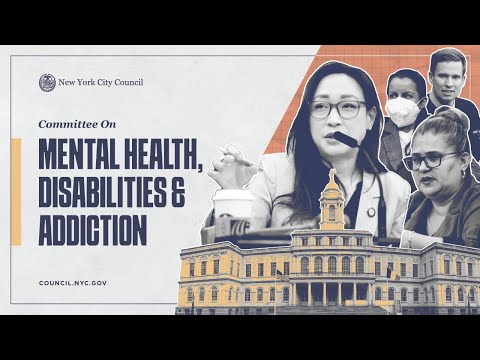
Chair Linda Lee, chair of the New York City Council Committee on Mental Health, Disabilities and Addiction, opened a hearing on the city’s 988 suicide and crisis lifeline and three proposed bills, saying the session would examine whether the lifeline “meets the needs of all who turn to it.”
Chair Linda Lee, chair of the New York City Council Committee on Mental Health, Disabilities and Addiction, opened a hearing on the city’s 988 suicide and crisis lifeline and three proposed bills, telling the panel that the session would examine whether the lifeline “meets the needs of all who turn to it.”
The hearing brought city health officials, advocates, service providers, union representatives and dozens of public witnesses to the Committee on Mental Health, Disabilities and Addiction to review how New York City’s 988 operation works, how it is funded, and how 988 connects callers to mobile crisis teams and other services. Lawmakers and witnesses pressed the Department of Health and Mental Hygiene (DOHMH) and the 988 vendor on staffing, data collection, language access, and whether emergency 911 calls can be routed to nonpolice responses such as BeHeard.
"The 988 works as a coordinated network of regional crisis centers," Chair Linda Lee said, noting that New York State operates 15 988 lifeline centers, three of them in New York City, and that the city and state both provide funding. Lee told the committee that in recent fiscal years the city “has reduced the funding of the helpline by $10,900,000” and that in the most recent budget the city added $5,000,000 for 988-related services in response to federal cuts affecting LGBTQ+ youth services.
DOHMH officials described the city’s role overseeing the 988 contract and the broader crisis-response system. "The health department is a key pillar of New York City's mental health system," said Dr. Gene Wright, executive deputy commissioner for the Division of Mental Hygiene, explaining that DOHMH procures and manages the 988 call-center contract and requires the vendor to provide crisis counseling, peer support, information and referral, single-point access to urgent behavioral health services, a website and follow-up services.
Jamie Neckels, assistant commissioner for the Bureau of Mental Health, provided detailed operational figures and contract-level performance data the health department uses to monitor the vendor. Neckels said that, from January through August 2025, NYC 988 handled about 243,000 contacts across calls, texts, chats and peer-support interactions, including roughly 48,753 peer-support contacts. She said counselors handled roughly 200,000 of those contacts and about 12,000 contacts were offered referrals to ongoing services—about 4,000 to mental health providers and about 8,000 to social supports such as food pantries. Neckels said the contractor’s most recent staffing claim listed 164 full-time-equivalent counselors and 22 FTE peers. She also said the system made about 6,600 referrals to mobile crisis teams in the same January–August period.
Officials described the city’s approach to the three items before the committee: Intro. 1385, to establish a construction-site opioid antagonist (naloxone) program; Intro. 1162, to require an annual DOHMH report on suicide deaths with demographic detail; and Resolution 1049, urging Congress to incorporate mental-wellness training into OSHA 10 and OSHA 30 courses. Dr. Wright said DOHMH “supports the intent” of the construction-site naloxone bill while noting the department emphasizes neighborhood- and community-based naloxone distribution and expects to work with Council on implementation. DOHMH also pointed to existing publications—such as the Summary of Vital Statistics—as sources that already report on suicide deaths but acknowledged the Council’s bill would require a more tailored annual report with demographic breakdowns that advocates said would sharpen local prevention efforts.
Committee members and public witnesses raised several recurring concerns: the national 988 rollout’s loss of an interactive voice-recording option that previously allowed callers to press a number for LGBTQ+-specialized counselors; whether calls routed by cell-tower geolocation always reach the closest call center; data gaps and the limits of demographic collection on live crisis calls; translation and outreach to immigrant and limited-English communities; whether 911 dispatchers are able or willing to transfer appropriate calls to nonpolice crisis responses; and whether BeHeard and other nonpolice emergency programs are consistently available and integrated with 988.
Public Advocate Jumaane Williams, testifying at the hearing, warned against relying on involuntary hospitalization and called for expanded community-based treatment and better-resourced crisis services. "We cannot incarcerate and institutionalize our way out of this crisis," Williams said. Several advocates and service providers urged expanding peer-led responses and argued that peers—people with lived experience—should be included on nonpolice response teams such as BeHeard and on transports.
Witnesses from service providers and nonprofits testified about both the promise and the limits of the current system. Fiona O'Grady of the Samaritans of New York urged the Council to insist on transparency, local adaptations and rigorous oversight, noting that national policy choices can conflict with local needs. Child-serving and school-based providers, including Sofia Addison of the Child Mind Institute, said schools remain a key prevention setting and commended earlier steps to provide students with information on crisis services.
DOHMH officials answered detailed questions about operations. Neckels said average speed-of-answer metrics for August 2025 were about 28 seconds for calls, 15.87 seconds for texts and 17.85 seconds for chats, and that 870 contacts were escalated to 911 so far this year for imminent-risk emergency response. She also said mobile crisis teams operate 8 a.m.–8 p.m., seven days a week, and that teams are licensed and operated by hospitals and community-based organizations under OMH oversight; there are 24 mobile crisis teams citywide—19 adult teams and five child-serving teams—per the testimony.
Several speakers pressed the agency about training, oversight and privacy. Neckels said new call counselors receive roughly 13 days of initial training and subsequent supervised practice. DOHMH and advocates differed on how much demographic detail can be gathered without undermining rapport during crisis calls; the department said counselors collect demographic details when clinically relevant but that demographic fields are incomplete for many contacts.
Committee members asked about federal interactions: DOHMH officials said Vibrant Emotional Health, the national vendor/administrator, had submitted an application through its national affiliate to SAMHSA seeking restoration of localized interactive options and that the city awaited a response. Several council members and witnesses urged the administration to have contingency plans to use the $5 million the Council added to the budget to maintain LGBTQ+-specific supports if the federal application is denied.
Public testimony emphasized language access and community outreach: advocates and community leaders asked for targeted advertising in immigrant and ethnic media, for more counselors and peers who speak languages used in the city, and for greater support for community-based organizations to provide culturally competent crisis care. Construction-trade witnesses and unions supported Intro. 1385, citing high suicide and overdose rates among construction workers and urging naloxone access and training on job sites.
The committee did not record any formal votes during the hearing. Members and staff asked DOHMH to provide detailed data and to follow up with the Council on locating the Summary of Vital Statistics and on a plan for how the council’s $5 million would be used if federal authorizations are not restored. Multiple witnesses asked the committee to press for integrated data and clearer public guidance about when to call 988, when to call 911, and how BeHeard and mobile crisis teams coordinate with 988 referrals.
The hearing closed after nearly three hours of testimony and questions. Committee members and DOHMH staff agreed to continue follow-up conversations on data access, marketing and operational coordination among 911, 988 and nonpolice dispatch systems.