Get Full Government Meeting Transcripts, Videos, & Alerts Forever!
Get email alerts on the Digital Infrastructure And Privacy topic
No spam. Unsubscribe anytime.
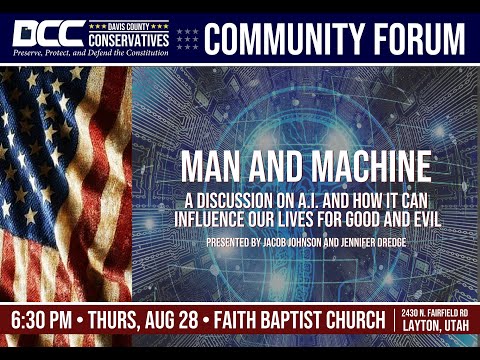
Davis County conservatives call for resistance to digital ID, data centers and 'smart' infrastructure
Summary
At a Davis County Conservatives PAC event, organizers warned about artificial intelligence, digital IDs, smart meters, and large data centers, urged residents to prioritize human needs, and encouraged civic engagement and noncompliance with technologies attendees view as invasive.
Davis County Conservatives chair Tina Horlacher told a packed meeting that the group’s goals include educating residents about local policy shifts, recruiting candidates for local office and mobilizing community opposition to technologies she described as threats to privacy and local resources.
"We are a PAC," Horlacher said, introducing the group's board and asking first‑time attendees to sign in. She urged residents to attend the group's regular meetings on the second and fourth Thursdays at 6:30 p.m. and to invite neighbors.
Presenter Jen Dredge framed the evening’s main topic as the local consequences of statewide and federal technology initiatives. Dredge urged attendees to question and resist several developments she said are underway in Utah, including digital IDs, the expansion of data centers, the installation of smart meters on energy and water infrastructure, and the state transportation plan she said is pushing electrification and vehicle‑to‑everything (V2X) systems.
Dredge said Utah is being piloted as a site for what she called "1 Health," a consolidation of environmental, animal and human health programs, and that state and local planning documents aim to position Utah as an artificial‑intelligence hub. She said those projects carry tradeoffs for water and energy. "Humans should come first for energy and water, period," Dredge said.
She cited specific policy touch points mentioned during the presentation: SB 125 (an effort to electrify parts of the state transit system), state actions implementing Real ID and digital‑ID requirements for some online business processes, and federal moves to accelerate permitting for data‑center infrastructure. Dredge warned that data centers consume large amounts of electricity and water and said residents should ask whether utilities will be prioritized for people, farms and local needs before being allocated to private data centers.
The presentation included local organizing advice: sign petitions or lists circulated at the event, run for local office or host "cottage meetings" to vet candidates, and take community actions such as neighborhood barbecues and outreach. Dredge encouraged attendees to decline digital ID and to exercise existing opt‑out rights where applicable.
Organizers also promoted upcoming events: a Constitution Day‑week "Freedom's Light Festival" at Bountiful City Park and a Sept. 11 meeting featuring Dr. Kirk Moore and a former Army helicopter pilot who will speak about resisting COVID‑era military vaccine mandates.
No formal municipal or legislative actions were taken at the meeting. The event consisted of presentations and audience Q&A.
Why this matters: speakers at the event linked statewide policy and federal permitting decisions to local resource allocation and personal privacy. Attendees were encouraged to pursue civic engagement, including running for office, and to exercise individual opt‑out options for some technologies.
The Davis County Conservatives said they will continue holding meetings and distributing slides and sources via their YouTube channel and by email to attendees.